
GEO cost depends on scope, model, and industry competitiveness. Project-based engagements for an audit and content overhaul typically run $2,000 to $8,000. Monthly retainers for active AI search management usually fall between $800 and $4,000. What you’re targeting and how competitive your category is in AI search moves the number significantly.
Most agencies won’t give you a straight answer on GEO cost. They’ll say “it depends,” schedule a discovery call, and then pitch a retainer. That’s frustrating. So here’s what the market actually looks like, and how to think about it before you sign anything.
GEO pricing hasn’t standardized yet. The field is genuinely new, agencies are still figuring out what drives results, and that uncertainty shows up in wildly inconsistent quotes. What one firm charges $15,000 for, another does for $3,000. The difference is usually scope clarity, not quality. Know what you’re buying before you negotiate the price.
What Is Actually Included in a GEO Engagement?
GEO, or Generative Engine Optimization, is the practice of optimizing your content to appear in AI-generated responses from tools like ChatGPT search, Google AI Overviews, Perplexity, and Gemini. You’re not chasing a ranking position. You’re competing to become the source AI pulls from when someone asks a question in your category. That’s a fundamentally different job than SEO, and the work reflects it.
A real GEO engagement covers several distinct workstreams:
- AI visibility audit: checking where your brand, content, and competitors currently appear across AI answer tools, query by query
- Content gap analysis: identifying what AI cites instead of you, and specifically why those sources are winning
- Content restructuring: rewriting or reformatting existing pages so AI can extract and quote them cleanly, with clear source attribution and standalone quotable sentences
- Authority signals: getting your content mentioned on third-party sites that AI tools already trust and regularly cite
- Citation monitoring: tracking which AI tools cite you across which queries, and how that changes over time as you publish and optimize
That last workstream is more labor-intensive than it sounds. There’s no Google Search Console equivalent for AI citations yet. As of mid-2026, the Semrush AI Toolkit is the closest thing to a structured monitoring dashboard, but it’s still limited compared to what SEO teams have had for years. Agencies doing serious GEO work are building custom tracking workflows on top of manual spot-checking. That overhead gets priced into engagements, and it should.
The Three Pricing Models You’ll Encounter
GEO engagements come in three main structures: project-based work, monthly retainers, and scope-based sprints. Project-based gives you defined deliverables in a fixed timeframe. Retainers provide ongoing optimization and citation monitoring. Sprints work well for specific product launches or new market entries. The right model depends on your current strategy phase and how much your internal team can execute independently.
| Model | Best for | Typical range | What you get | Main risk |
|---|---|---|---|---|
| Project-based | One-time audit and content overhaul | $2,000 – $10,000 | Defined deliverables, clear scope, fixed timeline | No ongoing monitoring after delivery; AI landscape shifts fast |
| Monthly retainer | Active GEO management, content production, reporting | $800 – $4,500/month | Compounding optimization and regular citation tracking | Expensive if scope is vague from day one |
| Scope-based sprint | Product launch, new market entry, specific campaign | $1,500 – $6,000 | Focused output in a defined 4-8 week window | Scope creep without a tight brief upfront |
Project-based is where most businesses start, and it’s usually the right call. You get a structured audit, a set of content recommendations, and typically some direct deliverables. If you have an internal team that can execute from there, this model gives you the best value per dollar of GEO cost.
Retainers make sense after you’ve established a baseline. The mistake most buyers make: signing a retainer before either side knows your current AI citation rate. You shouldn’t be paying $2,000 a month to “do GEO” when nobody knows what you’re actually optimizing from.
Scope-based sprints are underused. A focused six-week push around a product launch can build AI visibility for specific purchase-intent queries faster than a slow retainer burn. If there’s a defined commercial window, sprints are worth a hard look.
What Actually Drives GEO Cost Up or Down?
Five factors move GEO pricing significantly: how competitive your industry is in AI search results, the strength of your existing content foundation, how many AI tools you’re targeting, the rigor of ongoing citation monitoring, and the quality bar required for content production. Understanding these before you scope helps you avoid paying for things that won’t move the needle.
Industry competitiveness. In fintech, healthcare, or B2B SaaS, the sites currently being cited by ChatGPT and Perplexity are well-established publishers with years of authority. Displacing them takes more content, stronger third-party mentions, and a longer timeline. More time equals more cost. That’s not a surprise fee, it’s just math.
Your existing content foundation. A site with solid long-form content covering core topics mostly needs restructuring and authority work. Starting with thin or sparse content means production comes first, which adds to the budget before any optimization even begins.
Number of AI tools targeted. ChatGPT search, Google AI Overviews, Perplexity, and Gemini have meaningfully different citation behaviors. Targeting all four costs more than focusing on two. Early in a GEO program, depth beats breadth.
Content quality standard. Research from Princeton University and collaborating institutions, published on arXiv in 2023, found that content optimized with clear citation practices, standalone quotable sentences, and authoritative source references can boost AI visibility by up to 40%. Writing to that standard takes more time than standard blog production. Agencies that actually meet the bar price accordingly, and that premium is worth paying.
Is GEO Worth the Investment?
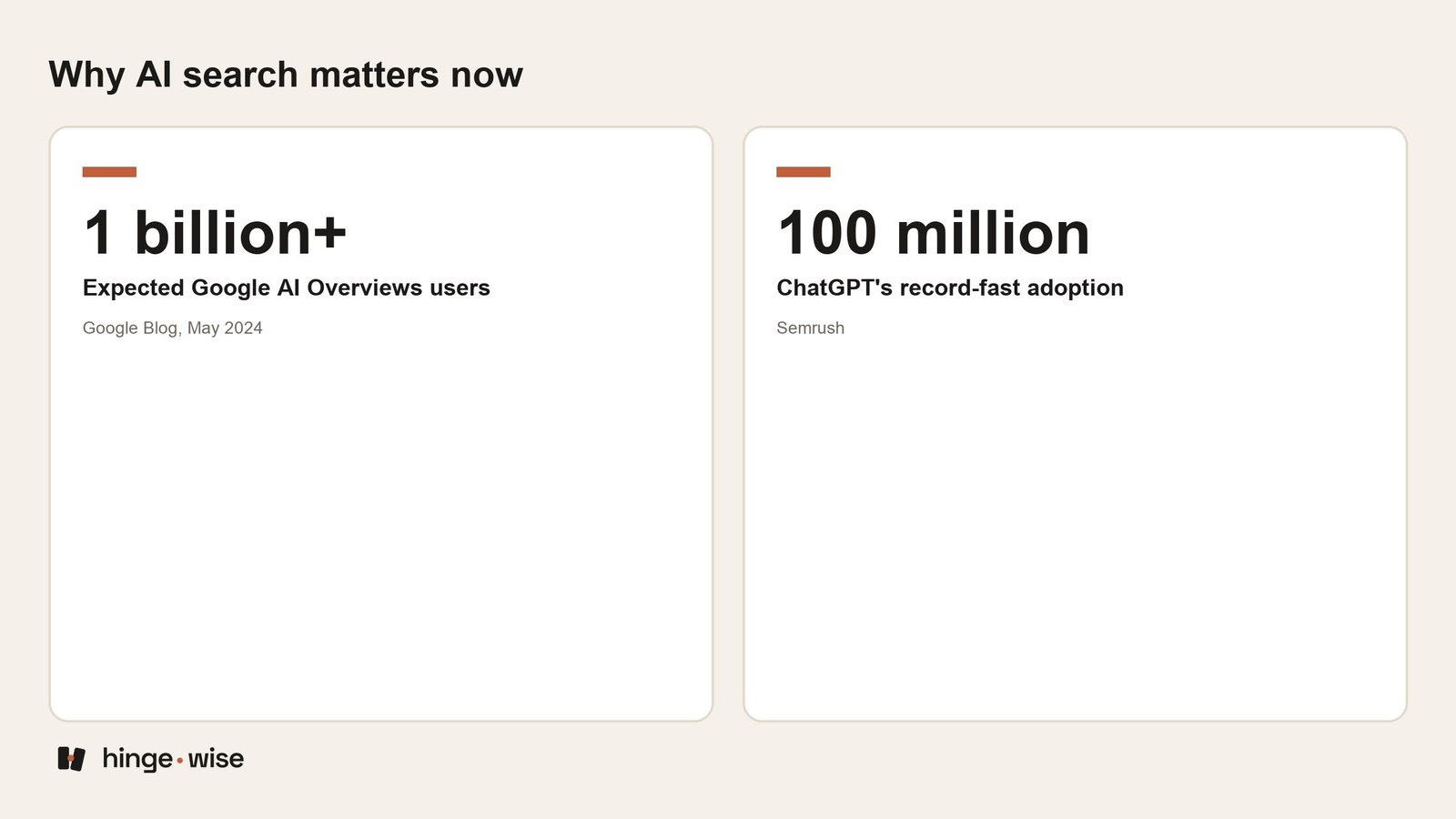
GEO is worth the investment if your buyers use AI tools to research before purchasing. Google AI Overviews reaches billions of users monthly, according to Semrush. ChatGPT reached 100 million users faster than any app in history. These aren’t niche research tools anymore. They’re where purchasing decisions get shaped before a buyer ever clicks a link to your site.
When a potential buyer asks Perplexity “which project management tool is best for a small agency,” one of two things happens: your brand appears in the answer, or a competitor’s does. GEO determines which outcome you get.
The ROI is harder to measure than SEO, and I’ll admit that openly. There’s no AI Overviews click-through rate in Search Console. No AI citation rank to track in standard Semrush reports. What you’re building is brand presence in the AI answer layer, and the compounding effect takes 3-6 months to become clearly visible in attribution data.
Personally, I think the comparison to early SEO investment holds. Businesses that built strong SEO foundations in 2013-2016 created compounding traffic advantages that competitors spent years closing. GEO looks similar: citation patterns compound, and the brands being cited today are establishing signals that AI systems keep reinforcing. The field is not crowded yet.
That said, be skeptical of anyone promising specific AI citation rates or guaranteed appearances. Google and OpenAI don’t publish their source selection criteria. Good GEO work measurably improves your odds. Guaranteed outcomes? No one can deliver that, and any agency claiming otherwise is overpromising.
How to Scope Your GEO Investment Before Committing
The most expensive GEO mistake is committing to a retainer before knowing your baseline AI citation rate. You can’t optimize what you haven’t measured, and you can’t set realistic targets without knowing your starting point. Baseline data shapes everything: the right model, the right budget, the right content priorities.
Before any budget conversation, you need three things: your current AI visibility across the queries that drive purchase decisions, which competitors AI tools are citing instead of you, and which content gaps are most commercially relevant to close first.
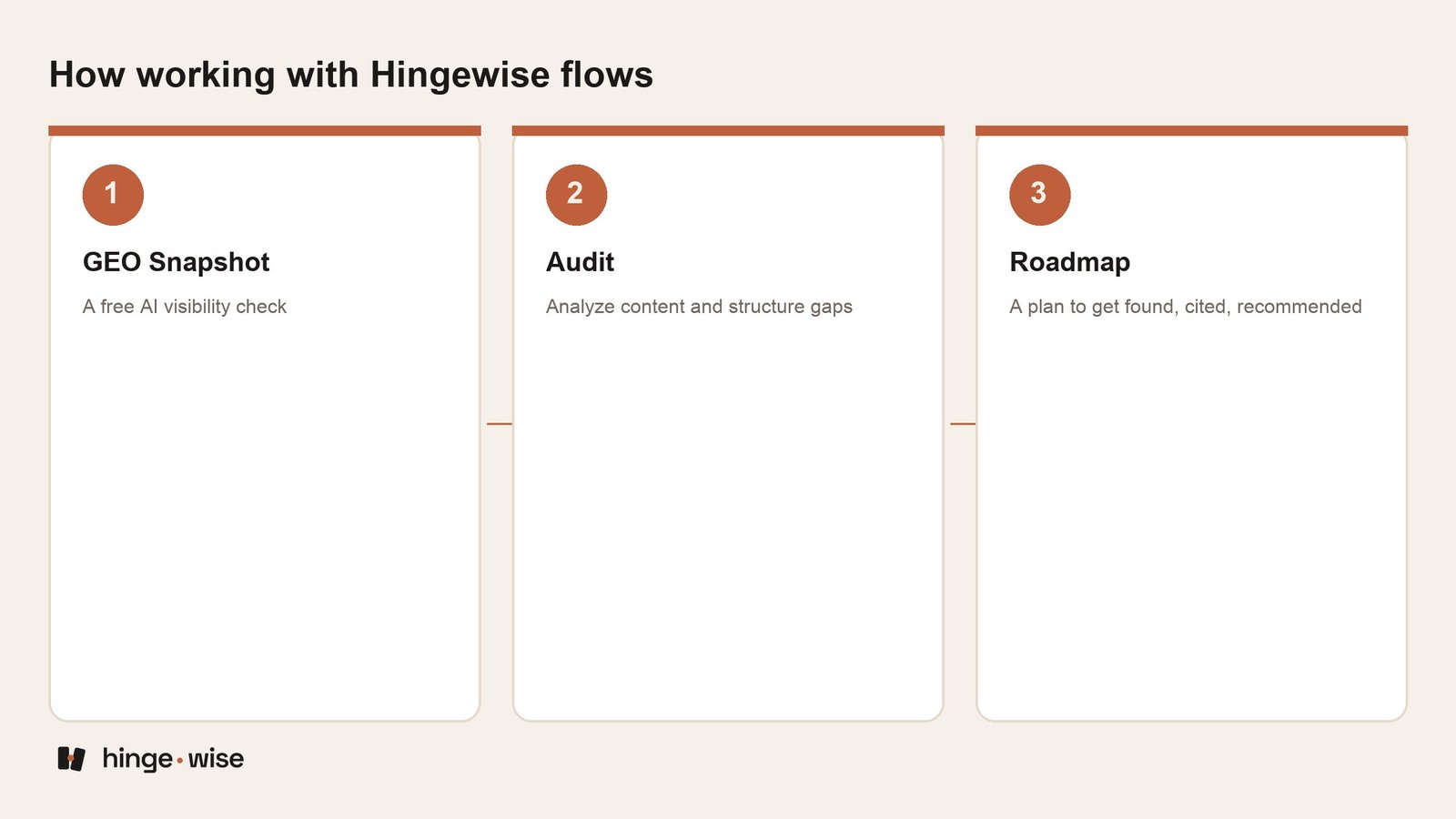
Hingewise’s free GEO Snapshot maps exactly that. It audits your current citations across ChatGPT search, Perplexity, and Google AI Overviews, identifies the competitive gap, and shows where GEO investment would actually move the needle on your revenue-relevant queries. No retainer pitch attached to the Snapshot itself.
If the results show you’re already appearing in most relevant AI answers, you may not need a full engagement yet. If they show zero citations in a category your competitors own, that’s your business case built on actual data rather than an agency’s sales deck. Start there. Then decide what to spend.
- GEO cost varies by model: project-based ($2,000-$10,000), monthly retainers ($800-$4,500/month), or scope sprints ($1,500-$6,000).
- The five main cost drivers are industry competitiveness, content foundation, number of AI tools targeted, monitoring rigor, and content quality standard.
- Research from Princeton/arXiv (2023) found GEO strategies can boost AI visibility by up to 40% when applied correctly.
- Never commit to a retainer before measuring your baseline AI citation rate. Scoping first avoids overpaying for the wrong things.
- A free AI visibility audit is the smart first move before any budget commitment.
Frequently asked questions
How much does GEO cost per month?
Monthly GEO retainers typically range from $800 to $4,500 depending on content volume, the number of AI tools monitored, and reporting depth. Light ongoing maintenance with minimal content production sits at the lower end. Active content production plus weekly citation tracking across ChatGPT search, Perplexity, and Google AI Overviews pushes toward the higher end.
Is GEO the same as SEO, and do I need both?
GEO and SEO share many best practices but target different outputs. SEO optimizes for ranking positions in search engine results pages. GEO optimizes for being cited inside AI-generated answers from tools like ChatGPT search, Google AI Overviews, and Perplexity. Most good SEO content helps GEO visibility too, but GEO additionally requires quotable sentence structure, clear source attribution, and active citation monitoring across AI platforms.
How long before GEO shows measurable results?
Initial citation improvements from well-executed content changes typically appear within 6-12 weeks. Sustained, compounding AI visibility growth takes 3-6 months to become clearly measurable in citation tracking. Timeline depends heavily on category competitiveness and how strong the existing content foundation already is before optimization begins.
Can a business do GEO without hiring an agency?
Yes, especially with a solid content foundation already in place. Core GEO tactics, including writing quotable standalone sentences, citing authoritative sources, keeping content fresh, and building third-party mentions, are things any skilled content team can implement. Agencies add the most value in systematic monitoring across multiple AI tools and in authority-building outreach that requires established editorial relationships.
How do I know if GEO is worth it for my specific business?
Test it directly before spending anything. Ask ChatGPT, Perplexity, or Google AI Overviews a question your customers would ask when researching your category. If a competitor appears in the answer and your brand doesn’t, GEO has clear commercial value. A structured AI visibility audit maps this gap across your core queries so you can build a business case on actual data.
How we made this: AI helped with research and the first draft. Lam Nguyen chose the topic, edited the piece and checked the figures against their original sources before publishing. How we work: Editorial policy.