
To measure AI visibility, track three core metrics: Share of Model (how often your brand appears in AI-generated answers for category queries), citation frequency (how many times AI systems cite your content as a source), and sentiment score (whether those mentions are positive or neutral). Run grounded prompt tests across ChatGPT, Perplexity, and Gemini to collect the data.
Imagine a SaaS brand that ranks in the top 3 on Google for its primary keyword. It asks ChatGPT, Perplexity, and Gemini about its own category and isn’t mentioned at all, while a competitor ranking lower on Google appears in almost every AI-generated answer.
That gap is AI visibility. And most brands have no idea where they stand.
Ranking on Google and appearing in AI answers are two different games now. The signals that drive one don’t automatically carry over to the other. If you want to compete in AI search, you need to measure AI visibility directly, with its own metrics, its own methods, and its own tools. Here’s how.
Why Google Rankings Don’t Tell You About AI Visibility
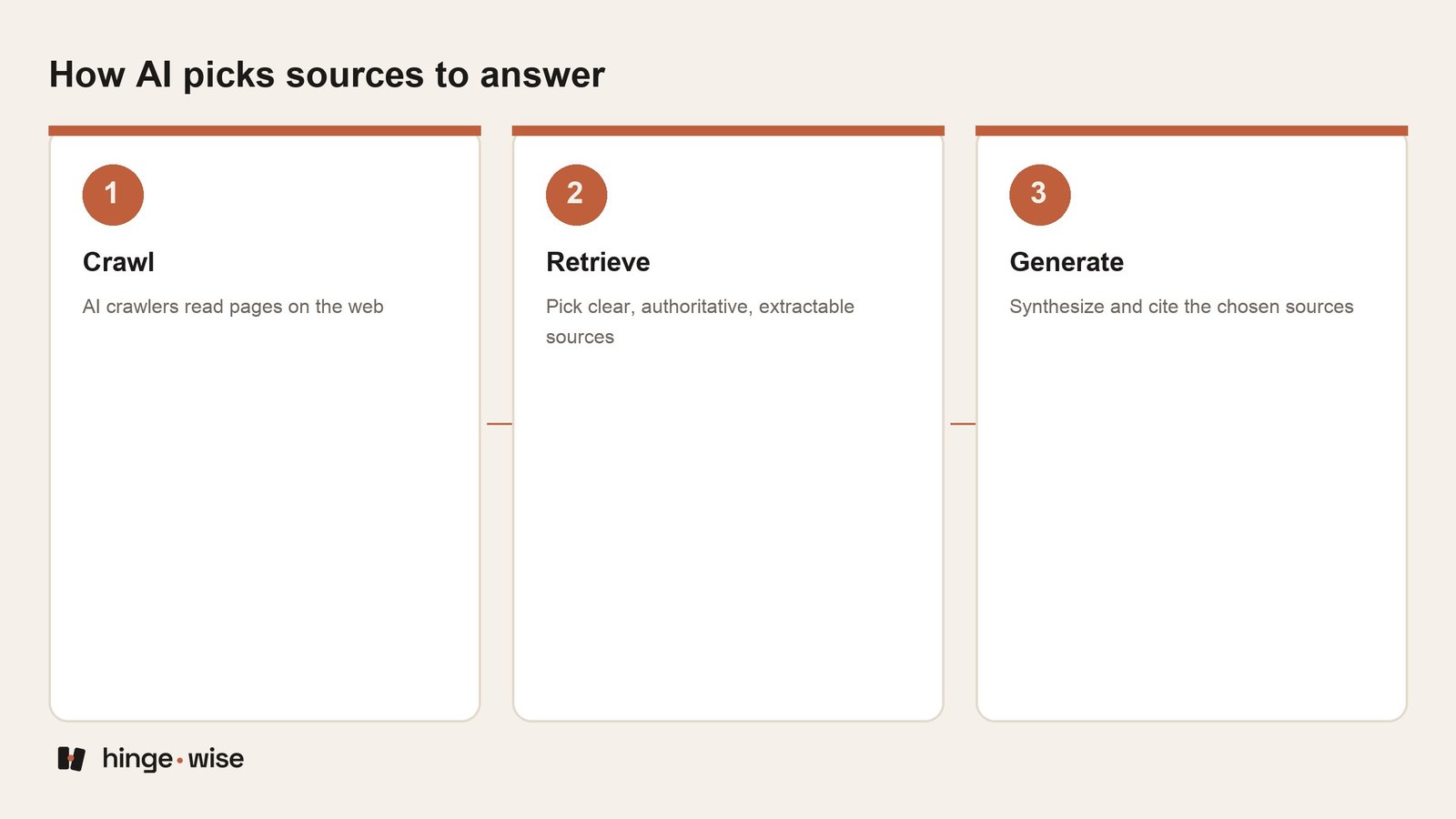
To measure AI visibility, you need to understand what AI systems are actually doing. Platforms like ChatGPT (with web search enabled), Perplexity, and Google’s AI Overviews don’t pull from SERP rankings the way a traditional crawler does. They synthesize information from multiple sources and often surface brands that communicate more directly, not just those that rank highest in search results.
According to Semrush, the key metrics in generative engine optimization differ from SEO: instead of rankings and traffic, you’re tracking “AI visibility, AI mentions, AI citations, and AI share of voice.” These require a distinct measurement process.
41% of marketers say they’re currently updating their SEO strategy for AI-related changes (HubSpot State of Marketing Report, 2026). But updating strategy and measuring AI visibility systematically are not the same thing. Most teams are making optimization decisions without a real baseline.
Why your brand monitor can’t see AI mentions either
Traditional monitoring tools crawl publicly indexed pages. AI answers aren’t pages. They are generated on demand inside a chat and disappear when the session ends, so a mention in a Perplexity answer never creates a URL that a monitoring tool could find.
Each engine leaves a different trail. Perplexity usually shows numbered sources, but you only see them if you run the question yourself. ChatGPT search sometimes cites sources and sometimes answers without attribution. Google AI Overviews link to source pages, yet those links don’t tell you which questions triggered your inclusion or how often it happens. That is why measurement starts with running the questions yourself.
The Three Core Metrics to Measure AI Visibility
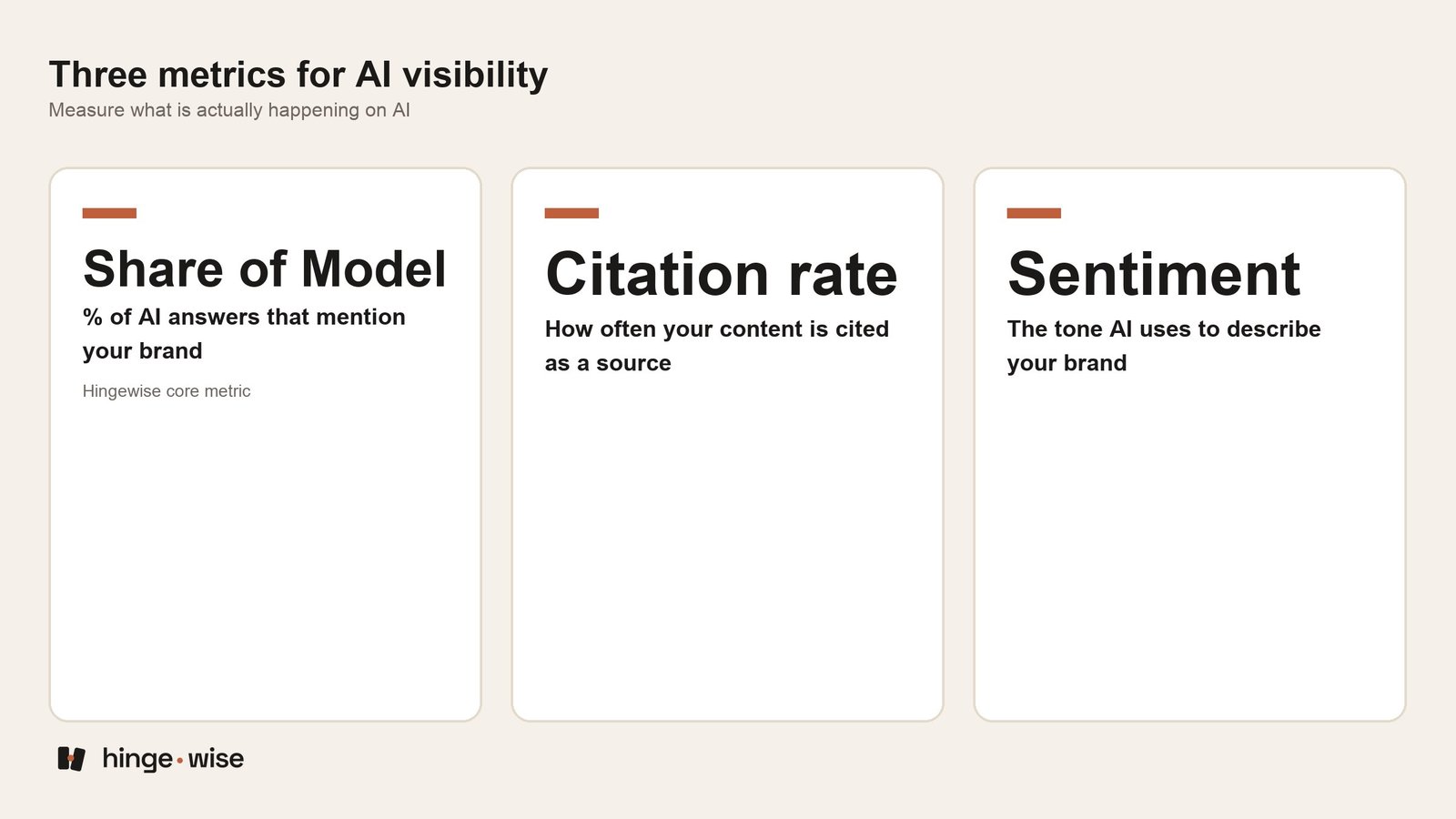
Before picking tools or designing prompt tests, get clear on what you’re actually measuring. Three metrics define AI visibility: Share of Model (how often your brand appears in category-level AI answers), citation frequency (how often AI systems source your content directly), and sentiment score (the framing around your brand when it does appear). Together, they give you the full picture.
| Metric | What It Measures | How to Collect It | Why It Matters |
|---|---|---|---|
| Share of Model (SoM) | How often your brand appears in AI answers for category-level queries | Run a standardized prompt set across AI platforms; count brand appearances vs. total responses | Top-line visibility benchmark; the AI search equivalent of share of voice |
| Citation Frequency | How many times AI systems cite or link to your content as a source | Count inline citations in Perplexity and ChatGPT search responses; track over time | Signals content authority; cited content earns indirect traffic and brand lift |
| Sentiment Score | Whether your brand is framed positively, neutrally, or negatively in AI responses | Human review of AI-generated text mentioning your brand; rate each mention | High visibility with negative framing can actively damage purchase intent |
| Context Accuracy | Whether AI systems describe your brand, product, or positioning correctly | Human-QC of AI responses; flag inaccurate descriptions or wrong audience framing | Inaccurate context is often worse than no mention at all |
That fourth metric, context accuracy, matters more than people initially expect. I’ve seen AI tools confidently describe a B2B software company as a consumer app, or attribute a competitor’s key feature to the wrong brand. Bad context compounds over time because AI systems learn from patterns. Catching it early is the move.
How to Run a Grounded Prompt Test
A grounded prompt test runs a standardized set of user questions across multiple AI platforms with live web access enabled, then scores each response for brand presence, citations, and sentiment. It’s the most direct method to measure AI visibility because you’re capturing what AI systems actually say right now, not what was true during their last training cycle.
“Grounded” is the key word. Run these tests with web search active: ChatGPT search mode, Perplexity Pro, Gemini with Google Search integration. Their base (knowledge-only) versions reflect training data that can be months old. For visibility measurement, you want live responses.
A solid prompt set covers three query types:
- Category queries: “What are the best [your category] tools in 2026?” Tests whether your brand gets included at all.
- Problem queries: “How do I solve [problem your product addresses]?” Tests whether your content surfaces as a credible solution.
- Comparison queries: “[Your brand] vs [main competitor]” Tests how AI frames your competitive position, and whether the framing is accurate.
Run each prompt three to five times per platform. AI responses vary run-to-run. A single query gives you noise, not signal. Record every brand mention, count citations, and flag sentiment for human review.
One honest caveat: this doesn’t scale easily by hand. A proper audit covering 30 prompts across four platforms generates a lot of output. That’s where structured rubrics and (increasingly) dedicated tools make the difference.
Two details make the results comparable over time. Keep every prompt word-for-word identical across testing cycles, because even a small rewording changes the answer. And mix short queries (“best CRM tool 2026”) with longer conversational ones (“which CRM should a 10-person agency use on a small budget”), because AI engines respond very differently to each.
The manual tracking workflow, step by step
Run every test in a private browser window, and start a new conversation for each prompt so earlier context doesn’t leak into the answer. For each run, record:
- Date and time, engine, and the model name if the interface shows one
- The exact prompt text
- Brand mentioned (yes or no), and whether it was a recommendation or a passing mention
- Position in the answer: opening, middle, or end
- Sentiment: positive, neutral, negative, or mixed
- Whether a link to your site was included
- A screenshot of the full answer
Screenshots are not optional. Answers change between sessions, and you need a record of what was actually said. A spreadsheet with one tab per engine and one row per run is enough. From it, calculate a simple mention rate (runs that mention your brand divided by total runs) and track it over time. If the mention rate falls while branded search stays flat, look closer: AI may be starting to recommend someone else before search behavior shows it.
Human-QC: What Automated Scoring Still Gets Wrong
Automated sentiment tools can scan AI responses at scale, but they consistently miss positioning-level issues that matter for brand strategy. An AI might mention your product positively while framing it for the wrong audience segment. That’s not a negative sentiment score, but it’s a real problem. Human review catches what classifiers can’t.
A human-QC scorecard for each AI response looks like this:
- Is the brand mentioned? (Yes / No)
- Is it cited as a source, or just mentioned in passing? (Citation vs. Mention)
- Sentiment: positive, neutral, or negative?
- Is the brand description factually accurate?
- Does the context match your actual target audience and positioning?
This adds time. It’s worth it. The brands that invest in accurate measurement are the ones who catch positioning drift early, before it shows up in pipeline numbers.
When manual tracking hits its limits
Manual tracking breaks down at scale. Once you need more than about 50 prompts across four or five engines, or several markets, doing it by hand every week becomes a real time cost, and a dedicated tool starts to make sense. A practical sequence is to track manually for the first 60 to 90 days to learn which engines and question types matter in your category, then choose a tool with that data in hand. Use tools for scale, and keep people reading the answers for the signal.
Which Tools Can Track AI Visibility Right Now?
The tooling category for measuring AI visibility is still forming as of mid-2026. No single platform covers everything yet. The most practical setup combines Semrush’s AI Toolkit for scale with manual testing in Perplexity for accuracy checks. Purpose-built platforms are emerging but haven’t reached the depth of established SEO tools, and most teams will end up using two or three solutions together for a while.
Semrush AI Toolkit tracks brand mentions and sentiment in AI Overviews and, increasingly, in other AI search outputs. It integrates with existing Semrush workflows, which matters if your team is already in the platform daily.
Perplexity.ai (manual testing) is still the most transparent AI search environment for audits. It shows sources inline, which means you can see exactly what content is being cited and where citations are going to competitors instead of you. Low-tech, but genuinely informative. I use it for quick spot-checks before building a full prompt set.
Purpose-built AI visibility platforms like Profound and Scrunch.ai are building specifically for this measurement problem. Worth watching. The category will consolidate, and the survivors will likely be acquired by or integrated into larger SEO platforms within the next 18 months. That’s my read, not a guarantee.
Brandwatch and similar web-listening tools can capture some AI-generated mentions but weren’t built for this use case. Coverage is inconsistent. Treat them as a supplement, not a primary source.
How Hingewise Approaches AI Visibility Measurement
Hingewise measures AI visibility using a four-layer rubric: presence, citation, sentiment, and context accuracy. Each layer is scored independently across a standardized prompt set, run across ChatGPT search, Perplexity, and Gemini. The composite score shows where a brand actually stands in AI search, and which layer to prioritize first.
What we consistently find is that Share of Model (presence) is the fastest metric to move, usually through structured and citable content combined with third-party mentions. Citation frequency follows, but it takes longer because AI systems need repeated exposure to a source across multiple contexts before weighting it reliably. Sentiment and context accuracy are the slowest to shift, and the highest-stakes to get right.
Competitor benchmarks run alongside the brand score. A 30% Share of Model reads completely differently when your closest competitor sits at 60% versus 15%. AI visibility is relative, not absolute.
If you want to see where your brand stands before investing in optimization, a free AI Visibility Snapshot runs a subset of this rubric and returns a baseline score with the specific gaps worth addressing first.
- Share of Model (SoM) is the top-line benchmark: the percentage of AI-generated category answers where your brand appears, measured across a standardized prompt set.
- Run grounded prompt tests with web search enabled (ChatGPT search mode, Perplexity Pro, Gemini + Google) – base models reflect old training data, not current visibility.
- Sentiment and context accuracy matter as much as raw presence: being mentioned with wrong positioning or inaccurate descriptions can actively work against you.
- No single tool covers AI visibility fully yet; combine Semrush AI Toolkit for scale with manual Perplexity testing for citation accuracy.
- Always benchmark against competitors – AI visibility is relative, and a score only tells you something meaningful when you know where rivals stand.
Frequently asked questions
What is Share of Model in AI visibility measurement?
Share of Model (SoM) measures how often your brand appears in AI-generated answers when users ask category-level questions. You calculate it by running a standardized prompt set across AI platforms, then counting what percentage of total responses include your brand. It’s the AI search equivalent of share of voice in traditional media.
How is AI visibility different from Google search ranking?
Google rankings and AI visibility are related but not the same. A high search ranking signals authority that AI systems do factor in, but ranking at the top of the SERP does not guarantee inclusion in AI-generated answers. AI platforms synthesize information differently and often surface brands with clearer, more citable content over those that rely on traditional ranking signals alone.
What is the difference between an AI mention and an AI citation?
A mention means your brand name appears in an AI-generated response. A citation means the AI specifically links to or attributes information to your content as a source, which is visible in tools like Perplexity and ChatGPT search mode. Citations carry significantly more authority and can drive direct referral traffic; mentions are presence signals only.
How often should I measure AI visibility?
Run a baseline audit now, then measure monthly. AI search outputs shift when platforms update their models, crawl fresh web content, or adjust how they weight sources. Google’s AI Overviews content in particular can change after core algorithm updates. Monthly tracking lets you catch movement before it compounds in either direction.
Do I need a paid tool to start measuring AI visibility?
No. You can run a useful baseline test using free versions of ChatGPT (with web search enabled), Perplexity, and Gemini. Build 10 to 15 prompts covering category queries, problem queries, and comparison queries. Run each prompt across all three platforms and score results manually. It takes time, but it gives you a real picture of where you stand before investing in paid tooling.
How do I track brand mentions in AI search?
Build a fixed set of 20 to 40 questions your buyers would ask, run them in ChatGPT, Perplexity, Gemini and Google AI Overviews in fresh sessions, and log whether your brand appears, how it is described and whether a link is included, with a screenshot of each answer. Repeat on a schedule with the exact same wording and track the mention rate over time.
Want to see how your brand shows up across AI? Get a free GEO Snapshot.
How we made this: AI helped with research and the first draft. Lam Nguyen chose the topic, edited the piece and checked the figures against their original sources before publishing. How we work: Editorial policy.