
AI visibility measures how often and how prominently your brand gets cited, mentioned, or recommended inside AI-generated responses from systems like ChatGPT, Perplexity, and Google AI Overviews. Unlike traditional search rankings, it is not about position in a results page. It is about presence inside the answer itself, and that distinction is becoming critical.
Try this yourself. Open ChatGPT Search, Perplexity, and Google’s AI Overviews. Type the same product question in your category across all three. Then check where your brand ranks in traditional Google search for that same query.
Odds are the numbers will not match. Ranked third on Google. Not cited once in any AI response. That gap is what AI visibility is about. And it is widening every quarter as more of your customers start their research in AI tools rather than a search bar.
Search behavior is shifting faster than most marketing teams are adjusting for. The brands that start tracking AI visibility now will have a meaningful head start over those that wait until AI-generated answers are driving the majority of first impressions in their category.
What AI Visibility Actually Means
AI visibility is the degree to which your brand, product, or content appears inside responses generated by AI systems. The major platforms right now: ChatGPT Search (which retrieves live web content to supplement its LLM training data), Perplexity (which builds synthesized answers from multiple live sources and displays citations inline), Google AI Overviews (built on Google’s custom Gemini model, rolled out to all US users in May 2024), and Microsoft Copilot. Each takes a user’s query and constructs an answer from sources it judges credible.
That construction step is everything. When Perplexity answers “which CRM is best for a small sales team,” it does not list ten results and leave the user to browse. It produces a recommendation with supporting explanation and attributed sources. The brands inside that recommendation get considered. The ones not included are invisible to that user at that moment, regardless of their position in traditional Google search.
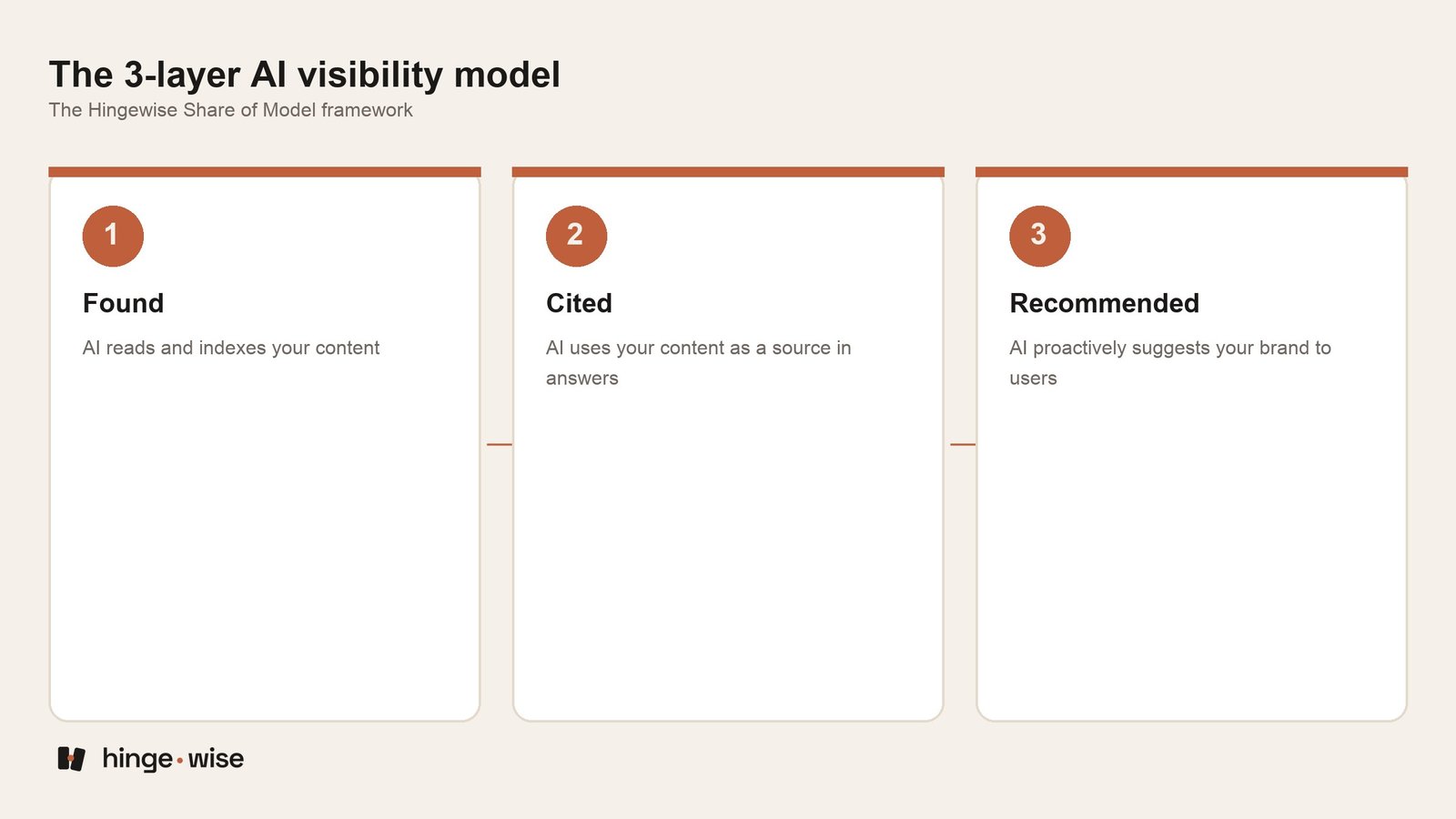
The distinction breaks down simply: traditional search visibility is a ranking position. AI visibility is presence inside an answer. One is about being found. The other is about being cited.
ChatGPT Search is worth singling out here. OpenAI deployed it across October to December 2024, turning ChatGPT from a static knowledge base into a live web retrieval system. That shift means content published today can influence ChatGPT answers today, not after the next training data update months away. The competitive dynamics of AI visibility changed significantly with that launch.
Why Your Google Rankings Do Not Tell the Full Story Anymore
Google AI Overviews now reach billions of users every month, according to Google. ChatGPT hit 100 million monthly active users within two months of its launch in late 2022, and by February 2026 had grown to 900 million weekly active users (Wikipedia/OpenAI). These are not niche tool adoption numbers. A real share of your customers are now using AI systems for product research, comparisons, and purchase decisions.
Traffic patterns are shifting as a result. When a user gets a complete synthesized answer inside a Google AI Overview or Perplexity response, the incentive to click through to individual websites decreases. Not across every query type, and not dramatically for transactional searches. But for informational and consideration-stage queries, the ones that used to reliably bring in top-of-funnel organic traffic, the dynamic is measurably different. Some brands tracking organic traffic from these query types are seeing plateau effects they cannot explain using traditional ranking data alone.
Here is what most marketing teams have not fully absorbed yet: ranking #1 for a query does not guarantee you appear in the AI-generated response for that same query. The signals that influence SERP positions and the signals that drive AI citations overlap significantly but are not the same algorithm. Content can rank well and still be structured in a way that AI systems struggle to extract clearly. A brand can have a strong backlink profile and still be absent from the network of third-party mentions that AI systems use as authority verification.
Ranking and being cited are correlated. Not the same thing.
Share of Model: The Metric Replacing Share of Voice
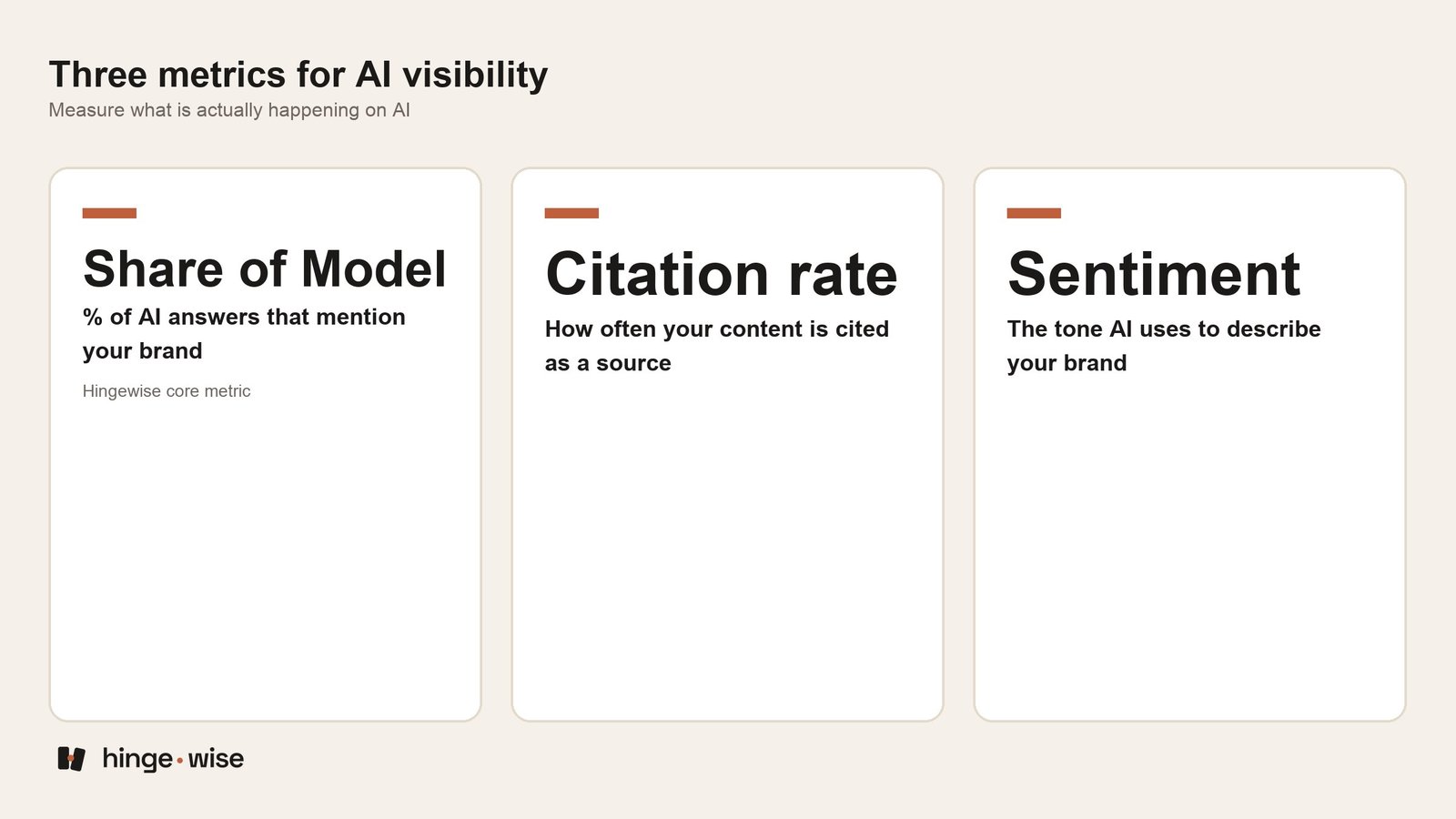
Share of Model is the framework Hingewise uses to quantify AI visibility. The method: define a set of queries relevant to your product category, run those queries across the major AI platforms, and record which brands appear in each response. The percentage of responses that include your brand across that query set is your Share of Model score.
The logic borrows from share of voice. In traditional marketing, share of voice tells you how much of the advertising conversation your brand owns relative to competitors. Share of Model does the same for AI-generated answers. The raw percentage only becomes meaningful in comparison. Your brand appearing in 31% of AI responses for target queries sounds either strong or weak depending on whether your nearest competitor sits at 18% or 65%.
One nuance worth knowing: Share of Model is not a single number. It varies by platform, by query type, and by product category. Your brand may appear in 40% of Perplexity responses and 15% of ChatGPT responses for the same query set. Breaking it down by platform and query intent gives a sharper picture of where to focus optimization effort.
Specialized tools are catching up. Semrush‘s AI Toolkit has started surfacing AI mention data, and a handful of dedicated GEO platforms have emerged since AI Overviews went live in 2024. But for most brands today, Share of Model tracking still means defining a query set, running it across platforms, and recording results consistently. The methodology matters more than the software. Start there.
The Factors That Drive AI Visibility
Research from Princeton University on generative engine optimization found that adding statistics with cited sources, quotations from credible sources, and clear source attribution raised a page’s visibility in AI answers by roughly 30-40%, measured on pages the engine had already retrieved. The consistent signal: AI systems favor content structured for extraction and attribution, not just content that covers a topic thoroughly.
Beyond that research, here are the factors that appear consistently in content that earns strong AI visibility:
- Extractable paragraph structure. Short paragraphs with a single clear point each are what AI systems quote accurately. A paragraph that makes three interwoven arguments is difficult to cite without distortion. Write each paragraph to stand alone. If it makes sense pulled out of context, it is ready to be extracted.
- Brand mentions across credible third-party sources. AI systems read far more than your own website. They index brand mentions across news sites, industry publications, review platforms, and authoritative blogs. Earned media and digital PR feed AI visibility directly, not just traditional domain authority scores.
- Content freshness for live retrieval systems. ChatGPT Search and Perplexity retrieve live web content when generating answers. A well-structured piece left unupdated for 18 months can lose ground to a more recent competitor piece on the same topic. Freshness matters differently for real-time AI retrieval than for traditional Google indexing, but it matters.
- Entity clarity and brand consistency. If your brand is described inconsistently across your website, press materials, and third-party directories, AI systems may produce vague or conflicting mentions. Consistent signals about what your brand does, who it serves, and what category it belongs to reduce the chance of being misdescribed or omitted.
- Schema markup. FAQ schema, Article schema, and HowTo schema help AI systems understand the format and intent of your content. Not a silver bullet, but meaningful signal on top of strong content fundamentals.
Not all of these factors carry equal weight across platforms. Perplexity displays citations visually and weights recent web content heavily, so extractable structure and freshness carry extra importance there. Google AI Overviews lean more on established entity signals and structured data. ChatGPT Search draws on both live retrieval and its training data, where brand familiarity built over time matters. Knowing which platform drives the most discovery in your category helps you prioritize where to focus first.
One thing to be straight about: Google has not publicly confirmed exactly how AI Overviews selects sources, and OpenAI is similarly quiet about ChatGPT Search’s ranking logic. The factors above come from observed patterns, published research, and what platform documentation implies about these systems. The direction is consistent. The exact weighting remains unconfirmed.
GEO vs. Traditional SEO: Same Foundation, Different Layer
The question that comes up constantly: does GEO replace SEO, or does it run alongside it? The foundations of strong SEO, quality content, technical accessibility, and earned authority, carry directly into GEO. You do not start over. But the optimization layer on top of that foundation is different enough to need deliberate attention.
| Factor | Traditional SEO | GEO / AI Visibility |
|---|---|---|
| Primary goal | Rank high in search results | Get cited in AI-generated answers |
| Success metric | Ranking position, organic sessions | Citation rate, Share of Model |
| Content format | Keyword-targeted, in-depth coverage | Extractable, quotable, clearly structured |
| Authority signals | Backlinks, domain authority | Brand mentions, entity clarity, earned citations |
| Freshness impact | Helpful for competitive queries | Critical for ChatGPT Search and Perplexity retrieval |
| Structured data | Rich results on eligible page types | Recommended for AI comprehension |
The foundations do not change. The optimization layer does.
In traditional SEO, you write to be found. In GEO, you write to be quoted. A 2,000-word keyword-rich article can rank well and still produce nothing an AI system can cleanly pull into a synthesized response. A 700-word piece with crisp definitions, cited statistics, and self-contained paragraphs may earn consistent AI citations without landing in the top 10 for any given query. Both formats have a place in a modern content strategy. The brands accounting for both will have an advantage over those still optimizing purely for SERP position.
Measure Before You Optimize
Measure first. You cannot improve AI visibility without knowing your baseline Share of Model score, which queries your brand appears in, and how that compares to your competitors. Before investing in new content or restructuring existing pages, run the audit.
The next piece in this series covers exactly how to do that: how to define a query set, how to run consistent testing across ChatGPT Search, Perplexity, and Google AI Overviews, and how to interpret what you find. If you want to see your current AI visibility score before going through that process yourself, Hingewise offers a free AI Visibility Snapshot for brands that want a fast baseline read across the major platforms.
- AI visibility measures how often your brand gets cited inside AI-generated responses from ChatGPT, Perplexity, Google AI Overviews, and similar systems. It is a distinct metric from your traditional search ranking.
- You can rank #1 in Google search and still have zero presence in the AI-generated answer for the same query. Ranking and citation are correlated, not identical.
- Share of Model is the primary metric for tracking AI visibility: what percentage of AI responses in your target query set include your brand, compared to competitors.
- Extractable content structure, brand mentions across credible third-party sources, and content freshness are the main drivers of AI visibility across platforms.
- GEO builds on the same SEO foundations but requires a distinct optimization layer focused on quotability, entity clarity, and structured content.
Frequently asked questions
What is AI visibility?
AI visibility measures how often and how prominently your brand appears inside responses generated by AI systems like ChatGPT, Perplexity, and Google AI Overviews. Unlike traditional SEO, which tracks ranking positions in a search results page, AI visibility tracks whether your brand is cited, mentioned, or recommended within the synthesized answer itself.
How is AI visibility different from traditional SEO?
Traditional SEO measures your ranking position in a search results page. AI visibility measures your presence inside AI-generated answers from systems like ChatGPT Search and Google AI Overviews. You can rank at position one in Google and still be absent from every AI response for that same query. Both require separate measurement and optimization strategies.
What is Share of Model?
Share of Model is a framework for measuring AI visibility. It tracks what percentage of AI-generated responses include your brand across a defined set of queries. Measured across platforms like ChatGPT, Perplexity, and Google AI Overviews, it works like share of voice but for AI-generated answers instead of ad impressions or SERP features.
What factors drive AI visibility?
The main drivers of AI visibility are extractable content structure (short, self-contained paragraphs with cited statistics), brand mentions across credible third-party sources, content freshness for real-time retrieval systems like ChatGPT Search and Perplexity, and consistent entity definition across your web presence. Schema markup also helps AI systems understand your content format and intent.
Does strong SEO automatically improve AI visibility?
Not automatically. Strong SEO foundations such as quality content, technical accessibility, and earned backlinks support AI visibility. But AI systems also weigh content extractability and brand mention breadth that traditional SEO does not directly optimize for. A brand can rank well in Google and still have low AI visibility if its content is not structured for citation.
How do I start measuring my AI visibility?
Define a set of 20 to 50 queries relevant to your brand and category. Run each query across ChatGPT Search, Perplexity, and Google AI Overviews, and record which brands appear in each response. Calculate the percentage of responses that include your brand. That baseline percentage is your starting Share of Model score.
Want to see how your brand shows up across AI? Get a free GEO Snapshot.
How we made this: AI helped with research and the first draft. Lam Nguyen chose the topic, edited the piece and checked the figures against their original sources before publishing. How we work: Editorial policy.