
To improve your GEO, audit where AI engines currently mention you, rewrite key pages to lead with direct answers, add attributed statistics and quotable definitions, implement structured data, build presence on sources AI trusts, then measure your Share of Model regularly. Each step compounds on the last.
Run a quick test right now. Open Perplexity and type the question your ideal customer asks before they find you. Read the full response. Count how many times your brand gets mentioned.
If the answer is zero, that is your baseline. And that is exactly what this checklist fixes.
According to Semrush, ChatGPT hit 100 million users faster than any app in history, and Google‘s AI Overviews now reach billions of users each month. The shift is not gradual. Most websites are already invisible inside these AI-generated responses, and the gap between cited brands and invisible ones widens every quarter.
What follows is the exact checklist I use when auditing a site for AI visibility. Six steps, in order. Each one builds on the previous.
How to Audit Your Current AI Visibility Before You Touch a Single Page
A GEO audit tells you where you currently stand inside AI-generated responses before changing anything. Pick 10-15 questions your customers actually ask, run them through ChatGPT, Perplexity, Gemini, and Google AI Overviews, and record which brands and sources appear. That spreadsheet becomes your roadmap.
The queries need to be specific. Not “best project management software.” More like “best project management tool for a remote design team under $50 per month.” Specific queries surface real citation patterns. Generic queries surface whichever brand has dominated the web for a decade, which tells you very little about what GEO work can actually move.
Build the spreadsheet with four columns: query, engine, your brand mentioned (yes/no), competitor brands mentioned. After 15 queries across 4 engines, you have 60 data points. Patterns become obvious fast. You will likely find 2-3 competitors appearing consistently across engines. Those sites become your GEO benchmarks for the next 90 days.
Semrush’s AI Toolkit can automate the tracking side of this over time. Still worth doing the manual pass first. Reading actual AI responses forces you to notice things a dashboard misses: the specific framing AI uses, which sources get footnoted, what type of content gets extracted versus paraphrased. The data in a spreadsheet is useful. The intuition from reading 60 AI responses is irreplaceable.
A 10-point check for your five most important pages
Once you know where you stand, run your five most important pages through these ten questions. Every “no” is a concrete fix, and most of them take minutes, not weeks.
- Does every H2 section open with a short, direct answer that makes sense on its own?
- Are statistics cited inline, with a source name and year at the point of mention?
- Is there an FAQ section whose answers stand alone without the rest of the page?
- Are headings written as questions or clear outcomes, not generic labels?
- Are key terms defined in one plain, self-contained sentence the first time they appear?
- Is your brand mentioned by name on credible third-party sites in your industry?
- Have you run your target questions in ChatGPT, Perplexity and Gemini to see who gets cited?
- Is your structured data valid, matched to the visible content, and not duplicated by your SEO plugin?
- Is the page indexable, and does its content render without JavaScript?
- Are you tracking AI visibility as a separate metric from organic rankings?
The Fastest Way to Improve Your GEO? Rewrite These Pages First
Rewriting content to lead with direct answers is the single highest-leverage GEO change you can make. AI engines break queries into smaller chunks and match each chunk against the clearest available passage. Pages that bury the main point under three paragraphs of background get skipped. Pages that answer first get extracted and cited.
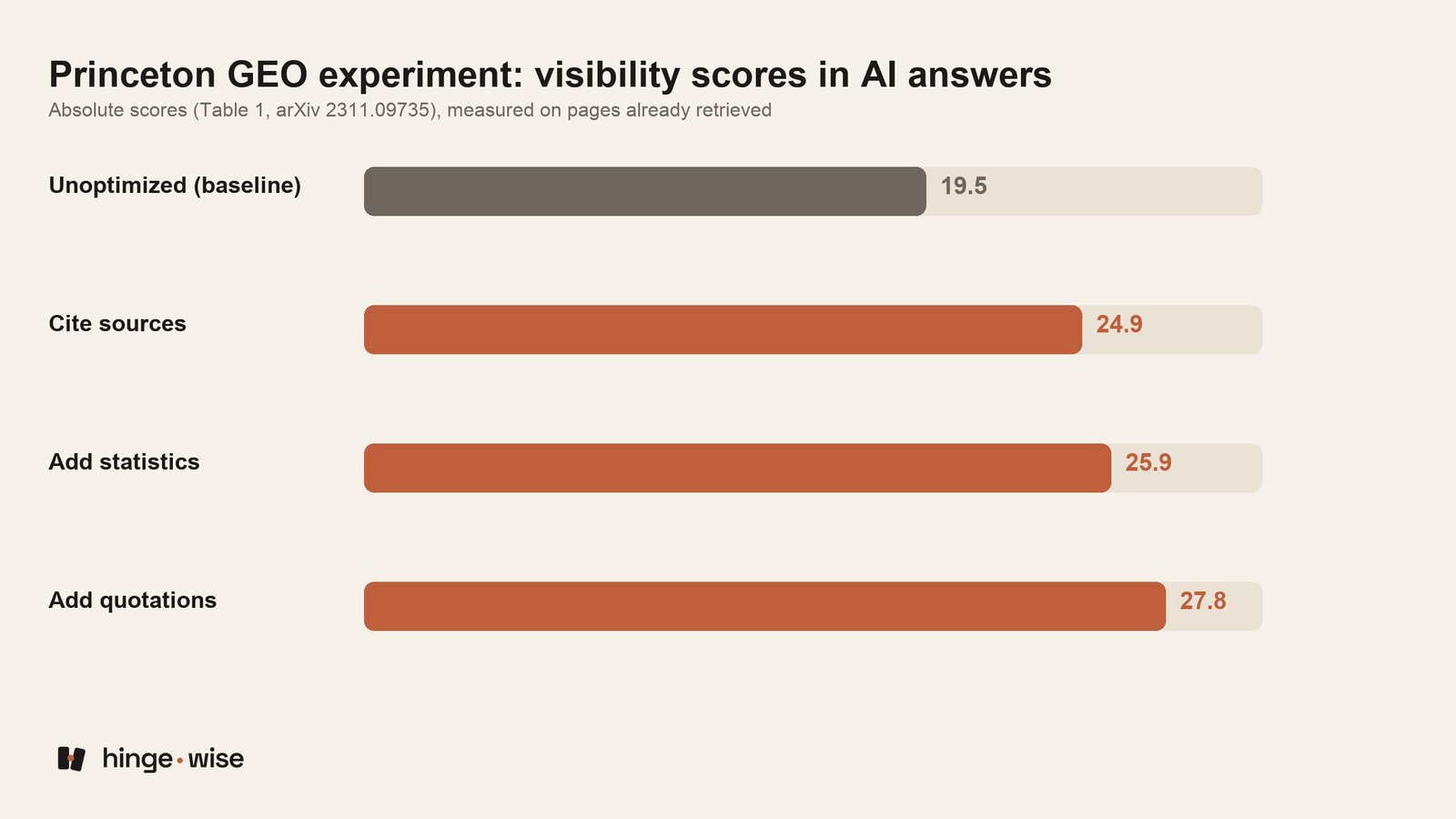
The Princeton GEO study found that adding quotations from credible sources was the strongest single tactic, lifting visibility about 41% on pages the engine had already retrieved. Answer-first structure is the prerequisite for this. You cannot write quotable statements if your content is built to build toward a conclusion. The answer has to come first, or nothing else in this checklist lands properly.
The rewrite formula, applied to every H2 section:
- First 1-2 sentences: Answer the question directly. No setup. No context. The answer.
- Next 2-3 sentences: Add the why, the nuance, or the exception that actually matters.
- Rest of the section: Evidence, examples, data with inline source attribution.
Apply this to every major content page targeting a query your customers search for. Yes, it is a lot of work. It also lifts your traditional featured snippet rate at the same time, so the investment covers two channels simultaneously.
Start with the 5-10 pages that already get the most organic traffic, or those targeting your highest-value queries. Not your homepage. The content pages where customers are trying to learn something specific.
Which tactics to do first when time is short
Not every tactic carries the same weight. If you are starting with a small team, sequence matters more than volume.
| Tactic | Effect on Google rankings | Effect on AI citations | Effort | When |
|---|---|---|---|---|
| Self-contained passage writing | High | Very high | Low | Do first |
| Inline source citations | Medium | High | Low | Do first |
| FAQ section with standalone answers | Medium | High | Low | Do first |
| AI visibility tracking set-up | Low (indirect) | High | Medium | Week one |
| Third-party brand mention outreach | High | Very high | High | Start now, long game |
| Conversational query targeting | Medium | High | Medium | Next sprint |
| Core Web Vitals work | High | Low (indirect) | High | Ongoing |
These ratings are Hingewise’s working judgment, not measured effect sizes. What matters is the order: the first three rows cost little, help both Google and AI search, and belong in every page you publish from now on.
Which Content Elements Do AI Engines Actually Extract?
Three types of content consistently get pulled into AI responses: attributed statistics, self-contained quotable statements, and clear inline definitions. Research from Princeton on GEO found that adding statistics with sources and quotations from credible sources lifted visibility by roughly 30-40% in its tests, on pages already retrieved as sources. Structure your content around these three patterns, in that order of effort.
Attributed statistics. A number without a source carries less weight in AI extraction. “73% of buyers research on AI tools before purchasing” is weaker than “according to the 2024 Demand Gen Report, 73% of B2B buyers use AI tools during research.” Write every statistic with inline attribution, at the point where you use it. Not in a reference list at the bottom of the page. AI engines parse inline citations as a quality signal.
That citation habit also pays off on its own: in the Princeton GEO study, citing sources clearly within content was one of the three strongest tactics, independent of the statistics themselves.
Quotable statements. These are sentences that work completely out of context. Short. Declarative. Unambiguous. “GEO (Generative Engine Optimization) is the practice of structuring content so that AI search engines extract and cite it in their responses” is a quotable definition. A four-clause sentence with three conditionals is not. Write 2-3 of these per major section. They are the sentences Perplexity and ChatGPT lift directly into their answers.
Clear definitions. Every important term should have a one-sentence definition that stands alone, the first time you use it. Keep definitions under 25 words. AI engines treat defined terms as extractable units, and users who ask “what is [X]” get routed to pages that define it cleanly.
The self-contained test
“Self-contained passage” shows up in almost every guide to LLM SEO, yet most content doesn’t pass it. Here is a quick test: take any paragraph from your page, strip away the heading and everything above it, and ask whether it still makes complete sense. If it doesn’t, an AI model faces the same problem you just noticed.
Perplexity runs several background searches per question and cites the pages it pulls from. Watch it work and you will see it lift specific paragraphs, not whole articles, and pick the block that answers its sub-question directly rather than the one that builds most elegantly toward a conclusion. So answer first, then explain, then expand. Google has never confirmed this as a factor for AI answers, but the pattern is consistent enough across ChatGPT, Perplexity and Gemini to treat it as a structural requirement.
Structured Data: The GEO Step Most Sites Skip
Structured data tells AI crawlers exactly what type of content they are reading and how to interpret it. FAQPage schema surfaces Q&A pairs as ready-to-extract units. HowTo schema signals sequential steps. Organization schema with sameAs properties helps AI engines build a coherent picture of your brand entity across the web.
The schema types that matter most for GEO right now:
| Schema Type | What It Signals to AI | Best Used For |
|---|---|---|
| FAQPage | Q&A pairs ready to extract | Blog posts, support pages, product pages |
| HowTo | Sequential steps for a process | Tutorial content, checklists |
| Article / BlogPosting | Author, publish date, publisher name | Every editorial piece you publish |
| Organization + sameAs | Links brand entity to LinkedIn, Wikipedia, Wikidata | Homepage and About page |
| Product + Review | Product details for comparison queries | Product pages, feature comparison pages |
The Organization schema with sameAs is the most underused of these by far. Connecting your brand entity to your LinkedIn company page, Wikidata entry, and Wikipedia page (if you have one) helps both Google’s knowledge graph and the underlying models build a coherent picture of who you are. A brand with a linked entity gets cited more confidently than one that exists only as a domain name.
Implement all of this in JSON-LD, not microdata. JSON-LD lives in the page head, parses cleanly for both traditional crawlers and AI retrieval systems, and you can update it without touching your page markup.
Build Your Presence on the Sources AI Engines Actually Trust
AI engines do not only read your website. They pull from a specific ecosystem of trusted sources, and your brand needs presence across those sources to be cited consistently. Wikipedia, Reddit threads, industry review sites, YouTube transcripts, and LinkedIn articles all feed into what AI engines know about you, separate from anything on your own domain.
From what I observe auditing sites across industries, the sources that appear most reliably in AI-cited footnotes include:
- Wikipedia and Wikidata (entity recognition, core fact sourcing)
- Reddit and Quora (authentic user opinions, real-world use cases that AI engines find credible)
- G2, Capterra, Trustpilot (especially for software and professional services)
- YouTube with transcripts enabled (Google AI Overviews increasingly surfaces video content)
- LinkedIn company pages and LinkedIn articles
- Mentions in sector-relevant press and trade publications
I want to be honest about the limits here: Google has not published an exact specification of which sources feed AI Overviews retrieval versus training data. The pattern I see across audits is that brands with active presence on four or more of these sources consistently outperform brands that only optimize their own site. That is pattern recognition across projects, not a published spec. Take it as directional, not definitive.
The practical move: audit each source for your brand name right now. Fix any incorrect information first. Then build presence systematically on the gaps. An active Reddit presence where you genuinely help users is worth more for GEO than a dozen thin blog posts. Earned mentions build trust. Manufactured ones do not.
How to Measure Whether Your GEO Work Is Actually Moving the Needle
Share of Model is the GEO metric that replaces traditional keyword rankings. It measures what percentage of AI responses about your category mention your brand, relative to competitors. Track it by running your core queries through multiple AI engines every two weeks, recording mention rates, and watching the trend line as you execute GEO changes.
The tooling here is still maturing, to put it diplomatically. Semrush’s AI Toolkit tracks AI brand mentions over time. Brand24 captures some AI mentions as well. Neither is comprehensive. Both give you directional trend data without querying every engine manually every week.
The manual method is slower. I still recommend running it alongside any tool, because reading actual AI responses catches nuances dashboards miss: not just whether you were mentioned, but how you were mentioned, and next to which competitors. Set a recurring calendar reminder every two weeks to run your 15-query audit, update the spreadsheet, and calculate your mention rate.
Did your mention rate go from 2 out of 15 queries to 5 out of 15 over the past month? Document what changed between those two checkpoints. That is how you start understanding which GEO actions actually move Share of Model for your specific category.
A secondary metric worth tracking: AI referral traffic in Google Analytics 4. As of 2025, you can filter sessions by source to see direct traffic arriving from ChatGPT.com, Perplexity.ai, and Gemini. It is small for most sites right now. The trend line matters more than the absolute number at this stage.
GEO results move slowly at first, then compound. Three months of consistent work across these six steps typically shows measurable Share of Model improvement. Six months often shows it in GA4 referral data as well.
If you want a baseline measurement done for you before starting this process, Hingewise offers a GEO Snapshot that maps your current AI visibility across the major engines and identifies which gaps to close first. It is the starting point we use for every client engagement.
- Before changing anything, run a manual GEO audit: query 10-15 customer questions across ChatGPT, Perplexity, Gemini, and Google AI Overviews and record which brands and sources appear. Your citation gap becomes visible in under an hour.
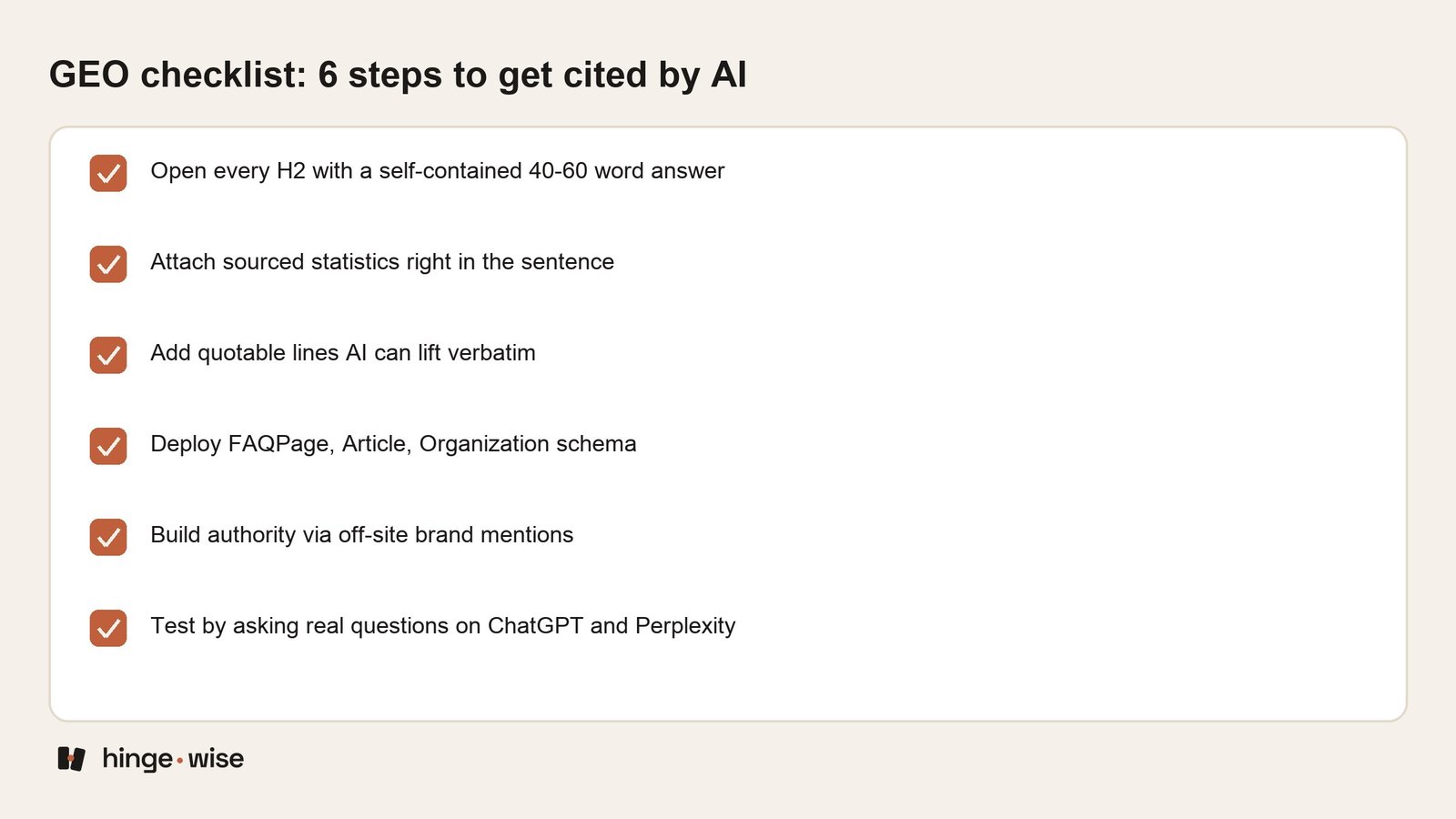
- Rewriting every major section to open with a direct 40-60 word answer is the highest-leverage GEO change you can make and the prerequisite for everything else on this checklist.
- The Princeton GEO study identified three content patterns that raised visibility most in its tests: attributed statistics, quotations from credible sources, and inline source citations (roughly 30-40% each, on pages already retrieved).
- Structured data, especially FAQPage, HowTo, and Organization with sameAs, helps AI crawlers parse and attribute your content correctly to your brand entity.
- Share of Model (how often AI mentions your brand across relevant queries compared to competitors) is the metric that replaces keyword rankings in a GEO measurement framework.
Frequently asked questions
What does it mean to improve your GEO?
Improving your GEO means increasing how often AI search engines (ChatGPT, Perplexity, Gemini and Google AI Overviews) cite, quote, or recommend your brand when answering relevant queries. The goal shifts from ranking in search results to becoming part of the AI-generated answer itself, which requires different content structure and a different measurement approach.
How long does it take to see results from GEO optimization?
GEO changes typically show measurable movement in Share of Model within 2-3 months of consistent work. AI referral traffic in Google Analytics 4 often takes 4-6 months to show a clear trend line. Unlike a keyword ranking jump, GEO progress is non-linear and harder to attribute to any single change, so track the aggregate over time.
Do I need to create new content or can I optimize existing pages?
Start with existing pages. Rewriting current content to be answer-first, adding attributed statistics, and implementing structured data on pages that already have traffic produces faster GEO results than publishing new content. New content makes sense after you have optimized your highest-traffic assets and identified the query gaps your current pages cannot cover.
Which AI engine should I prioritize for GEO?
Prioritize Google AI Overviews first because it reaches the largest audience and overlaps heavily with traditional SEO signals, meaning the same optimizations serve both channels. Then focus on Perplexity, which cites sources transparently and is widely used by research-oriented buyers. ChatGPT and Gemini matter for brand presence but drive less measurable referral traffic for most businesses right now.
What is Share of Model and why does it replace keyword rankings for GEO?
Share of Model is the percentage of AI-generated responses about your topic that mention your brand, relative to competitors. As AI engines handle more discovery queries, Share of Model increasingly predicts whether potential customers encounter your brand during their research phase. It is the GEO equivalent of share of voice in traditional media measurement.
Can GEO hurt my traditional SEO if I over-optimize for it?
The core GEO techniques (answer-first structure, attributed statistics, clear definitions, structured data) align directly with what Google’s quality guidelines have always rewarded. The one pattern to avoid is keyword stuffing in an attempt to appear in more AI queries; Princeton’s GEO research actually found that keyword stuffing reduces AI citation rates. GEO and SEO point in the same direction.
Where should I start if I only have time for a few GEO changes?
Start with three low-effort changes that help both Google and AI search: open every section with a short, direct answer, cite sources inline where you state a fact, and add an FAQ section whose answers stand alone. Then set up simple AI visibility tracking so you can see whether the changes move anything.
What is LLM SEO?
LLM SEO is another name for generative engine optimization (GEO): structuring content so large language models such as ChatGPT, Gemini and Perplexity can extract, trust and cite it. The checklist on this page is the practical version of it.
Want to see how your brand shows up across AI? Get a free GEO Snapshot.
How we made this: AI helped with research and the first draft. Lam Nguyen chose the topic, edited the piece and checked the figures against their original sources before publishing. How we work: Editorial policy.