
Generative engine optimization (GEO) is the practice of making your content visible inside AI-generated answers from tools like ChatGPT, Perplexity, and Google AI Overviews, not just on search result pages. Where SEO helps you rank, GEO helps you get cited, quoted, and recommended by AI systems that millions of people now use as their first stop for information.
Picture a software company that types “best project management tools for creative agencies” into Perplexity and gets a clean, synthesized answer: six tools, each with a short description and a clear recommendation at the bottom.
Its product isn’t on the list.
Suppose it ranks on page one of Google for several related keywords, with good backlinks and a blog maintained for years. Traditional SEO, technically solid. But when Perplexity synthesizes its answer, the brand simply doesn’t exist in the output. No citation. No mention. Nothing.
That gap is exactly what generative engine optimization is designed to close.
Why Traditional Rankings Are No Longer Enough
Generative engine optimization matters because the way people search has shifted fast. Google’s AI Overviews now reach billions of users each month (Google, May 2024). ChatGPT reached 100 million users faster than any product in history, according to usage data cited by Semrush. Perplexity processes tens of millions of queries weekly.
These aren’t future projections. This is current user behavior, and it’s accelerating.
When a generative engine answers a query, it synthesizes information from multiple sources and delivers a single response. The user doesn’t scan ten blue links and choose one. They read what the AI produced. If your brand contributed a source the AI trusted, you’re in the answer. If you didn’t, you’re invisible at that exact moment of decision.
Ranking #1 and being cited by AI are two different outcomes. We’ve seen pages that rank well never appear in AI responses. We’ve also watched pages with modest traditional rankings get cited repeatedly across ChatGPT, Perplexity, and Google AI Overviews. The criteria the AI uses to select sources are meaningfully different from what Google’s ranking algorithm rewards.
That difference is where GEO strategy lives.
The Hingewise 3-Layer Model: Found, Cited, Recommended
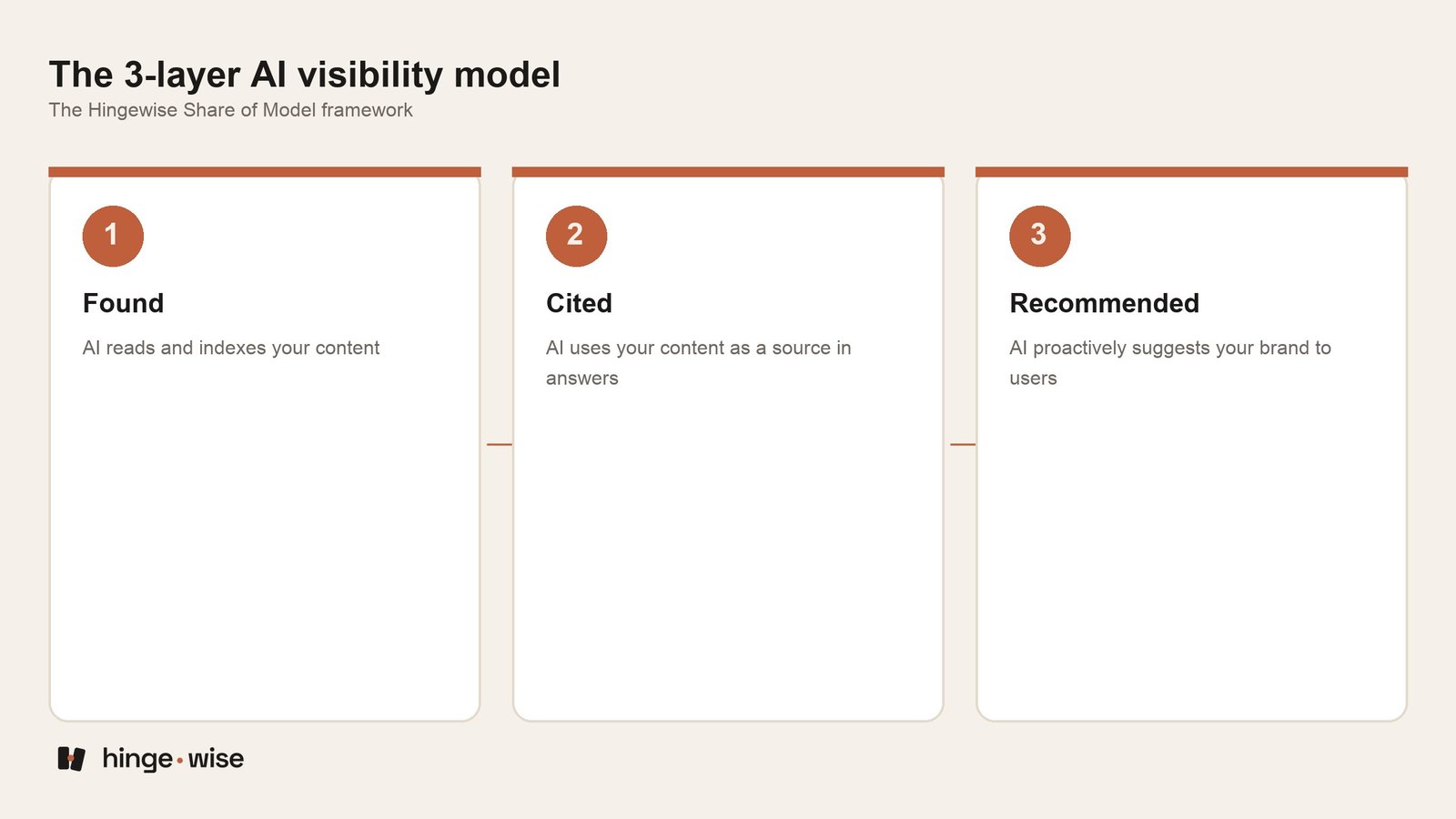
At Hingewise, we think about AI visibility as three distinct layers. Most businesses are only playing on the first one, and they don’t realize it yet.
Layer 1: Being Found. This is traditional SEO. Search engines crawl your content, index it, and rank it for relevant queries. It’s the foundation. Without it, the other two layers don’t function.
Layer 2: Being Cited. This is AEO, or Answer Engine Optimization. Your content gets pulled into featured snippets, Google’s AI Overviews, or cited directly by Perplexity and ChatGPT when answering a question. You exist inside the answer, not just behind a link someone has to click.
Layer 3: Being Recommended. This is where GEO specifically operates. The AI doesn’t just cite you as a background source. It actively suggests your brand, product, or service when someone asks “what should I use” or “who does this well.” You become part of the AI’s consideration set, the shortlist it builds on behalf of the user.
Most businesses work on Layer 1 by necessity. Some start thinking about Layer 2 when they notice featured snippets. Almost no one is systematically building for Layer 3.
The businesses that figure out Layer 3 first will have a real structural advantage. That’s not a hedged opinion. It’s what we see happening right now.
GEO vs. SEO: What Actually Changes
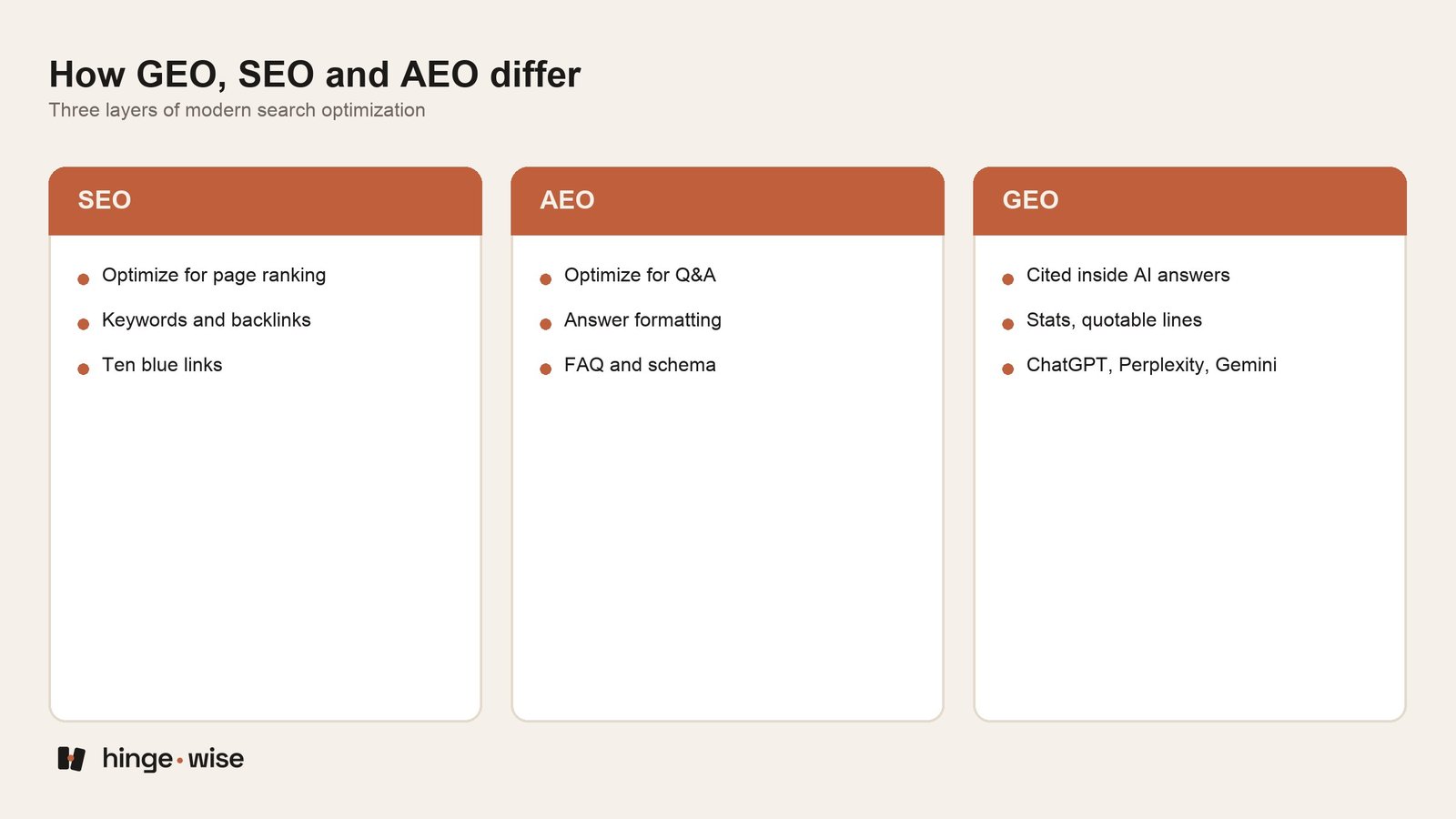
GEO doesn’t replace SEO. The strategies overlap more than most people expect. But they optimize for different outcomes, and the success metrics are completely different. Here’s a direct comparison:
| Factor | SEO | GEO |
|---|---|---|
| Primary goal | Rank on search result pages | Appear inside AI-generated answers |
| Success metric | Rankings, organic traffic | AI citations, Share of Model |
| Content style | Keyword-optimized, comprehensive | Structured, quotable, source-cited |
| Authority signals | Backlinks from authoritative domains | Brand mentions, trusted source citations |
| Freshness | Important for competitive queries | Critical for fast-moving topics |
| User journey | User clicks through to your site | AI delivers your message directly |
| Measurement tools | Google Search Console, Ahrefs, Semrush | Manual prompt testing, AI mention tracking |
The measurement row is the honest problem right now. There’s no Google Search Console equivalent for AI citations. Semrush is building AI visibility tracking features, but they’re early-stage as of mid-2026. For most businesses today, measurement is manual, which means it gets skipped. Don’t skip it.
What “Share of Model” Measures (And Why It Outranks a Ranking)
Share of Model is the metric our team uses to track AI visibility. The concept is straightforward: when someone asks an AI tool a question that’s relevant to your industry, how often does your brand appear in the response compared to your competitors?
The practical method: pick five to ten questions your target customers would realistically ask an AI assistant. Run each one across ChatGPT, Perplexity, Google AI Overviews, and Gemini. Record who gets named, in what context, and whether the AI is recommending them or just mentioning them in passing. Do this weekly and you start seeing patterns quickly.
Why does this matter more than a ranking position? A page ranked #5 still gets clicks when users scan results. But if an AI synthesizes a full answer and your brand never appears in it, there’s no position to fall back on. You’re absent from that user’s decision-making moment entirely.
Google confirmed in their May 2024 AI Overviews announcement that links included inside AI Overviews actually generate more clicks than traditional web listings for the same query. That’s the counterintuitive finding worth sitting with. Being cited in an AI answer drives more engagement, not less. The traffic opportunity is real.
We track Share of Model manually right now, which takes time. But it’s produced more useful insights about our content gaps than any ranking report we’ve run.
What Building Our Own AI Newsroom Actually Taught Us
This section comes from direct observation, not theory.
Our team built a bilingual AI newsroom that automatically publishes content covering AI, SEO, and GEO developments in both English and Vietnamese. We’ve been running it long enough to observe consistent patterns in what AI answer engines choose to cite from our content versus what they ignore entirely.
A few things we noticed. These are qualitative patterns, not data from a controlled experiment, and we want to be clear about that distinction:
- Content with a direct, standalone definition in the first 100 words gets cited significantly more often than content that buries its definition mid-article. Not close.
- Articles that cite external sources, arXiv research, official Google announcements, published studies, get referenced more than articles making the same factual claims without attribution. The AI seems to treat visible citations as a credibility signal.
- Structured content, meaning articles with clear headings, comparison tables, and bulleted lists, appears more frequently in Perplexity citations than dense prose covering the same information.
- For fast-moving topics like AI product updates, freshness dominates. An article about a specific Google change from three months ago gets displaced by newer content quickly. An article defining a stable concept can hold AI citations for much longer.
Honestly, content length surprised us. We expected longer, more comprehensive articles to win more citations. That’s not what we observed. A focused 900-word piece with clear structure frequently out-performs a 3,000-word guide on the same topic when it comes to AI citation frequency. The AI needs to extract a clean, usable passage. Dense long-form content makes that harder.
Google never explicitly confirms how AI Overviews selects its sources. Perplexity doesn’t publish a citation algorithm. So what we’re describing is pattern observation from our own content, not a confirmed mechanism. But the pattern is consistent enough that we’ve restructured how we write everything across the board, not just the newsroom.
How to Start With GEO Without Rebuilding Everything
GEO isn’t a separate channel you build from scratch. It’s a set of principles that change how you write and structure content. Research published on arXiv in 2023 found that specific content optimizations can boost visibility in generative engine responses by up to 40%. The strategies that moved the needle most: adding statistics with sourced attribution, writing direct quotable statements, and citing credible external references. Those three overlap heavily with good content writing in general.
Three practical starting points that require no new tools or budget:
- Audit your key definitions. Pick your ten most important topic pages. Does each one contain a single, direct, quotable definition in the first 100 words? If an AI can’t extract a clean definition from your page, it will pull one from somewhere else instead.
- Add visible source citations. Every statistic, research finding, or factual claim should have a clear attribution right next to it. Not for SEO trust signals alone. Because AI systems use citation density as part of how they assess source credibility when building a response.
- Run weekly prompt tests. Pick five questions your target customers would ask ChatGPT or Perplexity. Run them every week. Track whether your brand, your content, or your perspective appears in the answers. This is your baseline Share of Model measurement, and it costs nothing except time.
Start there. Build the habit before you invest in tools or infrastructure. The mindset shift matters more than the tactics anyway: you’re no longer writing only for a crawler that indexes keywords. You’re writing for an AI system that needs to extract, understand, and confidently reproduce your content in a synthesized response within seconds.
That’s a different bar. Most content doesn’t clear it yet. Which means the window to move first is still open.
- Generative engine optimization (GEO) is the practice of getting your content cited and recommended inside AI-generated answers, not just ranked on search result pages.
- The Hingewise 3-layer model: Being Found (SEO) is the foundation, Being Cited (AEO) gets you inside answers, Being Recommended (GEO) puts you on the AI’s shortlist.
- Share of Model, how often AI tools mention your brand versus competitors for relevant queries, is a more useful visibility metric than a ranking position alone.
- Structured, definition-first, source-cited content gets cited by AI answer engines more often than dense long-form content covering the same topic.
- Research published on arXiv (2023) found GEO strategies can boost visibility in generative engine responses by up to 40%, with statistics, quotable statements, and external citations driving the biggest gains.
Frequently asked questions
What is generative engine optimization in simple terms?
Generative engine optimization (GEO) is the practice of optimizing your content so it appears inside AI-generated answers from tools like ChatGPT, Perplexity, and Google AI Overviews. Instead of competing for a position on a results page, you’re competing to become one of the sources an AI synthesizes into its response.
Is GEO replacing SEO?
No. GEO builds on top of SEO, not in place of it. Search engines still need to crawl and index your content before AI systems can use it. The difference is that GEO adds a second optimization layer: making content structured, quotable, and source-cited in ways that AI answer engines prefer when selecting what to include in a response.
How do I measure GEO performance without specialized tools?
The most practical starting method is manual prompt testing. Pick five to ten questions your target customers would ask an AI assistant. Run them weekly across ChatGPT, Perplexity, and Google AI Overviews. Track how often your brand or content appears, and in what context. This gives you a baseline Share of Model measurement that costs no additional budget.
Which AI tools should I prioritize for GEO?
As of mid-2026, the platforms that drive the most relevant AI search traffic are Google AI Overviews (billions of monthly users), ChatGPT, and Perplexity. Gemini is growing. Optimizing for these four covers the majority of AI-influenced search behavior for most industries. The underlying content principles work across all of them.
Does the same content work for both SEO and GEO?
Largely yes, but with adjustments. GEO rewards direct definitions placed early, external source citations inline with claims, and structured formatting like tables and clear headings. Content that already follows good SEO practice needs these additions, not a complete rewrite. The biggest shift is prioritizing extractability over comprehensiveness.
How long before GEO efforts produce visible results?
AI citation patterns can shift faster than traditional rankings, especially for fresh content on topics where AI tools are actively indexing new sources. That said, building consistent AI visibility, particularly at Layer 3 (Being Recommended), takes sustained effort over months. There is no shortcut equivalent to an overnight ranking jump.
Want to see how your brand shows up across AI? Get a free GEO Snapshot.
How we made this: AI helped with research and the first draft. Lam Nguyen chose the topic, edited the piece and checked the figures against their original sources before publishing. How we work: Editorial policy.