
An AI visibility platform tracks your brand across multiple AI engines (ChatGPT Search, Perplexity, Gemini, Google AI Overviews, Bing Copilot) with reporting, competitor monitoring, and content recommendations built in. A standalone tool covers one specific function. The right choice depends on your scale, the number of AI engines that matter to your audience, and whether you need competitor benchmarks or just brand monitoring.
Most brands building a GEO strategy are running a single monitoring tool as their ai visibility platform and calling it a strategy. Not the same thing.
ChatGPT hit 900 million weekly active users as of February 2026 (Wikipedia). Google AI Overviews now reaches billions of queries every month, according to Semrush. My read: the brands that figure out the right ai visibility platform setup early will have a structural advantage over those still stitching together disconnected tools. The scale is real. The question is whether your current setup matches it.
The choice between a platform and a tool isn’t primarily about budget. It’s about whether your setup can answer the questions that actually drive decisions.
What Actually Separates a Platform from a Tool
A platform handles the complete AI visibility cycle: track where your brand appears in AI-generated responses, analyze why you’re cited or skipped, recommend specific content changes, and measure shifts over time across multiple engines. A tool does one or two of those things well. The rest is your problem to solve manually.
Here’s the test I use: if it can’t close the loop from “you weren’t cited in Perplexity” to “here’s what the cited content is doing differently,” it’s a tool. Doesn’t matter what the vendor’s landing page calls it.
Semrush added an AI Toolkit inside its broader platform. That’s different from a browser extension that flags ChatGPT Search mentions. One is a feature inside an orchestrated workflow. The other is a data point that lives outside your workflow, requiring you to connect the dots yourself.
Ask any vendor three direct questions: Can it track ChatGPT, Perplexity, Google AI Overviews, and Bing Copilot simultaneously? Can it benchmark your share of voice against competitors? Can it generate content recommendations based on what’s getting cited? Three yeses is a platform. Fewer is a tool with ambitious pricing.
When a Single Tool Is Genuinely Enough
Not every brand needs a platform right now. A standalone tool is the right call at specific stages, and buying beyond those stages wastes real money.
A tool is enough when you’re establishing your first AI visibility baseline, your team publishes fewer than ten pieces a month, you’re focused on one AI engine rather than five, and the internal business case for a full platform hasn’t been made yet.
Picture a mid-size SaaS brand that pays several hundred dollars a month for a platform before it has the content volume or team bandwidth to use it. The platform is likely to sit half-configured for months, while a basic monitoring tool would have covered that stage. The mistake isn’t ambition. It’s buying for a scale you haven’t reached yet.
Start lean. Upgrade when you actually hit the ceiling.
Signs You’ve Outgrown Your Current Setup
There’s a specific moment when a single tool stops being sufficient. A few clear signals:
You’re optimizing across ChatGPT, Perplexity, and Google AI Overviews, and they’re behaving differently. Your current tool covers one, maybe two. Cross-channel visibility requires centralized data, not three browser tabs open side by side.
Competitors are getting cited in AI responses consistently and you’re not, but you can’t tell why. That gap between “you’re invisible” and “here’s what the cited content does differently” is exactly where platforms justify their cost.
You need to report AI share-of-voice metrics to leadership. Raw mention counts from a monitoring tool aren’t a report. Trend lines, competitor comparisons, and content attribution are what stakeholders need to see. Those are different products.
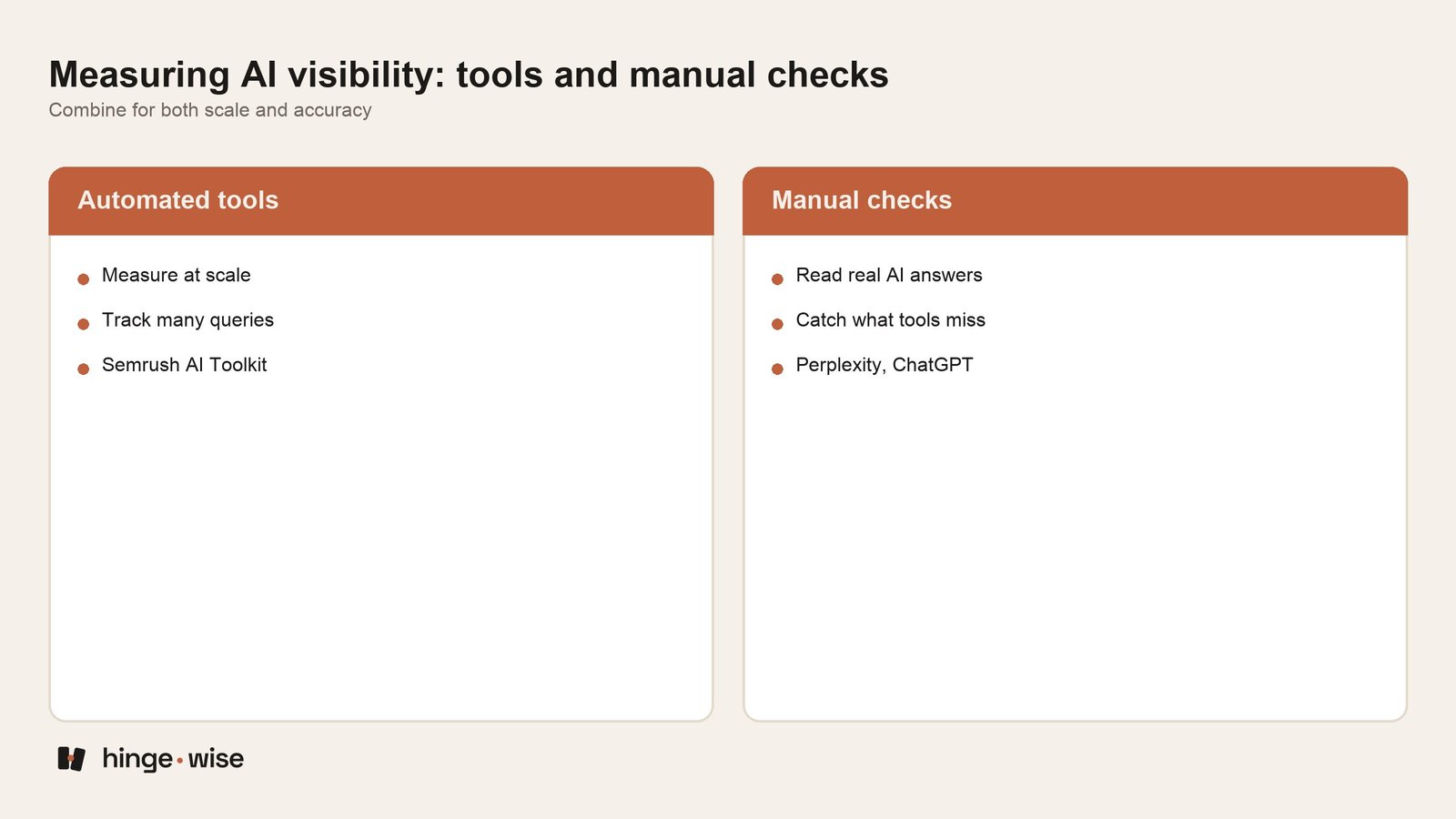
Your content team is publishing at scale and manually checking AI responses every week. That workflow breaks down fast once you’re at twenty-plus pieces a month. You need automation, not a recurring calendar reminder.
What to Look For in an AI Visibility Platform
Five criteria actually separate genuinely useful platforms from expensive dashboards.
Engine coverage. ChatGPT Search and Google AI Overviews are table stakes. Perplexity matters for research-intent queries. Claude’s web search mode is growing. If a vendor’s demo only covers Google, ask specifically what else they track before signing anything.
Citation attribution. Can it tell you which specific content piece drove a citation, or does it just confirm your brand was mentioned? Attribution converts monitoring data into editorial decisions. Without it, you know you won a citation but not how to repeat it.
Competitor benchmarking. AI share of voice, your citation rate versus competitors for the same target queries, is the metric that drives real strategy. A platform showing only your own data tells half the story and leaves out the half that matters most.
Content recommendations. Does it analyze existing content and suggest specific changes, or does it audit and stop there? The recommendation layer is where full platforms differ from sophisticated monitoring tools. Honestly, very few platforms nail this part yet. It’s the hardest layer to build and also the most valuable.
Workflow integration. Does it connect to your CMS, Slack, or reporting stack? A platform that requires manual CSV exports every week gets abandoned within two months. Integration isn’t a premium feature. It’s a survival requirement for sustained adoption.
Platform vs. Tool: A Side-by-Side View
Here’s how the two compare across the criteria that matter:
| Criteria | AI Visibility Tool | AI Visibility Platform |
|---|---|---|
| Engine coverage | 1-2 engines | 4+ engines simultaneously |
| Brand monitoring | Mentions only | Mentions + share of voice + sentiment |
| Competitor data | Usually absent | Share-of-voice benchmarking |
| Content attribution | Rarely available | Citation-to-content mapping |
| Optimization guidance | None or basic | Content gap analysis and recommendations |
| Reporting | Raw data or exports | Dashboards, trend lines, stakeholder views |
| Workflow integration | Manual or limited | CMS, Slack, reporting stack integrations |
| Best for | Early-stage, single-channel, small teams | Multi-channel, growing teams, leadership reporting |
A rough scale guide: fewer than five content pieces a month and one AI channel, a tool is enough. Ten to thirty pieces across multiple channels, a platform is worth evaluating. Fifty-plus pieces a month, a platform isn’t optional.
The Mistake Most Brands Make When Choosing
The most common error isn’t picking the wrong tier. It’s buying based on the vendor demo rather than the actual workflow.
A platform with beautiful share-of-voice charts does nothing if no one on your team has bandwidth to act on them. A simple weekly monitoring report, used consistently by one person making editorial decisions, drives more real impact than an underused platform.
Research published on arXiv (Aggarwal et al., 2023) found that structured GEO strategies can boost visibility in AI-generated responses by up to 40%. That’s a meaningful lift. But capturing it requires knowing your current baseline first, which is precisely what both tools and platforms surface, just at different depths and scales.
The ai visibility platform market is still maturing. Most solutions I’ve evaluated are strong in monitoring, weaker in recommendations, and uneven on multi-engine attribution. That’s not a reason to wait. It’s a reason to be clear about the specific gap you’re filling right now and not buy capabilities you won’t actually use for another year.
If you want to know where your brand currently stands across AI search channels before committing to a platform, Hingewise offers a free AI Visibility Snapshot. A concrete starting point, no strings attached.
- An AI visibility platform covers multiple AI engines with competitor tracking and reporting; a standalone tool solves one specific monitoring function.
- Minimum viable coverage for any serious AI visibility investment: Google AI Overviews, ChatGPT Search, and Perplexity.
- Single tools fit narrow use cases and early-stage testing; platforms pay off when you need cross-engine data, competitor benchmarks, or team-scale reporting.
- Evaluate solutions by five criteria: engine coverage, metrics depth, competitor tracking, content recommendations, and reporting capability.
- Price is a reliable category signal: under $200/month is a tool by design, regardless of positioning.
Frequently asked questions
What is an AI visibility platform?
An AI visibility platform is a software solution that tracks how your brand appears across multiple AI-powered search engines, including ChatGPT Search, Perplexity, Gemini, and Google AI Overviews. It typically includes dashboards, competitor comparison, share of voice metrics, and content recommendations, giving you a unified view rather than isolated data points.
How is an AI visibility platform different from a standalone tool?
A platform covers multiple AI engines, tracks competitors, and surfaces trend data over time. A standalone tool typically monitors one engine or one metric, like whether your brand appears in Google AI Overviews. The key difference is scope: tools answer “was I mentioned?” while platforms answer “how is my brand positioned versus competitors, across all major AI search engines?”
Which AI engines should an AI visibility platform cover?
At minimum, look for coverage of Google AI Overviews, ChatGPT Search, and Perplexity. These three represent the highest volume, fastest growth, and highest citation transparency respectively. Bing Copilot and Gemini are secondary priorities. Any solution covering fewer than three engines is a tool, not a platform, regardless of how it’s marketed.
When does a business actually need an AI visibility platform vs. a tool?
A platform makes sense when you need to track competitors, manage multiple product lines or markets, or analyze trends across AI engines over time. A standalone tool is sufficient when you have one specific question to answer, limited budget (under $500/month for SEO tools), or a small team without dedicated capacity to act on platform-level data.
How much does an AI visibility platform typically cost?
Entry-level platforms with multi-engine coverage and competitor tracking typically start at $500 to $1,000 per month. Enterprise tiers go significantly higher depending on query volume, number of brands tracked, and reporting features. Solutions priced below $200/month are effectively tools with constrained coverage, even if they’re marketed as platforms.
How do I measure AI visibility once I have a solution in place?
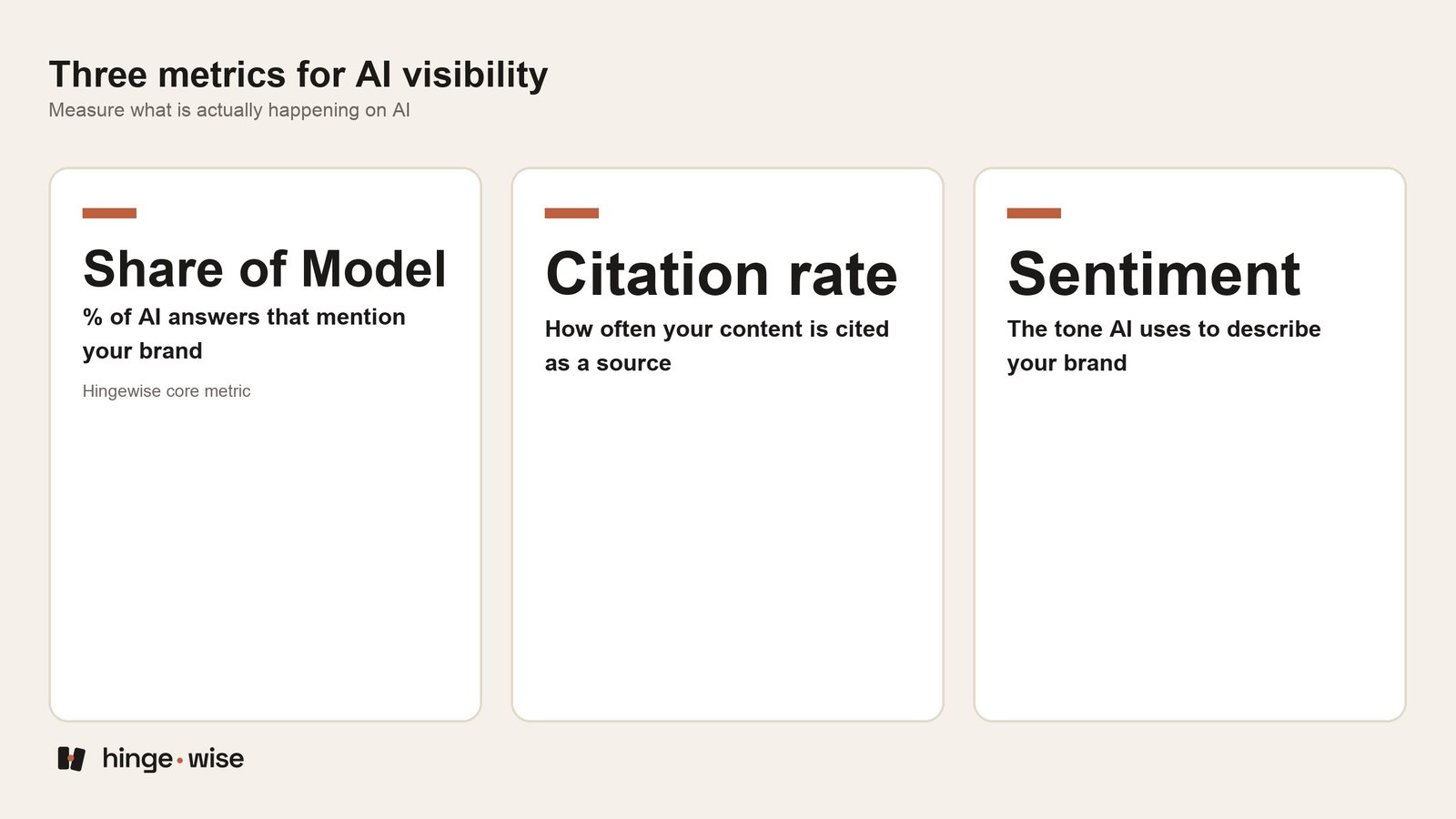
The core metrics are AI share of voice (what percentage of relevant AI responses mention your brand vs. competitors), citation frequency (how often your content is sourced), and response position (whether you’re named first, second, or buried). Track these weekly or monthly across each engine separately, since performance varies significantly between ChatGPT, Perplexity, and Google AI Overviews.
Want to see how your brand shows up across AI? Get a free GEO Snapshot.
How we made this: AI helped with research and the first draft. Lam Nguyen chose the topic, edited the piece and checked the figures against their original sources before publishing. How we work: Editorial policy.