
A GEO audit is a structured assessment of how visible your brand is in AI-generated search responses. It measures how often tools like ChatGPT, Perplexity, Gemini, and Google AI Overviews cite you, compares your visibility against competitors, and identifies the content gaps preventing AI from recommending your brand.
Most brands have no clue whether AI search results mention them. They check Google rankings, track domain authority, send monthly SEO reports. Meanwhile, ChatGPT, Perplexity, and Google AI Overviews are recommending their competitors by name, to buyers who never scroll past the AI answer.
That’s the gap a GEO audit finds. And fixes.
The first time I ran one, I expected something close to a regular SEO audit with AI paint on top. It isn’t. The data inputs are different. The signals look nothing alike. The deliverables don’t either. Once you’ve seen a proper GEO audit output, you stop confusing the two.
Why Your Google Rankings Don’t Tell You If AI Recommends You
Google’s AI Overviews now reach billions of users every month, according to Semrush. ChatGPT crossed 100 million users faster than any app in history. When someone asks these tools which software to buy, which agency to hire, or which local clinic to book, the AI picks sources and names brands. Your position on Google’s results page has nothing to do with who gets picked.
AI systems don’t rank pages. They cite sources. The logic is closer to academic citation than keyword ranking. A brand with clear, structured, quotable content on credible platforms gets named. A brand that ranks #1 for a keyword but publishes thin, unextractable content often doesn’t appear in AI responses at all.
So the question has shifted. It’s not just “where do I rank?” anymore. It’s “does AI mention me, how does it frame me, and how do I compare to whoever AI recommends instead?”
A GEO audit answers all three.
What a GEO Audit Actually Covers
A GEO audit has four components: measuring your current AI citation rate across platforms, analyzing the quality and framing of those mentions, benchmarking your AI visibility against direct competitors, and auditing your content for extractability gaps. These four pieces together produce something a standard SEO audit simply cannot: a complete picture of where you stand in AI search right now.
| Audit Component | What We Measure | Why It Matters |
|---|---|---|
| AI Citation Rate | How often your brand appears in responses from ChatGPT, Perplexity, Gemini, and Google AI Overviews across your target query set | This is your baseline. Zero citations means AI doesn’t know you exist, regardless of your Google rank. |
| Citation Quality Analysis | Sentiment, accuracy, context, and category placement of your mentions | Being cited in the wrong context or with inaccurate framing is often worse than not being cited at all. |
| Competitor Gap Analysis | Which competitors AI cites instead of you, for which queries, and how often | Identifies exactly where competitors are capturing AI recommendations at your expense. |
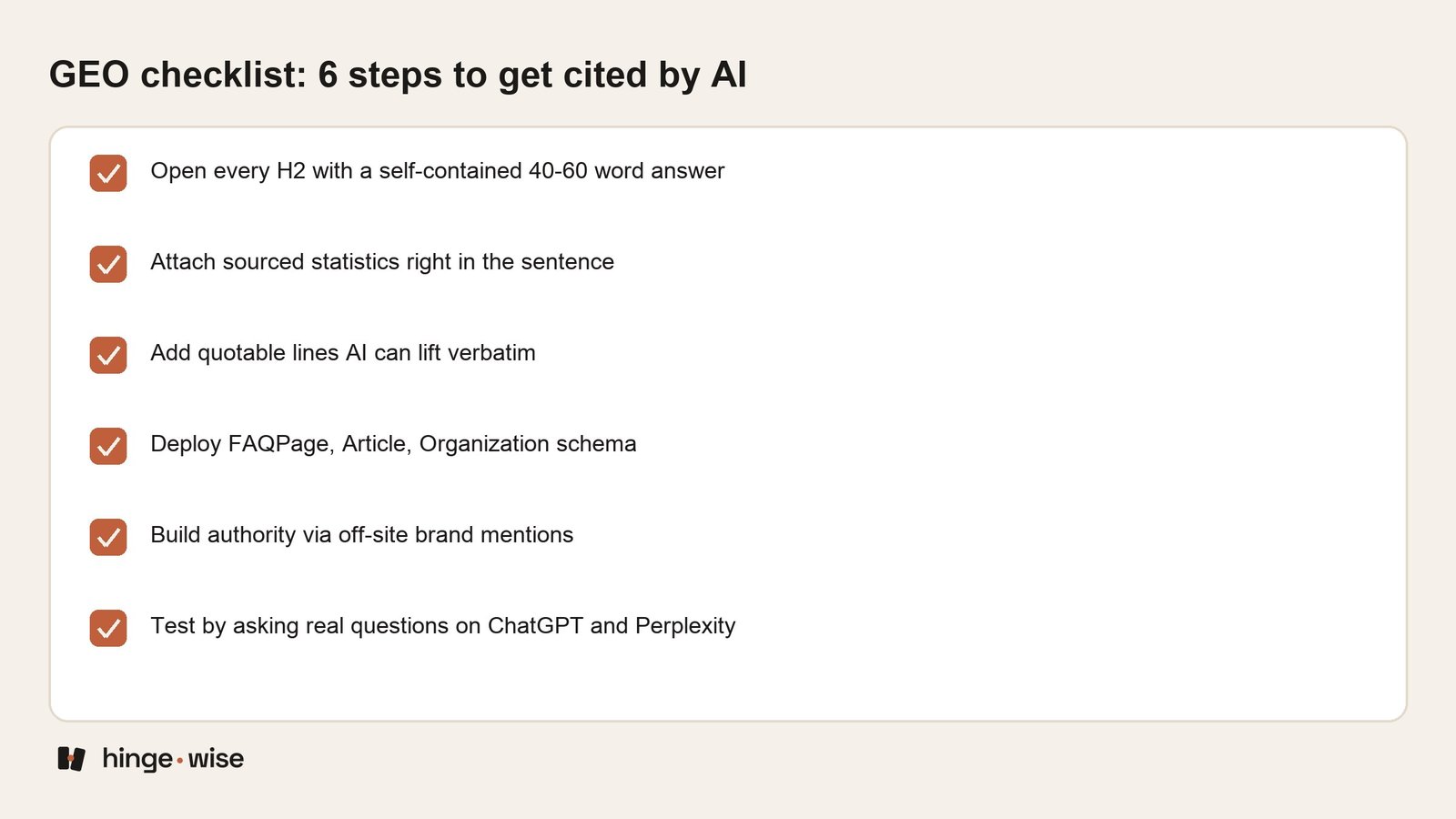
| Content Extractability Audit | Whether your pages have clear definitions, quotable passages, structured data, and properly sourced statistics | GEO optimization strategies applied to content structure can boost AI visibility by up to 40% (Princeton NLP Group / arxiv.org, 2023). |
The extractability component is where most brands are genuinely surprised. They have good content that ranks well. But when Perplexity or ChatGPT goes looking for a quotable, citable passage, the page isn’t structured to give one. That’s a fixable problem. The audit identifies it at the individual page level, not as a generic “improve content quality” note.
How the Audit Process Works
A GEO audit starts with a query inventory: 30 to 60 questions your target customers actually ask tools like ChatGPT and Perplexity. Not a keyword list. The exact prompts we run inside each AI platform to collect citation data: “best [product category] for [use case],” “which [service type] should I use,” “[your brand] vs. [competitor],” and problem-to-solution queries that show real buyer intent.
Then we test systematically. Each query runs multiple times across ChatGPT, Perplexity, Gemini, and Google AI Overviews. Every source citation and brand mention gets logged. Honestly, there’s no single consolidated tool for this yet. You have to triangulate across platforms, because ChatGPT and Perplexity regularly pull from different sources for the same query. That inconsistency is itself a signal worth capturing.
From there, the audit moves through three layers:
- Citation mapping: your brand mention rate vs. competitors across each query cluster, broken down by platform and query type
- Mention review: existing citations checked for accuracy, sentiment, and whether the framing matches how you want to be described
- Extractability audit: your content reviewed against specific structural criteria for what AI systems can actually read, parse, and pull from
A focused audit covering 30 to 60 queries and 3 to 5 competitors typically takes 7 to 10 business days. Single-product, single-market audits hit that timeline consistently. Broader audits take longer, and speed matters less than coverage depth here.
What You Get at the End
A complete GEO audit delivers five things: an AI Visibility Score, competitor benchmarks across query clusters, a citation quality review of existing mentions, a page-level content extractability audit, and a prioritized action plan. Every deliverable connects to a specific action. The audit doesn’t hand you a score and leave you to interpret the rest.
Here’s what each piece looks like in practice:
- AI Visibility Score: Your citation rate across the full query set, broken down by platform and query type, so you can see exactly where you’re invisible
- Competitor Benchmarks: Your AI mention rate compared side-by-side against 3 to 5 competitors, per query cluster, not just overall
- Citation Quality Report: Specific mentions reviewed for accuracy and framing, with flags for anything negative, misleading, or miscategorized
- Content Extractability Audit: Page-level review noting what’s missing and exactly what to change
- GEO Action Plan: Prioritized recommendations from quick wins on existing pages to strategic content gaps where competitors are currently winning AI citations that should be yours
The action plan is the part clients come back to. It names specific pages, specific queries, and specific changes. That’s the difference between a diagnostic and a deliverable.
GEO Audit vs. SEO Audit: Why You Can’t Use One Instead of the Other
An SEO audit measures rankings, backlinks, and technical crawlability for Google’s algorithm. A GEO audit measures AI citation rate, mention quality, and content extractability for tools like ChatGPT and Perplexity. The signals are fundamentally different. A brand can rank #1 on Google and appear in zero AI responses. That’s not a hypothetical. It’s common, and it’s exactly what a GEO audit catches.
| SEO Audit | GEO Audit | |
|---|---|---|
| What it measures | Rankings, crawlability, backlinks, on-page optimization | AI citation rate, mention quality, content extractability |
| Primary signals | PageRank, crawl coverage, keyword optimization | Citation frequency, structured definitions, quotable content, source credibility |
| Platform focus | Google SERP | ChatGPT, Perplexity, Gemini, Google AI Overviews |
| Competitive benchmark | Keyword rankings, domain authority | AI share of voice per query cluster |
| Key output | Technical fixes and content gap analysis | AI Visibility Score and extractability recommendations |
The two audits aren’t opposites. A site with solid technical SEO tends to be easier for AI crawlers to index too. Strong backlinks from credible sources help both. The overlap is real. But a GEO audit surfaces problems an SEO audit misses: content that ranks but can’t be extracted, brands invisible to AI despite strong SERP presence, and query types where AI recommends entirely different sources than Google does.
How to Get a GEO Audit
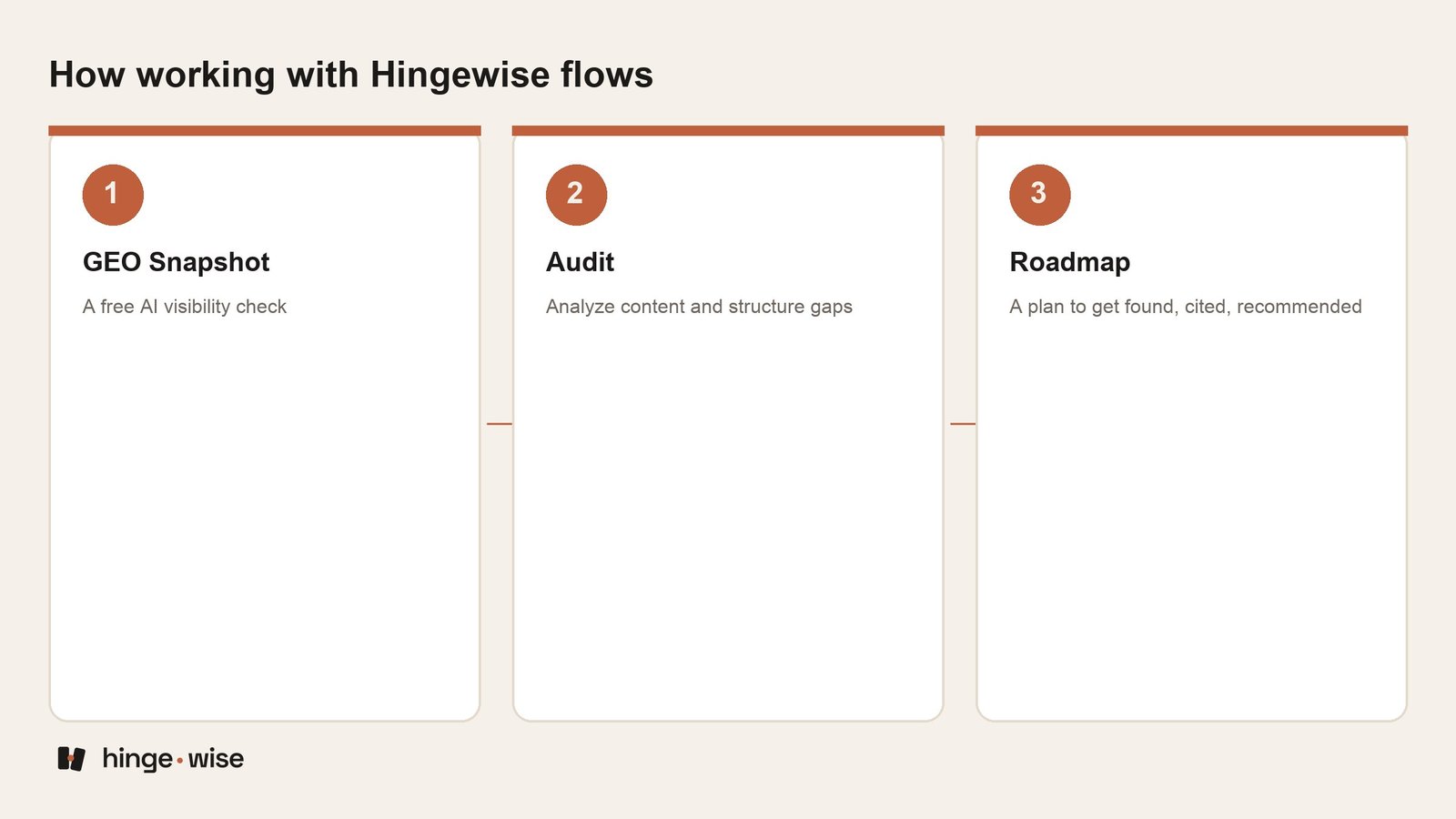
The free GEO Snapshot is the right starting point if you’re not sure where you currently stand. It covers your top 10 branded and category queries across ChatGPT and Perplexity: a citation rate baseline, one competitor comparison, and a short list of the biggest content gaps holding you back. No commitment required. Results land within 2 to 3 business days, and you walk away with a clear answer to “does AI mention my brand right now?”
The full GEO Audit is for brands that already know they have a visibility gap, or for situations where AI recommendations are actively costing leads: a product launch, a competitive market where a specific rival keeps getting cited instead of you, a rebrand that hasn’t registered in AI systems yet. The full audit covers 40 to 60 queries, all major AI platforms, complete competitor benchmarking, and an action plan you can start executing immediately.
The audit doesn’t tell you there’s a problem and stop there. It names the specific pages to update, the content to create, and the platforms to prioritize first.
Claim your free GEO Snapshot to see your baseline in 48 hours, or book the full GEO Audit if you need the complete picture. Either way, the only mistake is going another quarter without knowing where you stand while AI keeps reshaping who gets recommended.
- A GEO audit measures your brand’s AI citation rate, mention quality, competitor gaps, and content extractability across tools like ChatGPT, Perplexity, Gemini, and Google AI Overviews.
- Google rankings and AI citations run on completely different signals: keyword ranking is not the same as being extractable and citable by AI systems.
- GEO optimization applied to content structure can boost AI visibility by up to 40%, according to research from Princeton NLP Group (arxiv.org, 2023).
- A GEO audit delivers five outputs: AI Visibility Score, competitor benchmarks, citation quality review, extractability audit, and a prioritized action plan.
- The free GEO Snapshot (top 10 queries, one competitor, 48-hour turnaround) is the fastest way to see if AI is mentioning your brand right now.
Frequently asked questions
What is a GEO audit?
A GEO audit is a structured assessment of your brand’s visibility in AI-generated search responses. It measures how often tools like ChatGPT, Perplexity, Gemini, and Google AI Overviews cite your brand, analyzes the quality and framing of those mentions, benchmarks you against competitors, and identifies the content gaps preventing AI from recommending you.
How is a GEO audit different from an SEO audit?
An SEO audit measures rankings, backlinks, and technical crawlability for Google’s algorithm. A GEO audit measures AI citation rate and content extractability for tools like ChatGPT and Perplexity. A brand can rank #1 on Google and appear in zero AI responses. The signals are different enough that you need both audits for complete search visibility.
How long does a GEO audit take?
A focused GEO audit covering 30 to 60 queries and 3 to 5 competitors typically takes 7 to 10 business days. The free GEO Snapshot covering your top 10 queries and one competitor is delivered within 2 to 3 business days. Broader audits covering multiple product lines or markets take longer depending on scope.
Can I run a GEO audit myself?
You can manually check if your brand appears in ChatGPT or Perplexity responses, but systematic coverage across 40 to 60 queries, multiple AI platforms, and competitor benchmarking is difficult without a structured framework. The extractability audit component also requires specific criteria for what AI systems look for when selecting and citing sources.
Who needs a GEO audit?
Any brand where potential customers use AI tools to research, compare, or make purchasing decisions. This is especially relevant for B2B services, SaaS, professional services, e-commerce, and local businesses in competitive markets. If competitors are being named in ChatGPT or Perplexity answers and you’re not, a GEO audit shows you exactly why and what to change.
What happens after a GEO audit?
A GEO audit produces a prioritized action plan: specific pages to update for better extractability, new content topics to target where AI currently cites competitors instead of you, and structural changes to help AI systems read and pull from your content. Implementation typically starts with quick wins on high-intent pages, then builds out identified content gaps.
How we made this: AI helped with research and the first draft. Lam Nguyen chose the topic, edited the piece and checked the figures against their original sources before publishing. How we work: Editorial policy.