
AI naming your brand isn’t one number. It has two dimensions: coverage (how many buyer questions you show up in) and depth, your Share of Model: when you do appear, how often the AI actually picks you. Named everywhere but chosen nowhere still loses.
“Getting mentioned” measures one thing, and hides another
When a founder checks whether ChatGPT knows their brand and sees their name, it feels like a win. It usually isn’t the whole story.
Being present in an answer is not the same as being the recommendation. The AI can name you third, after two competitors. It can name you with the wrong price. It can mention you and link someone else.
Presence is the floor, not the finish line. That distinction is what AI visibility is really about. The real question is what happens after you show up.
Dimension 1: coverage, how many buyer questions you show up in
Your buyers don’t ask one question. They ask dozens, phrased their own way. “Best boutique hotel near District 1.” “Where do I store furniture while I move.” “Climate-controlled self-storage in Ho Chi Minh City.”
Coverage is simply how many of those real buying moments you appear in at all.
High coverage means you’re in the conversation across the category. Low coverage means whole clusters of buyers never see you, the AI answers them without you in the room.
Dimension 2: depth, your Share of Model
Showing up is one thing. Being the one chosen is another.
Share of Model is the share of AI mentions your brand wins against all competitors for a given buyer question, whether, when the topic comes up, the AI actually picks you.
Appear at the bottom of a list of five, and your Share of Model there is small. Get named first, recommended, cited or linked by AI, and it’s large.
Depth is the difference between “also available” and “the answer.”
The map: two axes, four positions
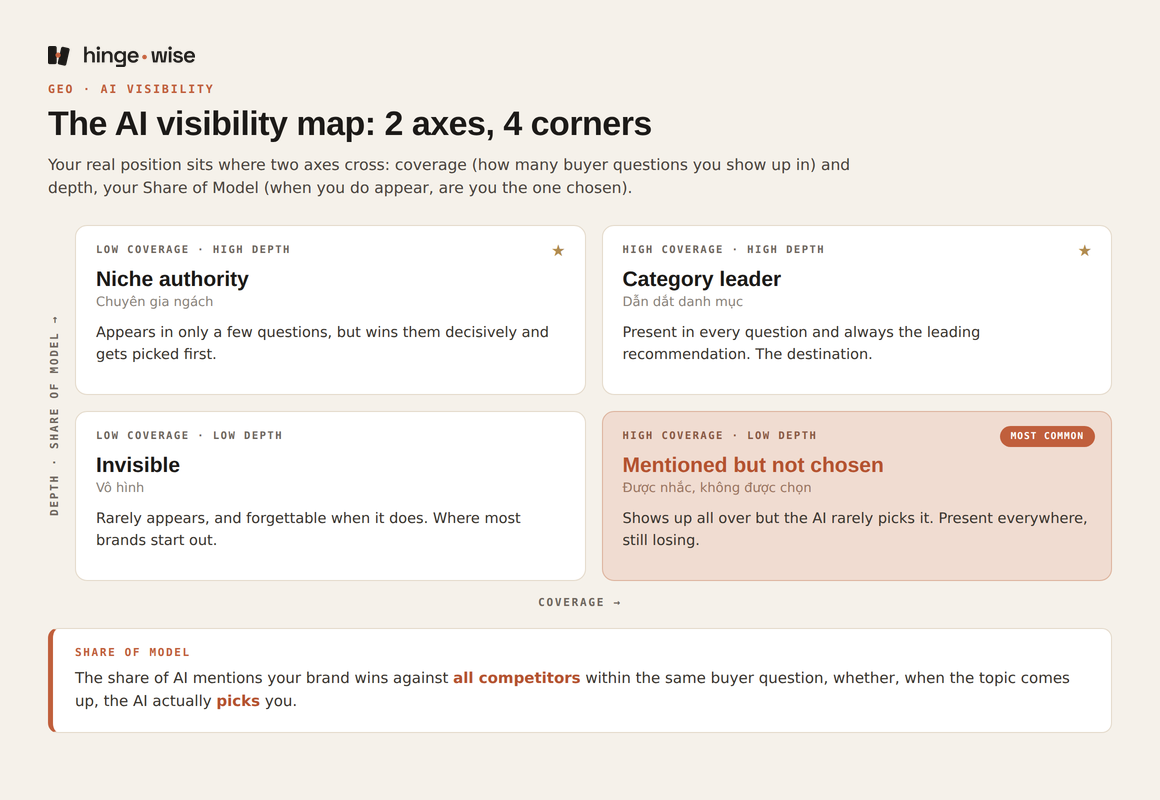
Put coverage on one axis and depth on the other, and every brand lands in one of four corners.
- Invisible (low coverage, low depth): rarely appears, forgettable when it does. Where most brands start.
- Mentioned but not chosen (high coverage, low depth): shows up all over, but the AI rarely picks it. The most common trap.
- Niche authority (low coverage, high depth): appears in only a few questions, but wins them decisively.
- Category leader (high coverage, high depth): present everywhere and chosen first.
Most brands that “got on ChatGPT” are sitting in the second corner, mentioned but not chosen, and mistaking it for progress.
The trap: wide but shallow
Here’s the uncomfortable part. Being mentioned in fifteen questions at a faint, never-chosen level loses to dominating three. Coverage without depth is a vanity number.
One real snapshot (not a typical result). A boutique hotel in Ho Chi Minh City, July 2026: named in four of five buyer questions, but only 22% Share of Model, and linked by AI 0% of the time. Present almost everywhere, chosen almost nowhere.
That hotel didn’t have a visibility problem in the “am I mentioned” sense. It had a depth problem. A report that only counted mentions would have called it a success.
Why you win deep first, then wide
So which do you chase, more coverage, or more depth?
Depth first, in a narrow place. Winning a small set of questions decisively gives you what a scattered presence never does: a visible win you can point to, and momentum to build on.
Spread thin across the whole category and you’re faint everywhere, easy for the AI to skip. Concentrate, own a beachhead, then expand. The full argument for picking one and holding it sits in winning AI recommendation one cluster at a time.
On the map, that’s the path from “mentioned but not chosen” through “niche authority” toward “category leader.” The order matters.
Which corner are you in?
Picture the two axes. Across the buyer questions in your category, how many do you show up in, and when you do, how often are you the one chosen?
Most brands find they’re further toward “mentioned but not chosen” than they assumed. That’s not a failure; it’s a starting point you can actually work with, once you can see it.
If you already track brand demand and want to know how the depth number relates to the metric you know, that comparison is in Share of Search versus Share of Model.
See your own AI map
Want to see your own AI map, coverage on one axis, Share of Model on the other? Get a free GEO Snapshot and we’ll show you which corner you’re in.
Frequently asked questions
How is coverage different from Share of Model?
Coverage is how many buyer questions you appear in at all. Share of Model is how often you’re the one chosen when you do. One is breadth; the other is depth.
If AI mentions my brand a lot, am I winning?
Not necessarily. Being mentioned is presence, not recommendation. You can be named across many questions and still rarely be the pick, “mentioned but not chosen.”
What does Share of Model measure?
The share of AI mentions your brand wins versus all competitors within the same buyer question, weighted by how prominently you’re named, measured on AI engines that actually search the web.
Should I go wide or deep first?
Deep first, in a focused area. Dominating a few questions beats a faint presence across many, and gives you a visible win to build on.
How do I know which corner I’m in?
Look at your category’s buyer questions on two axes, how many you appear in, and how often you’re chosen when you do. A measurement makes it concrete.
How is this different from SEO?
SEO asks whether you rank on a results page. This asks whether an AI names and recommends you inside an answer, and how often you’re the one it picks, not just whether you appear.
Want to see this measured on a real brand? Read how V-Box became the #2 AI-cited source in Vietnam, coverage, depth and the 8 facts AI got wrong.
How we made this: AI helped with research and the first draft. Lam Nguyen chose the topic, edited the piece and checked the figures against their original sources before publishing. How we work: Editorial policy.