
AI search intelligence is the practice of making your brand consistently findable, citable, and recommendable by AI systems like ChatGPT, Perplexity, and Google AI Overviews. At Hingewise, we break this into three layers (found, cited, recommended) and track progress with Share of Model, a metric that traditional SEO rankings cannot capture.
Last month, a SaaS founder messaged me after running a simple test. She typed her company’s core use case into ChatGPT search and Perplexity, back to back. Competitors she had never heard of showed up three times each. Her brand? Not once.
Her Google rankings were fine. Page 1 for several target keywords. But the AI systems had no idea she existed. That gap between traditional search visibility and actual AI presence is exactly what we built Hingewise to close. My honest take: most businesses are optimizing for a game that’s already changed.
Why Your Google Rankings Don’t Protect You Anymore
Traditional SEO tells you where you rank on a results page. It does not tell you whether ChatGPT mentions you when someone asks a question your product answers. Those are two completely different things, and conflating them is the most expensive mistake brands are making right now.
According to Google’s own announcement in May 2024, links included in AI Overviews get more clicks than a traditional web listing for the same query. That is not a marginal difference. It rewrites the economics of organic traffic. Google expected AI Overviews to reach over a billion users by the end of 2024 after rolling out to all US users (Google Blog, May 2024). We are well past the “experimental phase.”
Meanwhile, a research paper out of Princeton and the University of Maryland introduced the concept of Generative Engine Optimization (GEO) and found that structured GEO strategies can boost visibility in AI-generated responses by up to 40% (arxiv.org, 2023). The strategies that worked were not about keyword density or backlink count. They were about statistics with citations, quotable self-contained sentences, and authoritative sourcing.
So the question shifts. Not “what position am I ranking?” but “am I even in the conversation?”
What AI Search Intelligence Actually Means
AI search intelligence is the discipline of systematically understanding, improving, and measuring how AI systems perceive and represent your brand. It is the research and strategy layer underneath GEO work, not a replacement for it.
One distinction worth making clearly: this is not prompt engineering or chatbot optimization. Those are about controlling AI outputs inside your own products. AI search intelligence is about influencing what AI systems say about you to other people’s questions. Completely different problem. Completely different toolkit.
At Hingewise, we define it this way: AI search intelligence means knowing exactly where you stand in the AI knowledge graph, understanding why AI systems do or do not recommend you, and having a clear path to improve that standing. Without that knowledge, GEO work is guesswork dressed up as strategy.
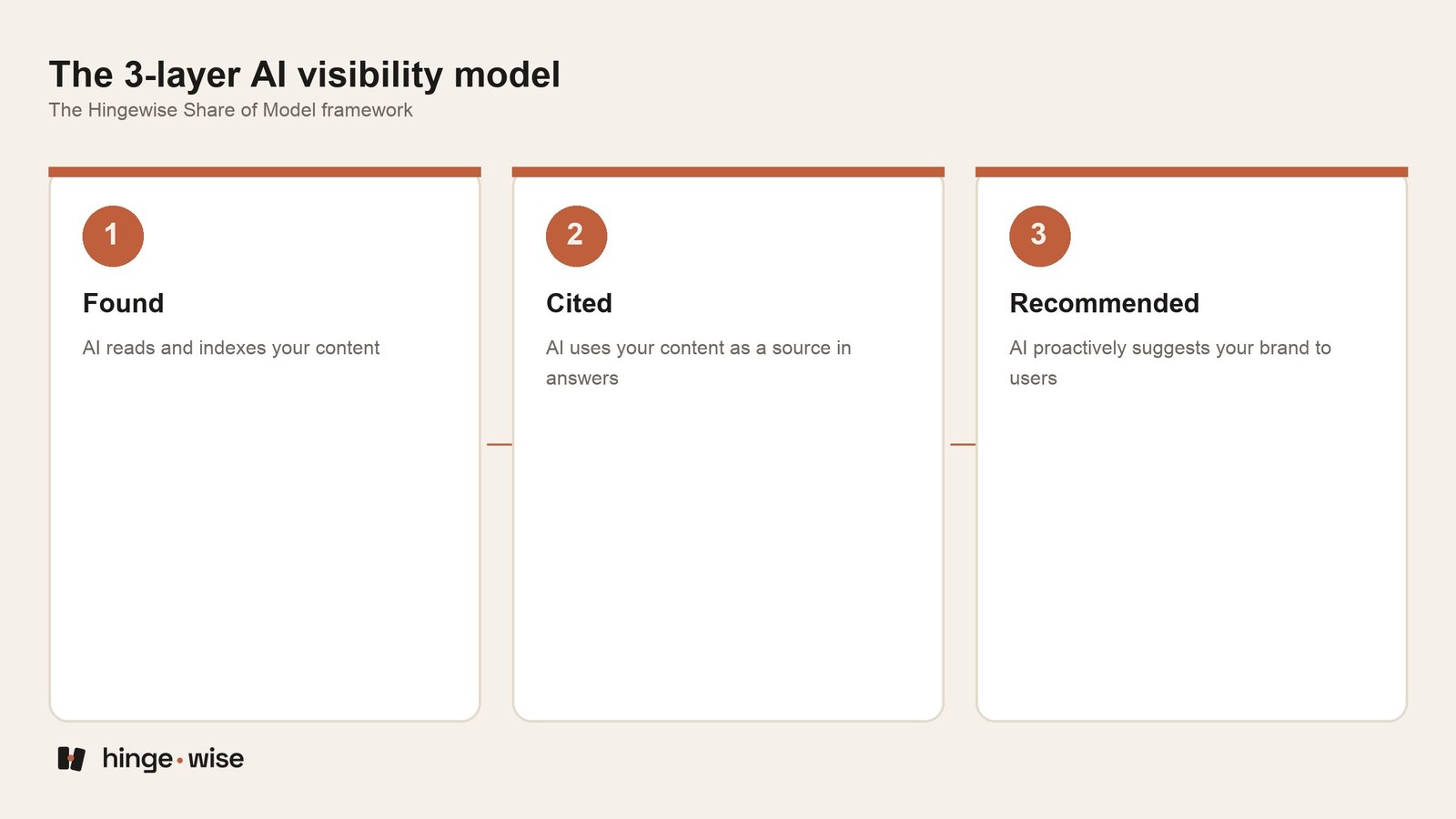
The 3-Layer Framework: Found, Cited, Recommended
Most brands that come to us are stuck at layer one. Getting unstuck requires understanding all three layers, and accepting that they are sequential. You cannot skip ahead.
| Layer | What It Means | How AI Systems Signal It | What Blocks It |
|---|---|---|---|
| Found | AI crawlers and knowledge pipelines know your brand exists | AI can answer basic factual questions about you accurately; your domain surfaces in source lists | Thin content, poor technical indexability, contradictory entity signals across the web |
| Cited | AI systems pull your content as a source when relevant queries appear | Perplexity links your URL; ChatGPT Search references your page; AI Overviews feature your text | Content lacks self-contained answers, no structured data, no credible sourcing within the page |
| Recommended | AI systems proactively name your brand in response to non-branded queries | ChatGPT says “you might want to look at [your brand]” without the user asking about you specifically | Weak or inconsistent brand entity, low E-E-A-T signals, no third-party coverage AI systems trust |
Most GEO content advice focuses on layer 2. That makes sense because citations are measurable and content-driven. But layer 3 is where the real commercial value sits.
When Perplexity recommends a product unprompted, that is not an SEO click. It is a trusted referral from an AI system the user already believes. I will be honest: we do not have a published study on conversion rates from layer 3 referrals yet. But the pattern we observe across clients is consistent enough that we treat “recommended” as the primary objective, not a stretch goal.
Share of Model: The Metric That Actually Matters for AI Visibility
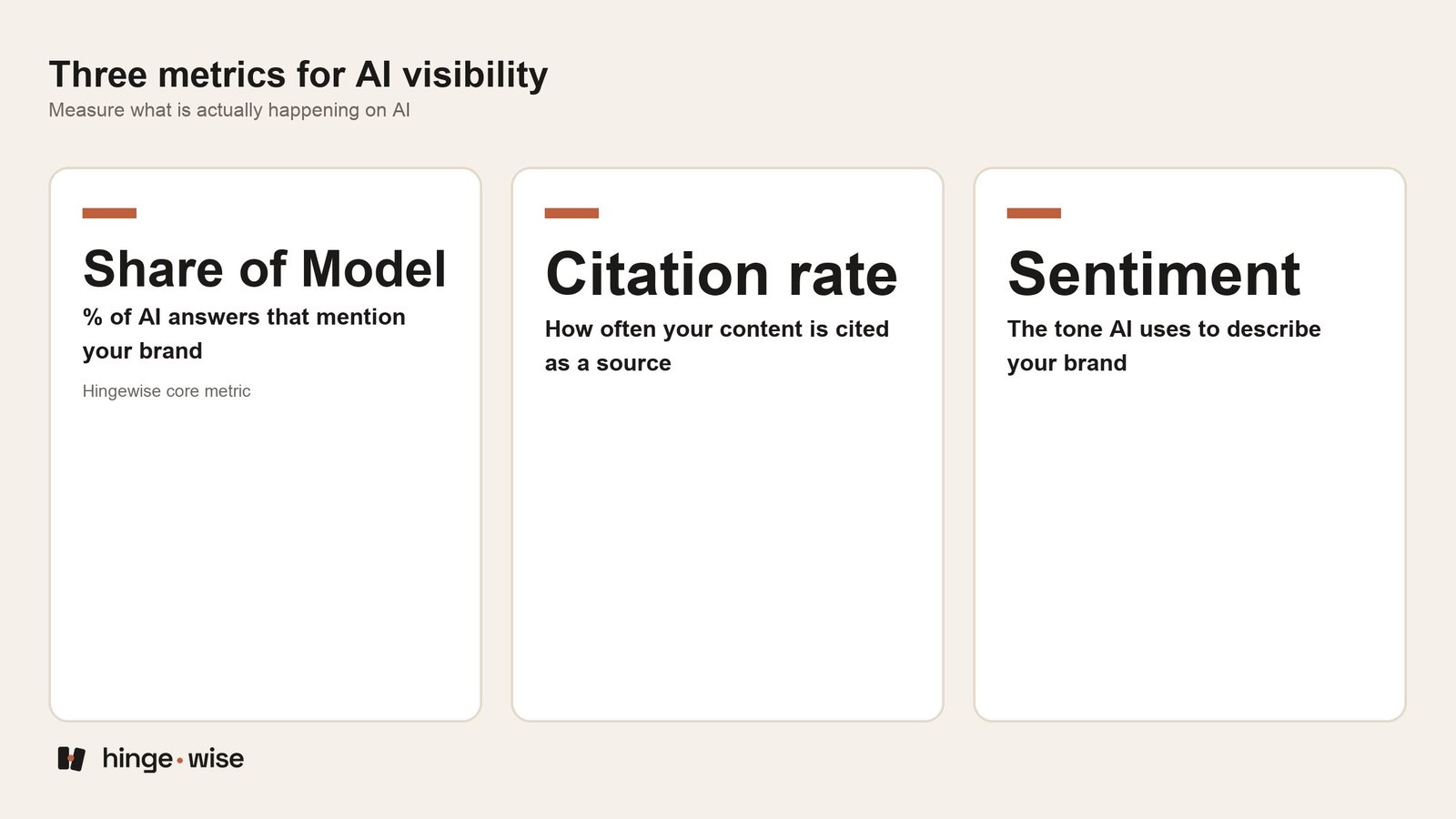
Share of Model is Hingewise’s core measurement concept. It tracks what percentage of relevant AI responses, across a defined set of test queries, mention, cite, or recommend your brand versus competitors.
Traditional SEO gives you Share of Voice in search results. Share of Model gives you Share of Voice in AI responses. They correlate in some areas and diverge sharply in others. The divergence is where the opportunity is.
Here is the concrete process. We define a query set, typically 30 to 60 questions a target buyer would actually type into an AI system. Then we run those queries across ChatGPT search, Perplexity, Google AI Overviews, and Gemini, recording which brands appear and in what role (cited, recommended, or mentioned in passing). We aggregate that into a Share of Model score by brand and by layer.
Two mistakes people make when they try to build this themselves.
First: using ChatGPT’s standard chat mode instead of ChatGPT search with web browsing enabled. The two give fundamentally different answers. Standard mode pulls from training data. Search mode pulls live from the web. If you are measuring current AI search visibility, you need web-grounded outputs. Training snapshots tell you about the past, not today.
Second: running the queries once and calling it a baseline. AI responses vary across sessions. Run the same query three times in Perplexity and you will often get three different citation sets. The only reliable baseline comes from running each query multiple times and averaging the results. Single-run snapshots are noise.
Grounded Measurement and Why Human QC Cannot Be Skipped
Here is something the automated AI visibility tools will not tell you: they are directionally useful and directionally wrong about 20 to 30 percent of the time, based on what we see when we cross-check their outputs manually.
The tools scrape AI responses and parse which brand names appear. That works for clear citations. It falls apart when AI systems paraphrase a brand name, describe a product without naming it, or bundle you into a category mention (“tools like X and similar platforms”). Automated parsing misses these cases. Human review catches them.
At Hingewise, every Share of Model audit includes a human-QC pass on the raw AI responses. Our reviewers are not just counting mentions. They are reading context. Was it a positive frame or a hedge? Was your brand the primary recommendation or one of six alternatives with no differentiation? That qualitative layer changes how we interpret the numbers and what we recommend next.
This is slower and more expensive than running an API loop. It is also the only way to produce numbers you can actually act on without second-guessing them a week later.
What the Hingewise AI Search Intelligence Process Looks Like End to End
When a new client starts with us, the first deliverable is always a GEO Snapshot: a baseline Share of Model audit across their 3 to 5 most important query clusters. This answers the core question before we do anything else. Where do you actually stand right now?
From there, the engagement moves through three phases.
Phase 1 is entity definition. Making sure AI systems can answer basic factual questions about the brand accurately. What does this company do? Who founded it? What problems do they solve and for whom? Gaps here block everything downstream. We have seen brands with excellent content still get misrepresented by AI because their entity signals were contradictory across sources, or because no credible third party had written about them in terms AI systems could parse.
Phase 2 is content architecture for AI citation. Restructuring or creating content so that key pages function as self-contained answers. This is the GEO work most people have heard about. Answer-first structure, structured data, authoritative sourcing, quotable sentences that AI systems can lift without losing meaning. According to the original GEO paper, adding statistics with citations and including quotable sentences from authoritative sources were among the highest-impact content interventions tested (arxiv.org, 2023).
Phase 3 is recommendation signal building. This is layer 3 work, and it takes longer. Getting your brand consistently named in AI responses requires multiple authoritative sources describing you in consistent terms. That means earned coverage in publications AI systems treat as credible, consistent brand language across your own content and third-party mentions, and E-E-A-T signals tied to real individuals, not just the company name.
The measurement cycle runs monthly. Share of Model scores, layer breakdown, query-level analysis. We track movement, not just current state. A brand that moves from 0% to 12% cited in 60 days is doing something very different from a brand that has been at 15% for six months with no upward trend. Both need different next steps.
If you want to see where your brand actually stands before committing to any of this work, the GEO Snapshot is designed for exactly that. It is a bounded, methodical audit: real AI query testing across the four major platforms, human-reviewed outputs, a Share of Model baseline, and a prioritized gap list organized by layer. No retainer required to get started.
See the numbers first. Then decide what to do about them.
- AI search intelligence covers three sequential layers: being found by AI systems, being cited as a source, and being proactively recommended without a branded query.
- Share of Model measures your brand’s presence in AI-generated responses across ChatGPT, Perplexity, Gemini, and AI Overviews, not just traditional search rankings.
- Automated AI visibility tools miss 20 to 30 percent of relevant mentions; human QC on raw AI outputs is the only way to get numbers worth acting on.
- The highest-impact GEO content strategies per the original research are statistics with citations, self-contained quotable sentences, and authoritative sourcing, not keyword optimization.
- Entity definition (making sure AI can accurately describe your brand) must come before content optimization. Skipping it means your GEO work builds on an unstable foundation.
Frequently asked questions
What is AI search intelligence?
AI search intelligence is the discipline of understanding, improving, and measuring how AI systems like ChatGPT, Perplexity, Gemini, and Google AI Overviews perceive and represent your brand. It covers three layers: whether AI systems can find you, cite your content, and proactively recommend your brand in response to non-branded queries.
How is Share of Model different from traditional Share of Voice in SEO?
Share of Voice in SEO measures how often your brand appears in search engine results pages versus competitors. Share of Model measures how often AI systems mention, cite, or recommend your brand across a defined set of relevant queries. The two metrics correlate in some areas but diverge significantly in others, particularly for brands that publish GEO-optimized content.
What is the Hingewise 3-layer framework for AI search?
The Hingewise framework tracks three sequential layers of AI visibility: Found (AI systems know you exist and can describe you accurately), Cited (AI systems pull your content as a source in relevant responses), and Recommended (AI systems proactively name your brand without being asked about you specifically). Each layer requires different strategies and blocks progress to the next if unresolved.
Which AI platforms does Hingewise measure for Share of Model?
Hingewise runs Share of Model audits across ChatGPT search (with web browsing enabled, not standard chat mode), Perplexity, Google AI Overviews, and Gemini. Standard ChatGPT chat mode is excluded because it reflects training data rather than live web retrieval, which produces different and less current brand representations.
How does Hingewise’s GEO Snapshot work?
The GEO Snapshot is a baseline AI visibility audit covering your 3 to 5 most important query clusters. We define a test query set, run each query multiple times across the four major AI platforms, apply human QC to the raw responses, and produce a Share of Model score broken down by layer (found, cited, recommended) alongside a prioritized gap list. No retainer is required to commission it.
Is AI search intelligence relevant if my business already ranks well on Google?
Google rankings and AI visibility are different metrics that diverge in meaningful ways. Brands ranking on page 1 for target keywords can have near-zero Share of Model if their content lacks self-contained answer structure, authoritative sourcing, or consistent entity signals. Google’s own data shows AI Overview links generate more clicks than equivalent traditional listings, making AI visibility a distinct and increasingly important channel.
How we made this: AI helped with research and the first draft. Lam Nguyen chose the topic, edited the piece and checked the figures against their original sources before publishing. How we work: Editorial policy.