
The ROI of GEO is measured across four stages: AI visibility (how often your brand appears in ChatGPT, Perplexity, and Google AI Overviews), branded search traffic, inbound leads, and closed revenue. Tracking leading indicators early prevents overspending on visibility that never converts to pipeline.
Most GEO reports I’ve reviewed stop at one slide: “your brand appeared in ChatGPT eight times this week.” Clients nod. Then comes the question they always ask eventually.
“But are we making more money?”
Hard to answer without a real measurement system for the ROI of GEO.
The roi of geo isn’t untrackable. It requires thinking in four distinct layers instead of one, and being honest about what each layer actually tells you. The mistake that costs agencies credibility: presenting layer-one data as layer-four proof.
Why Your Current Analytics Miss Most of GEO’s Impact
Standard web analytics don’t capture GEO influence. GA4 has no “cited in AI Overview” attribution channel. Perplexity doesn’t pass referral data cleanly. ChatGPT Search, which launched with serious momentum in late 2024 and reached 900 million weekly active users by February 2026 (Wikipedia/OpenAI), routes clicks through its own interface. The result: GEO’s real impact appears in your data in disguise, making attribution nearly impossible without a deliberate multi-layer approach.
Google AI Overviews now reach billions of users monthly (Semrush, 2024). But even when AI Overviews cite your brand, many users don’t click through. They absorb the information, form an impression, and move on.
Here’s what actually happens next: someone reads a Perplexity answer that names your product. They close the tab. Three days later, they search your brand name directly. GA4 logs that as branded organic search. GEO gets zero credit.
Without a framework built to account for this gap, you’ll systematically undercount GEO’s contribution to revenue.
The Four-Layer GEO ROI Framework
The ROI of GEO framework has four layers: AI visibility (how often you’re cited), branded search (whether that awareness converts to search intent), qualified traffic (whether that traffic engages), and revenue (whether it converts). Each layer is a prerequisite for the next. A gap at any one layer explains exactly where the chain breaks.
Layer 1: AI Citation Share
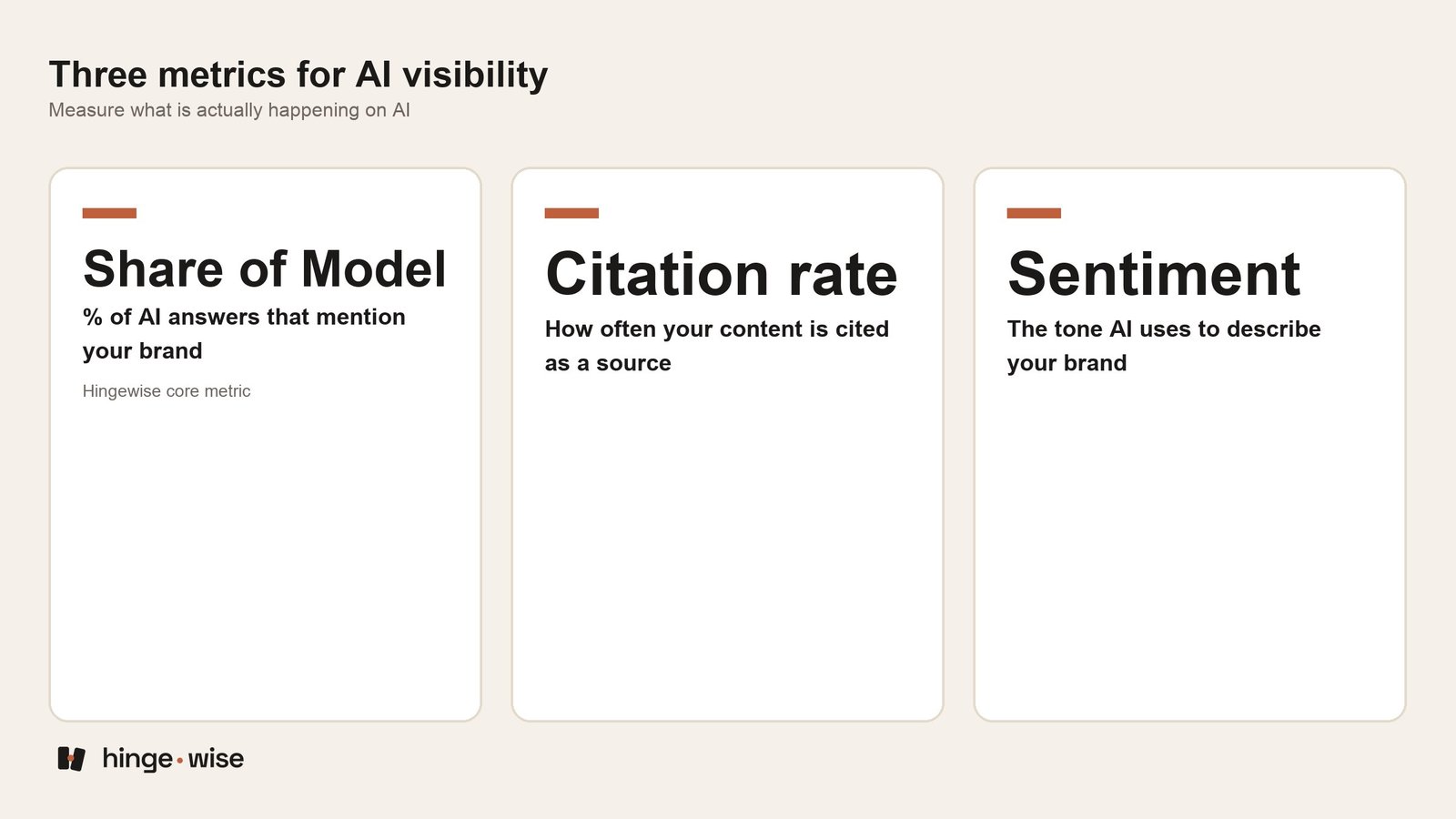
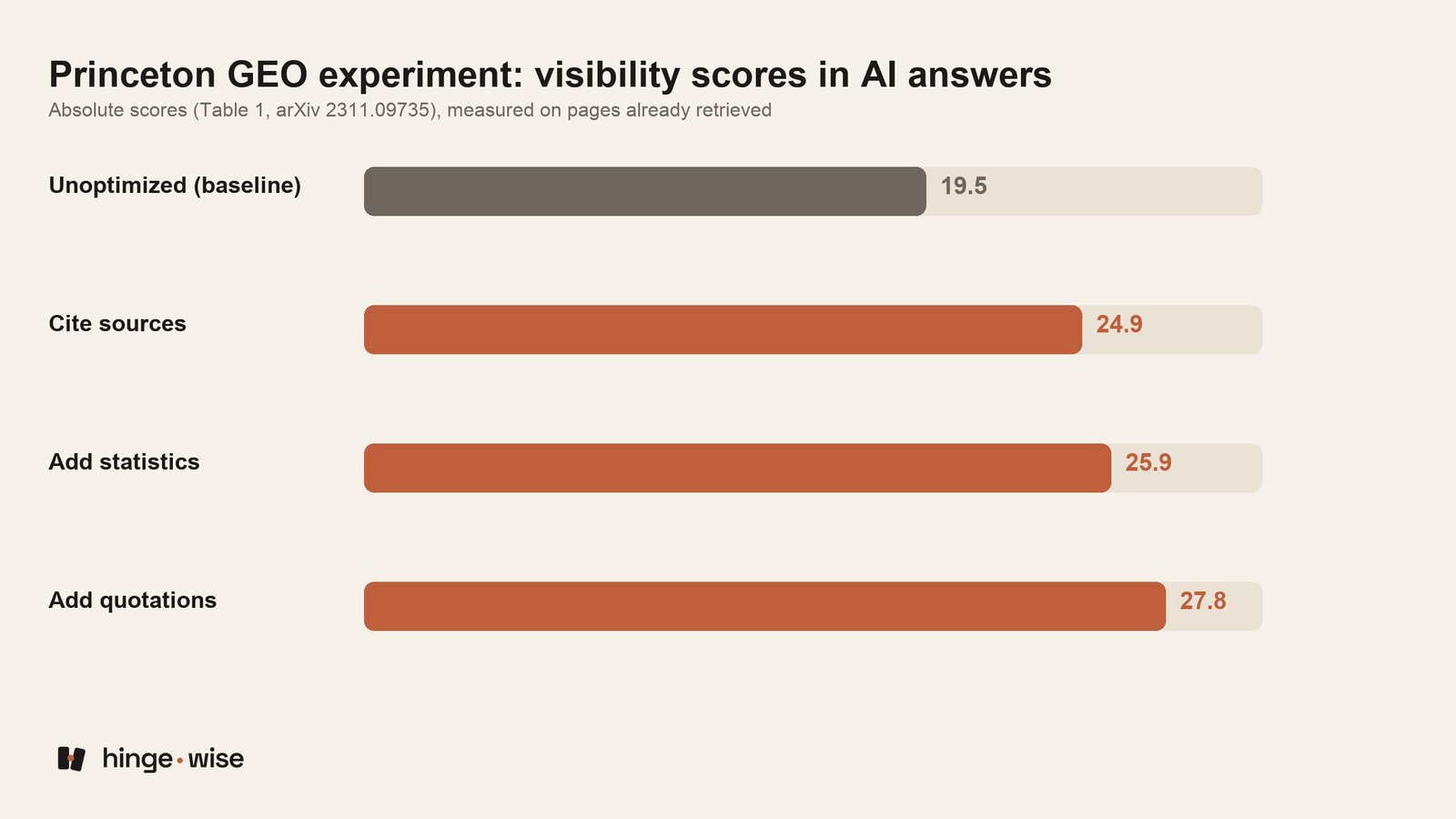
How often does your brand appear when relevant queries run through ChatGPT Search, Perplexity, Google AI Overviews, or Gemini? Track this with Semrush’s AI Toolkit, Otterly.ai, or manual weekly prompt audits. Research published on arxiv.org found GEO strategies can boost visibility in generative engine responses by up to 40%. Citation context also matters. Being cited positively (“Brand X is the standard for…”) carries different downstream value than a passing mention.
Layer 2: Branded Search Volume
AI mentions create brand awareness before they create clicks. The proxy signal is direct search for your brand name in Google Search Console. If citation share increases but branded search stays flat for 60-90 days, either the mentions aren’t memorable or the brand name is hard to recall and search. Both are solvable.
Layer 3: Qualified Traffic and Engagement
When traffic does arrive from AI referrers, are these the right visitors? Session depth, pages per session, and conversion rate tell you whether GEO is attracting high-intent visitors or curious ones. Tag AI referral sources in GA4 and compare their behavior to your overall traffic baseline.
Layer 4: Revenue and Pipeline
This closes the loop. Demo requests, sign-ups, purchases, closed deals traced back through the earlier layers. It requires attribution setup from day one. Retrofitting this after three months means losing months of clean data you can never recover.
Which GEO Metrics Are Leading Indicators (And Which Are Actually ROI)?
Leading indicators predict future outcomes but don’t prove current revenue impact. Lagging indicators confirm results but arrive months later. In GEO, AI citation share and branded search volume are leading indicators, useful for diagnosing whether the strategy is working but not evidence that revenue is being generated. Conflating them is the most common GEO reporting mistake, and the fastest way to lose client trust when the quarterly revenue review comes around.
| Layer | Metric | Indicator Type | Expected Timeframe |
|---|---|---|---|
| 1, AI Visibility | Citation share, AI mention frequency, AI share of voice | Leading | Weeks after optimization |
| 2, Branded Search | Brand keyword volume (Google Search Console, Semrush) | Leading | 1–3 months |
| 3, Traffic Quality | AI referral engagement, session depth, conversion rate | Bridge | 2–4 months |
| 4, Revenue | Leads, pipeline, closed deals from GEO-influenced paths | Lagging | 3–6+ months |
The table also shows why patience matters. Layer 4 is months behind Layer 1. Reporting only citation share in month two and calling it “ROI” sets up a credibility problem when the quarterly review arrives.
The “Mentioned But Not Making Money” Warning
High AI citation share does not automatically produce revenue. Appearing frequently in Perplexity for “best project management software” is valuable only if the chain below it is working: branded search responding, traffic converting, pipeline building. Without that chain, you’re accumulating visibility that isn’t being monetized. This is the core GEO vanity metric trap.
Not all query types convert at the same rate. Being cited for informational queries (“what is [your category]?”) builds brand awareness over time. Being cited for comparison queries (“best [your category] for [use case]”) drives more direct purchase intent. Both matter, but they produce revenue through different paths and on different timelines.
I’ve seen GEO campaigns stall at Layer 1 for months while the conversion funnel below wasn’t set up to capture the downstream benefit. Being cited isn’t the finish line. It’s the starting gun.
The diagnostic: if Layer 1 is improving but branded search isn’t moving after 90 days, the problem isn’t your GEO strategy. The problem is either brand recall or query intent alignment. Fix the right thing.
How to Track This Without Enterprise-Level Tooling
You don’t need an enterprise analytics stack to measure the ROI of GEO. Manual prompt auditing in ChatGPT Search and Perplexity, Google Search Console for branded volume, GA4 for AI referral behavior, and a CRM with first-touch attribution covers all four layers. The discipline is weekly consistency, not expensive software.
Layer 1 is the manual work: run weekly prompt audits across 10-15 target queries in ChatGPT (web search mode on), Perplexity, and Google AI Overviews. Log whether your brand appears, where in the response, and what context surrounds the mention. Track share of voice as your brand mentions divided by total mentions across all tested prompts.
For branded search (Layer 2): filter Google Search Console by brand-name queries, track month-over-month, and compare the trend line before and after GEO work started. Semrush fills in longer historical volume context.
In GA4, build a segment for sessions originating from AI referrers (perplexity.ai, chatgpt.com, gemini.google.com) and compare engagement metrics to your overall site baseline. Imperfect, but directionally useful.
Revenue attribution (Layer 4): check your CRM for upticks in “direct” and “branded search” leads since GEO began. Add “how did you first hear about us?” to lead forms. An uptick in brand-recognition answers is a GEO signal you can actually show a client. A practical read: if branded organic and direct leads increase by 15-20% in month four while AI citation share grew in months one through three, that correlation is your attribution story. Not proof of causation, but strong enough to justify the program.
What a Realistic GEO ROI Timeline Looks Like
A realistic GEO ROI timeline for B2B runs four to six months before revenue attribution becomes defensible. Months 1-2 move Layer 1 metrics. Months 3-4 show branded search response. Month 5-6 builds qualified pipeline. Expecting revenue impact in month two is not a GEO failure. It’s a timeline expectation mismatch.
- Months 1-2: Citation share increases as content and authority improvements take effect. No expected revenue impact at this stage.
- Month 3: Branded search volume begins responding, especially if Perplexity and Google AI Overviews are surfacing the brand consistently for high-intent queries.
- Months 4-5: Qualified traffic from AI referral sources builds. Pipeline starts filling if the product and conversion path are working.
- Month 6 onward: Revenue attribution becomes defensible. The chain from AI visibility to revenue is traceable, provided tracking was set up from day one.
Consumer brands with shorter consideration cycles may see Layer 4 impact in month three. A SaaS company with a six-month average sales cycle should plan accordingly.
Honestly, I don’t think there’s a universal timeline answer yet. GEO is young enough that every industry is still writing its own curve. Track the layers, adjust expectations based on what you actually observe at each stage, and resist the pressure to call month-one citation share “ROI.” That’s how you stay credible with clients long enough to demonstrate real impact.
- The ROI of GEO moves through four stages: AI visibility, branded search uplift, site traffic, and leads or revenue. Breaking down which stage is underperforming tells you exactly where to fix the program.
- High AI mention rates do not guarantee revenue. Query targeting matters as much as optimization tactics. Make sure the queries where you appear match actual buyer intent.
- Track leading indicators (AI mention rate, branded search volume) every two weeks in the first quarter so you catch conversion problems early, before months of budget are spent.
- The most practical revenue attribution method is branded search lift: measure the baseline, track the uplift, multiply by conversion rate and deal value.
- A GEO ROI program needs a Month 0 baseline before optimization starts. Without it, you cannot prove whether results came from GEO or something else.
Frequently asked questions
What is the ROI of GEO and how is it different from SEO ROI?
The ROI of GEO measures how generative engine optimization investments convert into business outcomes, specifically through AI citations driving branded search, traffic, and eventual revenue. Unlike SEO ROI, which tracks rank positions and GSC clicks directly, GEO ROI works through indirect influence and requires proxy metrics like branded search lift to attribute value.
How do I know if my brand is appearing in ChatGPT or Perplexity?
Manually test 30 to 50 queries your buyers actually ask before purchasing, using ChatGPT Search, Perplexity, and Google AI Overviews. Tools like Semrush’s AI Toolkit and Otterly.ai automate this tracking at scale, showing your mention rate across a defined query set over time and alerting you when competitors displace you.
How long does it take to see measurable ROI from GEO?
AI visibility improvements typically show within two to four weeks of publishing optimized content. Branded search lift follows within four to eight weeks. Revenue attribution, which depends on your sales cycle length, usually becomes trackable between three and six months after starting. Do not evaluate GEO performance before the three-month mark.
Can AI search platforms send direct traffic to my website?
Yes, but inconsistently across platforms. Perplexity and ChatGPT Search cite sources with clickable links that appear in GA4 as chatgpt.com and perplexity.ai referral sessions. Google AI Overviews sometimes link out but often synthesize without attribution links. Track each platform as a separate source segment in GA4 for an accurate picture.
Why might a brand with high AI visibility still have flat revenue?
Usually a query targeting problem. If you appear in AI responses for informational queries (research, definitions, comparisons) rather than commercial-intent queries (best options, pricing, reviews before buying), the visitors arriving have no purchase intent. Audit which queries you appear for, then compare them against your actual buyer journey to identify the mismatch.
Is the ROI of GEO better or worse than paid search ROI?
Too early to say definitively across industries. What the data does show: branded visitors, often driven by GEO brand awareness, convert at higher rates than non-branded paid visitors because they arrive with prior familiarity. Once GEO content compounds over six-plus months, the cost per influenced lead tends to fall below equivalent paid brand campaigns. Attribution remains the ongoing challenge.
Want to see how your brand shows up across AI? Get a free GEO Snapshot.
How we made this: AI helped with research and the first draft. Lam Nguyen chose the topic, edited the piece and checked the figures against their original sources before publishing. How we work: Editorial policy.