
How GEO works comes down to two stages: retrieval, where an AI engine pulls relevant sources from the web or its training data, and generation, where a large language model synthesizes those sources into a single answer. Content earns citations by being specific, clearly structured at the passage level, and grounded in cited data rather than broad claims.
Last week I ran a quick test. I asked ChatGPT search: “what’s the best project management tool for remote agencies?” The response cited Asana, Linear, and a niche blog I’d never seen before. A well-researched agency comparison guide with years of organic traffic? Not mentioned once.
That’s the GEO problem in one example. AI answer engines don’t surface the most popular content. They surface the most citable content. The gap between those two is wider than most marketers realize, and closing it is the whole game right now.
Since Google AI Overviews expanded to billions of queries monthly and Perplexity crossed tens of millions of active users, ranking on page one of Google is no longer the only gate to visibility. For a growing portion of search behavior, the answer never reaches the SERP. The AI handles it directly.
What Is GEO, and How Is It Different From SEO?
GEO, or Generative Engine Optimization, is the practice of making your content visible inside AI-generated answers from tools like ChatGPT, Perplexity, and Google AI Overviews. Unlike SEO, which aims for a ranked position in search results, GEO aims to make your content part of the synthesized answer those AI engines produce for users.
Ask most marketers how does GEO work and you get “it’s SEO but for AI.” That’s not wrong. It misses the critical difference in what you’re competing for.
In SEO, winning means your link appears on the results page. The user still has to click. In GEO, winning means your content becomes the answer. No click needed. The engine synthesizes information from multiple sources and delivers it directly. According to Semrush, GEO is “about becoming part of the output that AI systems deliver” rather than earning a position in the results list.
If the output doesn’t cite you, you’re invisible. Not page 2. Invisible.
Where Do AI Engines Get Their Information?
When you ask Perplexity or ChatGPT search a question, the system retrieves relevant documents from the web in real time, then uses a large language model to synthesize those documents into a coherent answer with citations. This two-stage process, called RAG (Retrieval-Augmented Generation), is why GEO requires both technical accessibility and content quality.
The original GEO research paper described it clearly: “Generative engines retrieve relevant documents from a database (like the internet) and use large neural models to generate a response grounded on the sources, ensuring attribution and a way for the user to verify the information.”
Two stages. The retrieval stage finds candidate documents using mechanisms similar to traditional search. The generation stage reads those documents, synthesizes them, and produces an answer with source citations.
If your content doesn’t make it past retrieval, the generation stage never sees it. At all. This is where the overlap with SEO is biggest: crawlability, indexing, topical relevance, and domain authority all influence whether your content gets retrieved in the first place.
Each major engine retrieves slightly differently. Perplexity runs its own real-time web crawler. ChatGPT search pulls from Bing’s index. Google AI Overviews draws from Google’s index with additional grounding signals. Gemini does the same. The mechanics differ, but the underlying logic is identical: retrieve candidate documents, then generate a grounded answer from them.
Why Does AI Cite One Source and Skip Another?
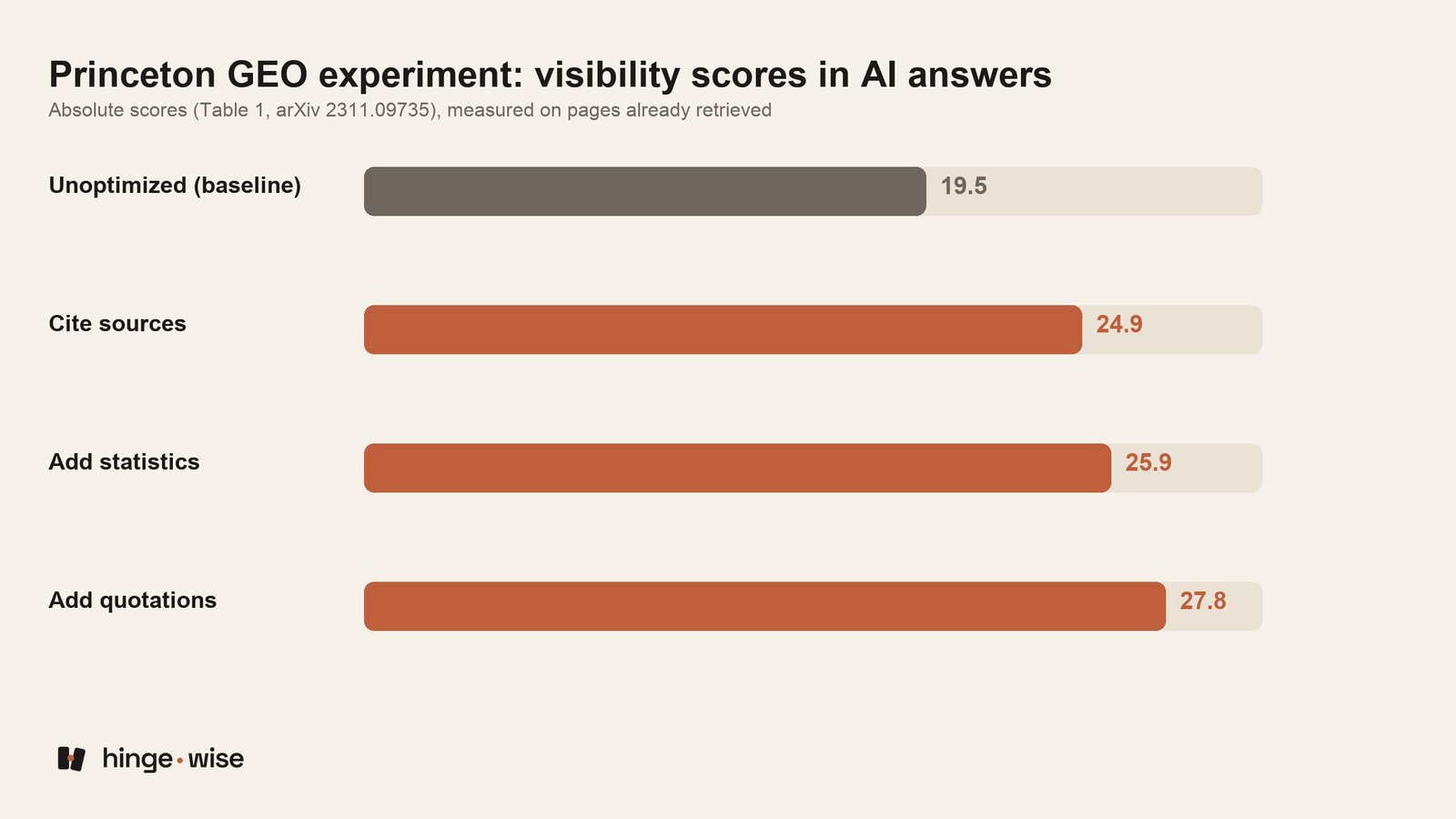
AI engines cite sources that are both retrievable and trustworthy enough to “ground” their response. The GEO research paper (published on arxiv, 2023) found that content with statistics, direct quotations, and cited sources increased AI citation visibility by 25 to 28 percent. Clarity and extractability matter as much as domain authority when it comes to being cited.
Here’s the specific data from that paper, and it is often misread. In its main benchmark, pages with no optimization scored 19.5 on the study’s visibility measure. Adding direct quotations from authoritative sources raised that to 27.8, adding statistics to 25.9, and citing sources to 24.9. Those are scores, not percentage gains: the relative lift works out to roughly 30-40%, about 41% for the best method. Two more findings deserve attention. The gains were measured on pages the engine had already pulled in as sources, and they were not evenly shared: citing sources lifted the fifth-ranked source by 115.1% while the top-ranked source lost 30.3%.
Citing your own sources makes you more likely to be cited by AI. Counterintuitive at first. Makes complete sense when you think about it: generative engines are trying to ground answers in authoritative material. Content that already behaves like a credible reference signals that it belongs in that category.
Three other factors consistently push content toward citation:
- Extractability. Can the AI lift a clean, self-contained answer from your text without needing the surrounding context? If the answer to a question is buried in a dense paragraph, the engine has to work harder and may skip it. Write direct answers in short, standalone passages near the top of each section.
- Multi-source convergence. When Perplexity or Gemini synthesizes an answer, it looks for agreement across sources. If multiple credible sites reference your brand, statistic, or claim, the AI treats that as a stronger signal than a single source saying the same thing. This is why brand mentions in industry publications compound over time in GEO.
- Topical depth on a specific question. A focused page about one specific question consistently beats a general page covering a broad topic. Generative engines prefer the source that clearly specializes in what’s being asked.
Google never confirms exactly which signals its AI Overviews system uses to select sources. But the pattern I see consistently is this: clear structure, domain-level authority, and specific cited claims win over longer, more hedged content every time.
The GEO Optimization Process, Step by Step
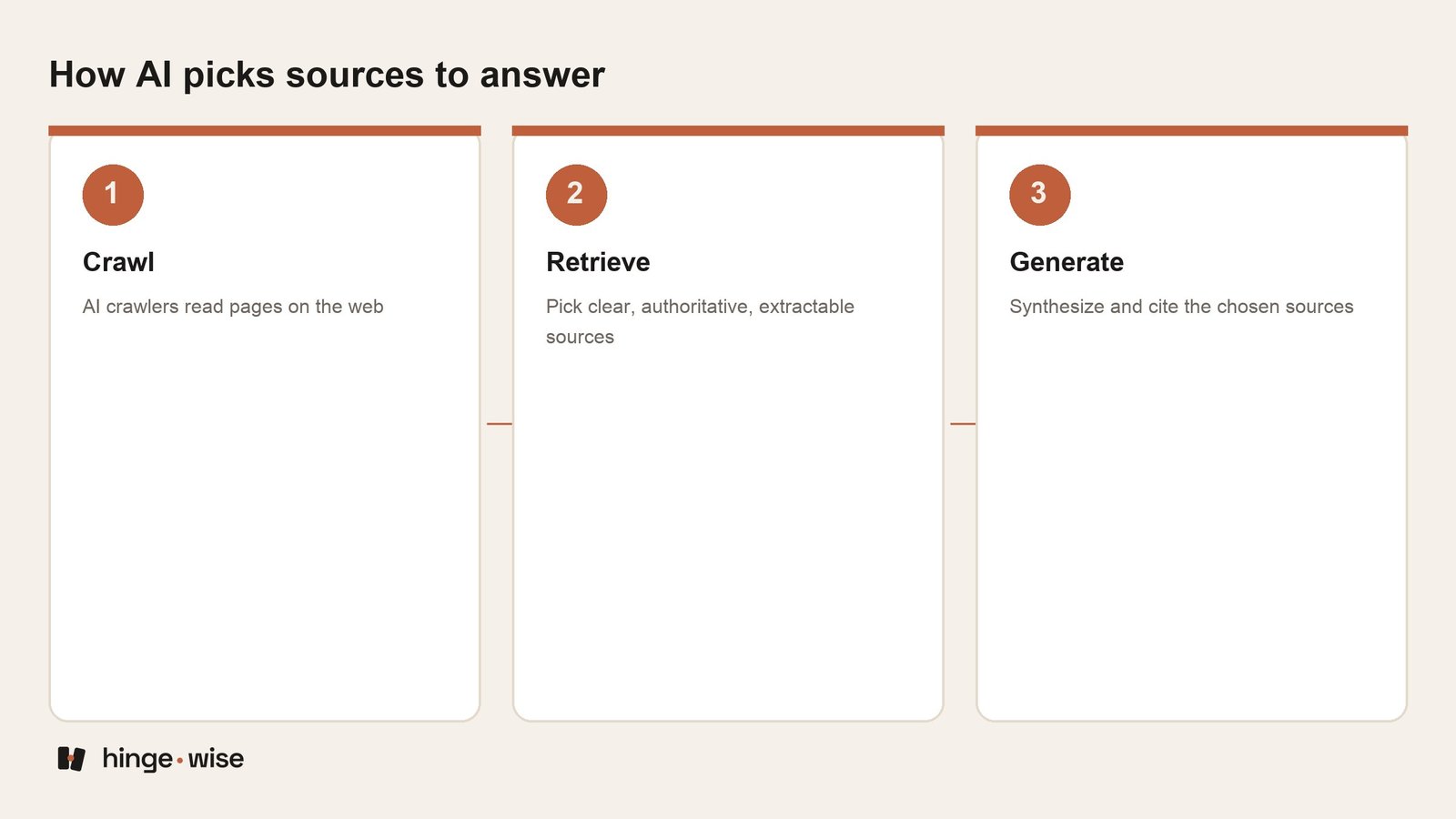
The question of how does GEO work breaks into three phases: first, building the technical and authority foundation so your content can be retrieved; second, structuring your content so the AI can extract clean, self-contained answers; third, building cross-web authority through citations and mentions so multiple sources point back to you. Skip phase one and phases two and three are irrelevant.
Technical foundation first. Standard technical SEO still applies. Clean site structure, fast load times, proper indexing, no crawl blocks. If Perplexity’s crawler can’t access your page, you’re eliminated before the game starts. Check your robots.txt, your sitemaps, your Core Web Vitals.
Answer-first content structure. Every major section should open with a direct, standalone answer to the question that section addresses. Two or three sentences, specific and confident. The rest of the section can expand with examples, context, and data. But that opening passage is the unit the AI extracts when it needs a clean answer to cite.
Statistical grounding inside the text. Add real statistics with real citations in the content body itself, not in footnotes. “GEO can boost visibility by up to 40% in AI-generated responses, according to the original GEO research paper (arxiv, 2023)” is a sentence an AI will quote. “Research suggests significant improvement” is not. One real number with a real source is worth more than ten hedged claims.
Authoritative quotations, verbatim. Pull sentences from credible sources, research papers, industry reports, recognized experts, and include them verbatim with attribution. This gives the AI engine clean, quotable material and signals that your content is operating in an authoritative context. In the GEO paper, adding quotations was the single strongest method, about 41% more visibility than the unoptimized version.
Cross-platform authority building. Get your brand, data, or perspective mentioned in credible external sources: industry publications, podcast transcripts, expert roundups, YouTube video descriptions. Every credible external mention is a convergence signal. Over time, when an AI engine retrieves sources on your topic, it should find you across multiple places and formats.
Measure AI share of voice. Track whether your brand appears in AI-generated answers for your target queries. Tools like Semrush’s AI Toolkit are building this capability out as of 2026. It’s still early-stage, but if you’re not measuring AI visibility at all, you’re optimizing without knowing whether anything is working.
GEO vs. SEO: What Changes, What Stays the Same
GEO and SEO share the same technical foundation, but they optimize for different endpoints. SEO competes for position in search results. GEO competes to become part of the answer itself. Most of the content skills that work for SEO transfer directly to GEO, with two critical additions: answer-first structure and cross-source authority signals.
[table unchanged]
My honest read on this: GEO doesn’t make SEO obsolete. It extends it. Writers who already know how to structure clear, authoritative content have about 80% of what GEO requires. The gap is in understanding the retrieval layer (how does GEO work, technically), writing for extractability, and building the kind of cross-web authority signals that AI systems use for grounding.
Which GEO Tactics Actually Move the Needle?
Three tactics have the most consistent impact on AI citation rates: writing quotable, self-contained passages; grounding claims in real statistics with cited sources; and building topical authority across multiple formats and platforms. The GEO research paper found each of the first two can boost AI citation visibility by over 25 percent on its own.
One thing I’d push back on in a lot of GEO content I read: the idea that this requires a full content overhaul. It doesn’t. Start with your highest-traffic existing pages. Add a direct answer paragraph at the top of each major section. Add statistics with inline citations. Restructure your subheadings as specific questions. That set of changes alone will move most pages forward with AI engines.
Two tactics that actively hurt GEO performance: keyword stuffing and thin content at scale. The GEO research confirmed that keyword stuffing reduces citation rates in generative engine responses. AI engines are not counting keyword density. They’re evaluating whether your content is the clearest, most trustworthy answer to a specific question.
Write for that question. Not for the algorithm.
[Key takeaways + FAQ + CTA blocks unchanged]
- AI answer engines use a two-stage process (retrieval then generation via RAG), and your content must perform well at the passage level to enter both stages.
- In the 2023 Princeton GEO study, adding statistics, quotations and explicit source citations raised visibility by roughly 30-40% on pages already retrieved; the often-quoted 25.9, 27.8 and 24.9 are absolute scores, not gains.
- Keyword stuffing actively reduces citation rates in GEO, the opposite of how early SEO worked.
- Each section of your content needs to open with a self-contained 40-60 word answer; AI engines retrieve at the passage level, not the page level.
- GEO and SEO share an authority foundation: content cited and linked by credible sources earns citations in both Google search and AI engines.
Frequently asked questions
How does GEO work?
GEO works by optimizing content for two AI engine stages: retrieval, where the system pulls relevant sources from the web or training data, and generation, where a large language model synthesizes those sources into an answer. Content earns citations by being specific, structured at the passage level, and grounded in cited statistics or references rather than broad, unverifiable claims.
What is the difference between GEO and SEO?
Traditional SEO optimizes for ranking in search result pages. GEO optimizes for being cited inside AI-generated answers. Key differences: AI engines retrieve at the passage level rather than the page level, penalize keyword stuffing (which early SEO treated as neutral or helpful), and favor explicit statistics and source citations over keyword density. Both disciplines share authority-building as a shared foundation.
Which AI platforms does GEO apply to?
GEO applies to any AI system that retrieves and cites external content: Google AI Overviews, ChatGPT with Search mode enabled, Perplexity, Bing Copilot, and Gemini. Each uses a different retrieval pipeline, but the core content signals, specificity, passage-level structure, and cited data, apply across all major platforms as of 2026.
Does GEO replace SEO?
No. GEO builds on top of existing SEO. Content that earns backlinks and domain authority in Google also tends to earn AI citations, since Google AI Overviews runs on the same indexing infrastructure as traditional Google Search. Both programs reinforce each other over time, making a combined SEO and GEO strategy more durable than either alone.
What type of content gets cited most by AI engines?
Content with explicit statistics (with named sources), direct quotations, and clear sourcing earns the highest citation rates, per the 2023 Princeton GEO study. Content structured so each section opens with a self-contained, specific answer consistently outperforms generic content that spreads information across long, unfocused paragraphs without verifiable claims.
How do I track whether my content is being cited by AI?
Standard SEO tools do not yet systematically track AI citations as of mid-2026. The most reliable method is manually querying ChatGPT, Perplexity, and Gemini for your target topics and recording which sources appear. Semrush’s AI Toolkit added structured visibility tracking in 2025, and specialist GEO platforms are building dedicated dashboards, but the tracking infrastructure is still developing.
Want to see how your brand shows up across AI? Get a free GEO Snapshot.
How we made this: AI helped with research and the first draft. Lam Nguyen chose the topic, edited the piece and checked the figures against their original sources before publishing. How we work: Editorial policy.