
An AI SEO agency optimizes your brand’s presence across both traditional search rankings and AI-generated answers from ChatGPT, Perplexity, and Google AI Overviews. Unlike a conventional agency, they apply GEO (generative engine optimization) to make your content citable, extractable, and visible where your customers are actually searching today.
Most agencies pitching “AI SEO” are running the same playbook they used in 2020. Keyword research, backlinks, monthly reports with green arrows. Your competitors are being cited inside ChatGPT and Perplexity while you’re optimizing for a search experience that’s quietly shrinking. The rebrand is just marketing.
Something real has shifted. Google’s AI Overviews now reach billions of users each month, according to Semrush. ChatGPT hit 100 million users faster than any app in history. Perplexity is the default research tool for a growing share of professionals who used to start on Google. These platforms don’t return a list of blue links. They generate answers, and they cite specific brands while doing it.
If your agency isn’t optimizing for that, they’re optimizing for yesterday.
What Does an AI SEO Agency Actually Do?
An AI SEO agency works two parallel tracks: keeping your brand visible in traditional search results while building the signals that get you cited inside AI-generated answers. The first track most agencies can handle. The second track is newer, less understood, and where most self-proclaimed AI SEO agencies fall flat.
On the traditional side, you still need solid technical SEO, quality content, and authority backlinks. That hasn’t changed. What has changed is the layer on top: your content now needs to be written and structured so that AI systems can extract clean answers from it, quote it accurately, and surface it to users asking relevant questions.
A real ai seo agency delivers:
- Content audited for “extractability”: can Perplexity or Google AI Overviews pull a clean, accurate answer from your page?
- Answer-first page structures, opening with direct responses to target queries (the format AI Overviews consistently pull from)
- Entity authority building: making sure Google’s knowledge graph and AI systems recognize your brand as a credible source in your niche
- AI citation tracking: how often ChatGPT, Perplexity, or Gemini mention your brand when users ask relevant questions
- Competitor AI share of voice monitoring, something traditional monthly reports still almost never include
The research is clear on this. A study published on arXiv (2311.09735) by researchers studying generative engine optimization found that GEO techniques can boost content visibility in AI-generated responses by up to 40%. The same paper showed that adding statistics, authoritative citations, and quotable language to content consistently lifted AI citation rates across domains.
How Is an AI SEO Agency Different from a Traditional One?
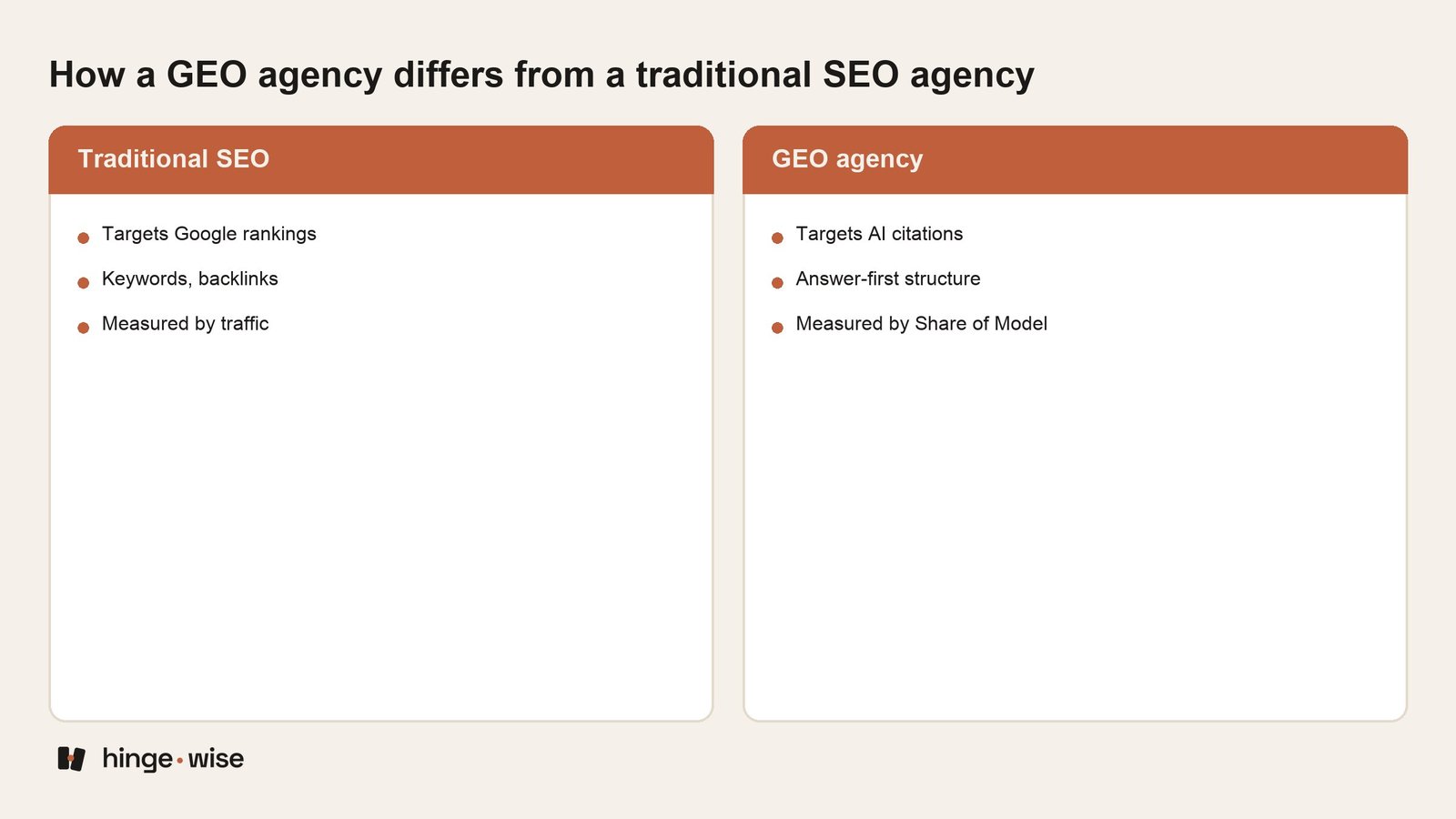
The clearest way to see the gap: look at what each agency measures as success.
A traditional SEO agency reports keyword rankings, organic traffic, domain authority, and links acquired. An AI SEO agency reports all of that, plus AI citations, AI share of voice, and answer-box capture rates across ChatGPT, Perplexity, and Google AI Overviews.
| Area | Traditional SEO Agency | AI SEO Agency |
|---|---|---|
| Primary goal | Rank on page 1 of Google | Rank AND get cited in AI-generated answers |
| Content strategy | Keyword-focused, long-form articles | Answer-first, extractable, quotable passages |
| Key metrics | Rankings, traffic, backlinks | Rankings + AI citations + AI share of voice |
| Technical work | Crawlability, page speed, basic schema | Same + entity optimization, structured data for AI |
| Reporting tools | Google Search Console, Ahrefs, Semrush | Same + Semrush AI Toolkit, cross-platform AI brand monitoring |
| Platforms tracked | Google, Bing | Google, Bing, ChatGPT, Perplexity, Gemini, Claude |
I’ll be direct: most agencies advertising AI SEO today belong in the left column. The right column requires a genuinely different skill set, including understanding how large language models weight sources, how Google’s AI Overviews select citations as of mid-2026, and how to structure content so it works for both human readers and machine extraction.
5 Criteria That Separate Real AI SEO Agencies from Rebranders
Choosing an AI SEO agency right now is genuinely hard. Google doesn’t publish its exact AI Overview citation algorithm. Nobody does. But based on auditing dozens of sites and watching what gets cited across ChatGPT and Perplexity, here’s what separates the serious shops from the noise:
| Criterion | What Good Looks Like | What to Avoid |
|---|---|---|
| Measurement | Tracks AI citations and AI share of voice, not just rankings | Monthly report is a keyword position PDF and nothing else |
| Content approach | Writes answer-first pages with clear, quotable, self-contained passages | Churns out keyword-stuffed long-form with no extractable structure |
| Technical depth | Implements structured data, FAQ schema, entity signals | Fixes meta tags, calls it technical SEO |
| Platform coverage | Optimizes for ChatGPT, Perplexity, Gemini, and Google AI Overviews | Google-only. Never mentions the other platforms. |
| Own results | Agency’s own brand appears in AI answers about their industry | Ask ChatGPT about their niche and they’re invisible |
That last one is underrated. If an agency pitching you AI visibility optimization doesn’t show up when you type their category into ChatGPT or Perplexity, ask them why. The answer tells you a lot.
Red Flags to Watch For Before You Sign
These come up in almost every bad engagement:
They guarantee AI rankings. No one can guarantee placement in AI Overviews or ChatGPT responses. The systems are probabilistic, change frequently, and are not transparent about their citation logic. An agency promising specific AI positions either doesn’t understand how generative engines work or is betting you won’t follow up.
They confuse AI-generated content with AI SEO. Using Claude or ChatGPT to write articles faster is a production decision. It has nothing to do with getting cited BY AI platforms. This conflation is the most common bait-and-switch in the space right now.
Their reporting stops at Google Search Console. AI citations don’t appear in GSC. If they’re not monitoring brand mentions across Perplexity, ChatGPT, and Gemini, or using tools like Semrush AI Toolkit, they are not doing AI visibility work. They’re just doing SEO and calling it something else.
Vague deliverables. “We’ll optimize your content for AI” is not a deliverable. What specifically gets rewritten? Which pages? What does the answer-first restructure look like? Real agencies show their process.
Questions to Ask on the First Call
Five questions that cut through the pitch quickly:
“How do you currently track our brand’s presence in ChatGPT, Perplexity, and Google AI Overviews?” A real answer names specific tools and a monitoring cadence. A bad answer: “We keep an eye on AI trends.”
“Show me an example of content you structured for AI citation. What changed and what happened after?” You want process and evidence together, not just a headline result.
“What’s your approach when a competitor’s content gets pulled into AI Overviews instead of ours?” This tests whether they’ve actually dealt with this problem. If they go quiet, they probably haven’t.
“How do entity optimization and structured data factor into your strategy?” Entity optimization, making sure Google’s knowledge graph correctly identifies your brand and its relationships, is how you build the kind of authority that AI systems trust as sources. If they can’t explain this, the technical foundation isn’t there.
“What does your reporting include beyond keyword rankings?” The answer tells you immediately whether they’re measuring AI visibility or just repackaging traditional SEO metrics.
Where Hingewise Fits In
As the arXiv GEO research put it, generative engines “can generate accurate and personalized responses, rapidly replacing traditional search engines like Google and Bing.” The shift is already underway at scale. As Wikipedia‘s SEO article notes, “in the 2020s in response to the AI boom, digital marketers developed new optimization approaches for LLM-based search, referred to as answer engine optimization (AEO) or generative engine optimization (GEO).”
Hingewise was built for this gap specifically. We don’t repackage old SEO with new labels. We audit your brand’s current AI visibility across ChatGPT, Perplexity, Gemini, and Google AI Overviews, find exactly where you’re missing from AI-generated answers your customers are reading, and build a strategy to close that gap.
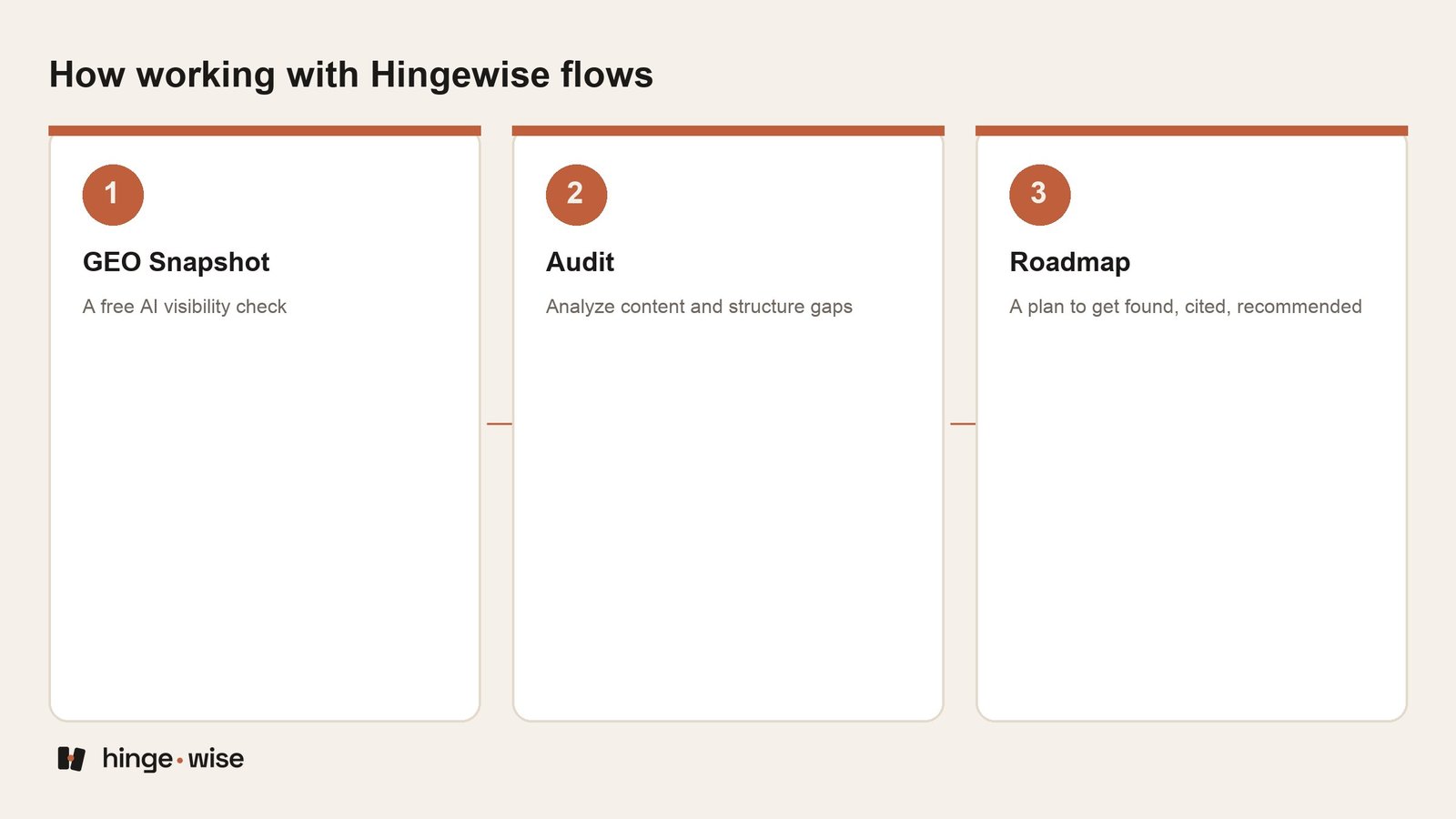
The GEO Snapshot is where we start. It’s free, it shows you precisely how visible your brand is across AI search platforms right now, and it gives you a baseline to measure against. No vague promises. Just your actual AI share of voice, compared to competitors, with a clear picture of what’s driving the gap.
If you’re evaluating what an ai seo agency can actually do for your brand, start there.
- An AI SEO agency optimizes for both Google rankings and citations in ChatGPT, Perplexity, and Google AI Overviews, not just one or the other.
- Most agencies calling themselves “AI SEO” are still doing traditional SEO: demand metrics that include AI citations and AI share of voice, not just keyword rankings.
- GEO techniques (answer-first content, quotable passages, entity signals) can boost AI visibility by up to 40%, according to arXiv research (2311.09735).
- Red flags: guaranteed AI rankings, confusing AI writing tools with AI SEO, reporting that stops at Google Search Console.
- Ask any agency candidate to show their own AI brand presence before you sign anything.
Frequently asked questions
What is an AI SEO agency?
An AI SEO agency combines traditional SEO (improving Google and Bing rankings) with GEO, generative engine optimization, which gets your brand cited in AI-generated answers on ChatGPT, Perplexity, Gemini, and Google AI Overviews. The key difference is that success is measured by AI citations and AI share of voice, not just keyword positions.
How do AI SEO agencies measure results differently from traditional agencies?
Traditional agencies report keyword rankings, organic traffic, and backlinks. AI SEO agencies add AI citation rate (how often your brand is mentioned in AI-generated answers), AI share of voice against competitors, and answer-box capture rate across platforms like ChatGPT and Perplexity. These metrics don’t appear in Google Search Console and require separate monitoring.
Can a small business benefit from hiring an AI SEO agency?
Yes. AI platforms like Perplexity and ChatGPT frequently surface local businesses, niche service providers, and specialist brands when users ask relevant questions. If your competitors are being cited and you’re not, you’re losing consideration before a user ever visits a website. A focused AI visibility audit can show exactly where the gap is.
What red flags should I watch for when evaluating AI SEO agencies?
Avoid agencies that guarantee AI rankings (no one can), that conflate AI writing tools with AI search optimization, or whose reporting covers only Google Search Console. Also watch for vague deliverables. A legitimate AI SEO agency names specific tools, shows a clear methodology, and can demonstrate their own brand’s AI visibility in relevant categories.
How long does it take to see results from AI SEO?
AI citation gains are generally slower than traditional ranking changes, often 3 to 6 months before measurable shifts in AI share of voice. However, structural content improvements (answer-first formatting, entity signals, quotable passages) can influence AI Overview inclusion within weeks of being indexed. Baseline measurement at the start is essential for tracking progress accurately.
What is a GEO Snapshot and why does it matter?
A GEO Snapshot is a structured audit of your brand’s current visibility across AI platforms including ChatGPT, Perplexity, Gemini, and Google AI Overviews. It shows which queries surface your brand, where competitors appear instead, and what content or structural gaps are causing the difference. It’s the starting point for any serious AI SEO strategy.
How we made this: AI helped with research and the first draft. Lam Nguyen chose the topic, edited the piece and checked the figures against their original sources before publishing. How we work: Editorial policy.