
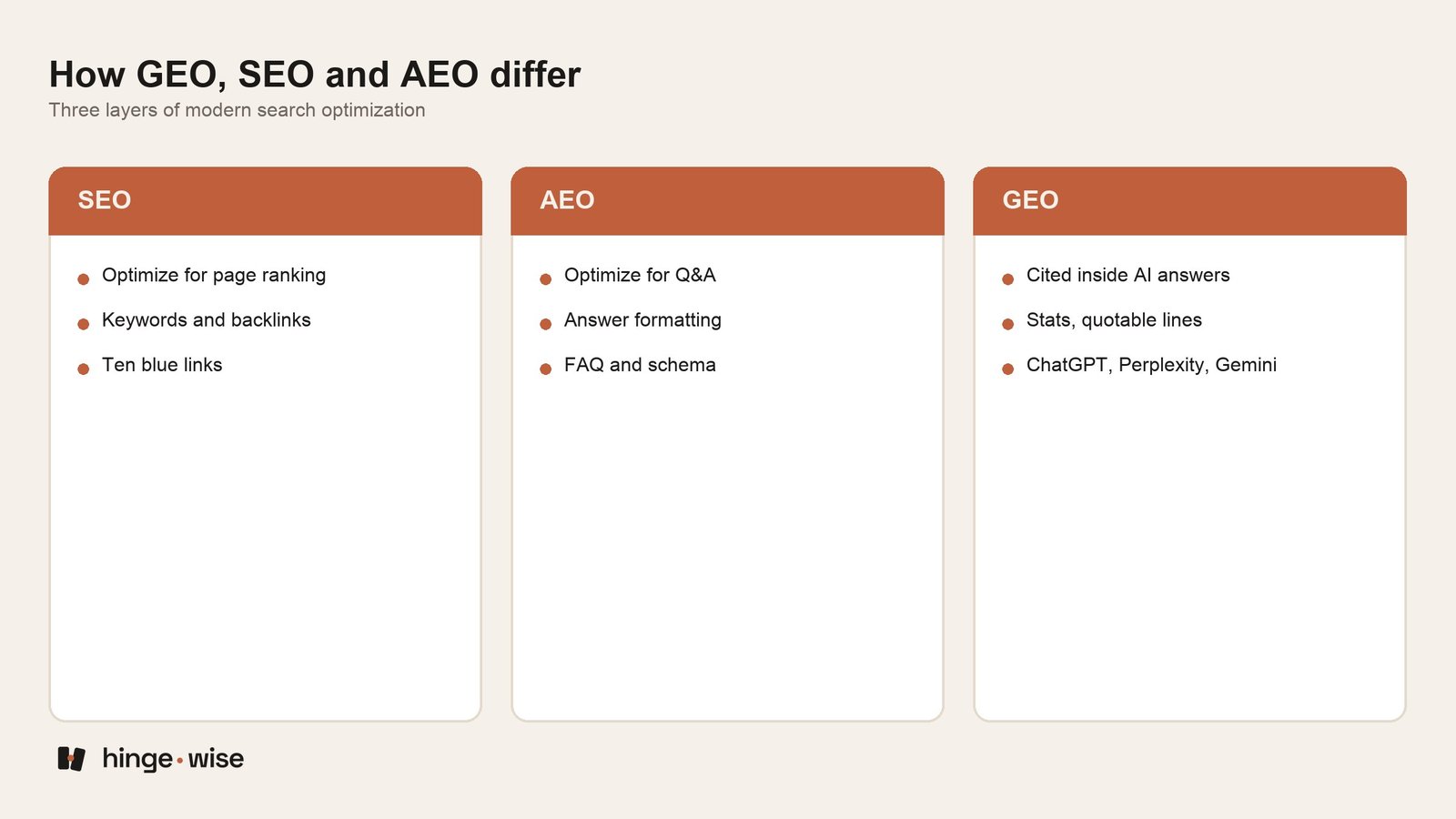
GEO (Generative Engine Optimization), SEO (Search Engine Optimization), and AEO (Answer Engine Optimization) target different channels with different tactics. SEO earns rankings in traditional search results. AEO earns citations in AI-generated answers. GEO shapes how generative engines synthesize and recommend your content. They do not replace each other. They stack.
GEO vs SEO: someone types “best project management tool for remote teams” into Perplexity. The answer arrives in eight seconds. Three tools compared by feature, one recommended. The user picks one, opens a new tab, and signs up.
They never scrolled a list of blue links. Your product might rank second on Google for that keyword. Didn’t matter. You weren’t in the answer.
That’s the geo vs seo gap generative engine optimization exists to close. And most brands don’t know it exists yet.
What Generative Engine Optimization Actually Means
The clearest way to understand GEO: AI systems like Perplexity and ChatGPT Search don’t return a ranked list. They synthesize a response from multiple sources and present one answer.
Generative engine optimization (GEO) is the practice of structuring your content and brand signals so that those systems select you as one of those sources, not a competitor.
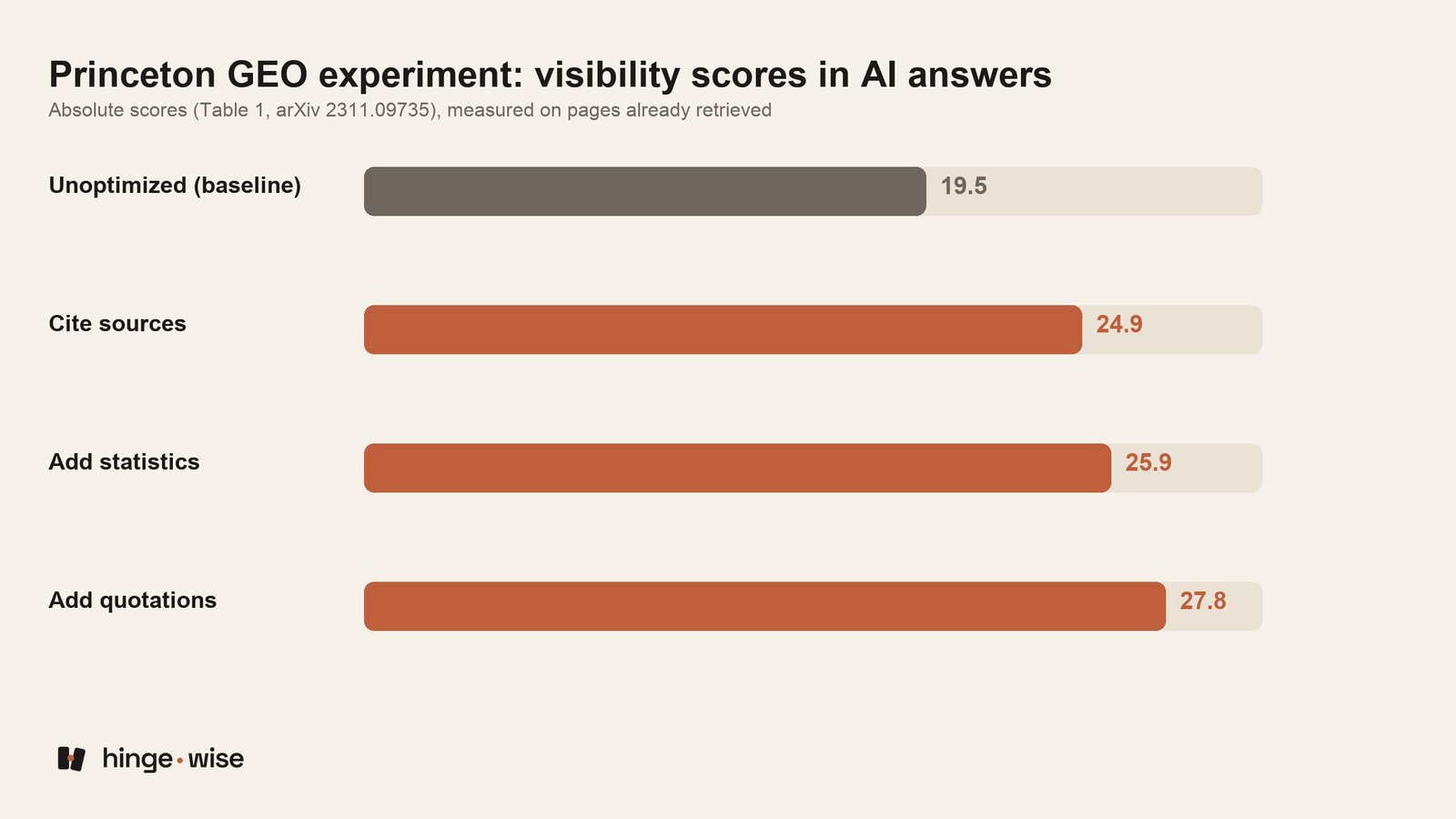
The term was formalized in a 2023 paper from Princeton, Georgia Tech, and The Allen Institute (arXiv:2311.09735). Their framework described GEO as a “flexible black-box optimization” problem. Since you can’t see inside how AI systems choose their sources, you optimize the signals you can control.
Benchmark tests in that paper found GEO strategies could boost content visibility in AI-generated answers by up to 40%.
What this means in practice: the source that gets cited wins the trust signal, the consideration, and often the conversion decision. Before the user even considers clicking anywhere.
Either your brand is in the synthesis or it isn’t. There’s no partial credit.
Why This Shift Matters More Than Most Marketers Realize
GEO matters because AI answer systems are now where purchase research begins.
Google AI Overviews rolled out to all U.S. users in May 2024. Google projected reach beyond one billion users by the end of that year (Google Blog, May 2024). ChatGPT crossed 100 million users faster than any app in history. Perplexity has become a default research tool for professionals who stopped using traditional search for anything requiring synthesis.
These are not niche tools anymore. They are the new front door.
When a potential customer uses one of these systems to research a buying decision, two outcomes are possible. Your brand gets cited by name, with context, as part of a synthesized recommendation. Or it doesn’t.
There is no page two. No “you ranked sixth and still captured some clicks.” The AI builds a shortlist before the user builds one themselves.
Here’s the part that trips up most marketers: AI systems influence consideration sets before users know they’re being influenced. If your brand isn’t named, it isn’t in the running. The decision narrows before the comparison even starts.
GEO vs SEO: Not a Replacement, a New Layer
GEO doesn’t replace SEO. Our team spent time wrestling with this framing, and the most honest answer we landed on: they operate at different points in how people find and trust information.
The tactics overlap significantly. The success metrics don’t.
| Dimension | SEO | GEO |
|---|---|---|
| Primary goal | Rank in search engine results pages | Be cited in AI-generated responses |
| Success metric | Position, CTR, organic traffic | AI citation rate, Share of Model |
| How engines use your content | Index and rank pages | Synthesize and attribute sources |
| Backlinks | Core ranking signal | Brand authority signal (still matters) |
| Content format priority | Title tags, headings, keyword density | Extractable structure, clear definitions, quotable sentences |
| Measurement tools | Google Search Console, rank trackers | Prompt testing, AI mention monitoring |
| Feedback speed | Weeks to months | Days to weeks in many cases |
What the geo vs seo table above doesn’t show: a brand can have strong SEO metrics and near-zero GEO presence. We’ve seen this pattern when auditing sites.
High rankings, solid traffic, but run those same category topics through Perplexity or ChatGPT Search and the brand barely shows up. That gap is what GEO work addresses.
The Hingewise 3-Layer Model: Found, Cited, Recommended
Our team frames the full visibility challenge as three compounding layers. Each layer requires the one below it.
Brands that skip to GEO tactics without the foundation in place tend to get limited results. AI systems cannot cite what they cannot find or extract cleanly.
Layer 1: Found (SEO). Can search engines and AI crawlers access, index, and understand your content? Technical health, crawlability, keyword relevance, quality backlinks. This is still the foundation. Without it, nothing above works. Most brands have this partially covered, though rarely as well as they think.
Layer 2: Cited (AEO). When an AI system needs to answer a specific question, does your content give it something extractable? Answer Engine Optimization focuses on structured content: clear definitions, FAQ markup, comparison tables, and sentences that function as standalone quotes. Google featured snippets live at this layer. AI Overviews source from it heavily. Most brands are inconsistent here.
Layer 3: Recommended (GEO). When someone asks an AI “what’s the best tool for X,” does your brand get named? This requires layered authority: topical expertise built across multiple interconnected pieces, consistent third-party mentions from credible sources, and a brand signal strong enough that AI systems recognize you as a reliable voice in the space. Almost no brand has consciously built toward Layer 3.
The model changes how we prioritize client work. A brand with weak Layer 1 foundations does not need GEO tactics first. A brand solid at Layer 2 but without third-party signal infrastructure won’t reach Layer 3, regardless of how good their content is.
The work compounds upward, not in parallel.
What Is Share of Model, and Why It Tells You More Than Rankings
Share of Model is the metric our team uses to measure GEO performance. Simple concept: out of all the times AI systems are asked about your category, how often does your brand appear compared to competitors?
The measurement is still manual. That’s an honest limitation.
We build a set of 20 to 30 prompts covering questions a target customer would realistically ask an AI. Run them across ChatGPT, Perplexity, and Google AI Overviews. Log which brands appear, how often, in what context, and whether the mention is a recommendation or a contrast. Then track it over time.
Semrush and a few other platforms are starting to build AI visibility monitoring into their toolkits. But as of mid-2026, nothing automates this cleanly enough for reliable monthly reporting. We’re working with manual processes and building structure around them as the tooling matures.
Why it beats rank tracking: a position report tells you where you appear when someone searches. Share of Model tells you whether you exist in the AI’s working understanding of your industry. Those are different things.
A brand can hold top-10 positions across 50 keywords and have zero AI presence for those same topics. As AI-first research behavior grows, that absence becomes a real commercial gap. Not a theoretical one.
What Our Own AI Newsroom Taught Us
Hingewise built a bilingual AI newsroom publishing content about AI, SEO, and GEO on a consistent cadence. Automated pipelines, editorial review, steady publishing rhythm.
We didn’t build it as a product to sell. We built it to observe, directly, what content AI answer engines actually choose to cite.
Here’s what we’ve seen.
Structured, definitional content gets extracted more consistently than narrative content. A piece that opens with a clean, self-contained definition gets pulled by Perplexity more reliably than a 2,000-word explainer that takes six paragraphs to arrive at the point.
The explainer might read better for a human. The structured piece gets cited.
Topical saturation matters more than a single standout article. Publishing one excellent piece on a topic helps. Building 8 to 12 interconnected pieces covering that topic from different angles appears to help significantly more.
AI systems seem to weight sources that demonstrate consistent expertise across a topic, not just sources with one strong post.
FAQ-format content and comparison tables get cited at rates that don’t match their Google rankings. This one surprised us.
Some of our most-cited content by Perplexity and ChatGPT Search does not rank at position one on Google. But the format, a direct question followed by a concise answer, appears to be exactly what AI systems want when building synthesized responses.
This is observation from watching behavior over time. Not a controlled study. We don’t have a clean sample size, and we’re cautious about overgeneralizing from our own case.
But the patterns have been consistent enough that they now shape how we write every article across every client cluster.
How to Build GEO Presence: Practical Starting Points
You don’t need to rebuild your content library to start. Most GEO foundations overlap with content and SEO work you should already be doing. The difference is in how you measure progress and which formats you prioritize.
Run a Share of Model audit first. Pick 15 to 20 prompts your target customer would realistically ask an AI in your category. Run them on ChatGPT, Perplexity, and Google AI Overviews. Document who appears. If your brand is absent from most responses, you now have a baseline to work against.
Reformat your key content for extractability. Every important article needs a crisp, self-contained answer to its core question within the first two paragraphs. Write definitions as single clean sentences. Use comparison tables for structured information. Make it easy for an AI to pull your text verbatim without paraphrasing.
Build topical clusters, not isolated articles. A single piece on a topic sends a weak authority signal. Eight to twelve interconnected pieces covering different angles of the same topic, each accurate and internally consistent, send a signal that compounds over time.
Earn third-party mentions from credible sources. Digital PR, guest content on relevant industry publications, being cited in roundups. When authoritative sources reference your brand in context, AI systems treat you as a credible entity in that space.
This is GEO’s equivalent of link building. Slower than content work, but the layer that ultimately drives Layer 3 presence.
Track monthly and adjust. Run your prompt set on a consistent schedule. Watch how Share of Model shifts after publishing new content clusters. Notice which competitors appear more frequently and try to understand the pattern. The measurement infrastructure will improve. Brands building the habit now will have a working process when the tools catch up.
- SEO is the foundation: fix crawlability, technical health, and topical authority before adding AEO or GEO
- AEO focuses on getting your content cited in AI-generated answers; optimize for quotability and structure, not just rankings
- GEO stands for Generative Engine Optimization, not geographic targeting; it shapes how AI engines recommend and synthesize your brand at the topic level
- The three strategies stack in order: SEO first, AEO second, GEO third; skipping layers creates gaps that undermine the whole strategy
- GEO measurement is still early-stage; running manual brand queries in ChatGPT, Perplexity, and Gemini is currently the most reliable way to check your AI visibility
Frequently asked questions
Is GEO the same as geographic targeting in ads?
No. GEO in search strategy stands for Generative Engine Optimization, a term formalized in a 2023 Princeton and Georgia Tech research paper. It means optimizing content for visibility in AI-generated responses from engines like ChatGPT, Perplexity, and Google’s AI Mode. Geographic targeting is a paid media concept that happens to share the same abbreviation.
Which should I prioritize first, GEO, SEO, or AEO?
SEO first, without exception. Generative engines like Perplexity and ChatGPT search still rely on crawled and indexed web content as their primary source material. Pages that Google struggles to understand or trust are unlikely to be cited by AI systems either. Build the technical and content foundation first, then layer AEO, then let GEO compound from there.
Can AEO replace traditional SEO?
No. AEO sits on top of SEO, not beside it or in place of it. You need indexed pages, domain authority, and well-structured on-page content before AEO tactics like FAQ schema and earned editorial mentions can take effect. They target different outputs but share the same content and authority foundation.
What is the practical difference between AEO and GEO?
AEO is about getting specific content cited or quoted in AI-generated answers, typically for direct question-based queries. GEO operates at a broader level, shaping whether generative engines recommend or reference your brand when synthesizing information across a topic. AEO is about individual citations; GEO is about overall brand presence inside AI-generated responses.
How do I measure GEO performance right now?
Dedicated GEO tracking is still early-stage. Tools like Semrush’s AI Toolkit and Profound are developing monitoring features, but no clean rank-tracker equivalent exists yet. The current practical approach: run regular manual queries in ChatGPT, Perplexity, and Gemini for your core topics and note whether your brand appears in the synthesized response. Track this consistently over time to spot trends.
Want to see how your brand shows up across AI? Get a free GEO Snapshot.
How we made this: AI helped with research and the first draft. Lam Nguyen chose the topic, edited the piece and checked the figures against their original sources before publishing. How we work: Editorial policy.