
Answer engine optimization (AEO) is the practice of structuring your content so AI-powered tools, including ChatGPT, Perplexity, and Google AI Overviews, select and cite you in their generated responses. Unlike SEO, which targets ranked links, AEO targets the answer itself. Your goal: be the source an AI cites when a user asks a question your brand can best answer.
Type “best project management tool for remote teams” into Perplexity. You get a two-paragraph response. Three sources cited. Maybe a short list of tools. That’s it. If your product isn’t named, the user closes the tab without ever landing on your site.
My take: this shift matters more than most marketing teams realize. Google rolled out AI Overviews to all U.S. users in May 2024 and projected over one billion people would have access by year’s end (Google Blog, May 2024). Perplexity and ChatGPT search field millions of queries daily. Users interacting with these tools aren’t scrolling a results page. They’re reading one answer and making a decision based on it.
That changes the game for content strategy. Not completely. But enough that answer engine optimization deserves dedicated attention alongside whatever you’re already doing for search.
How AEO Differs from SEO (and Where GEO Fits In)
Answer engine optimization targets citations inside AI-generated responses. SEO targets ranked positions in search results. The two share a foundation: quality content, technical authority, credible sourcing. But they have different endpoints. AEO success looks like getting named inside a Perplexity or Google AI Mode response. SEO success looks like holding a top position on a results page.
The distinction is sharper than it sounds. Ranking well in organic search does not guarantee you’ll appear in AI answers. Semrush tested this and found the overlap between organic rankings and AI Overview citations is smaller than most marketers expect. A brand holding a top-three organic position for a keyword can still be completely invisible in Google AI Mode’s response to that same query.
GEO, or Generative Engine Optimization, often gets used interchangeably with AEO. In practice, the techniques are identical. Both terms describe the work of making your content retrievable, credible, and extractable by AI systems. If you see one term on a client deliverable and the other in an agency pitch, they’re describing the same strategy.
One layer above both: ASO, Agentic Search Optimization. This covers situations where AI isn’t just answering a question but taking action on a user’s behalf, recommending a product and initiating the purchase, or suggesting a service and booking it. AEO sits at the citation layer. ASO sits at the action layer. For most brands, AEO is the right starting point.
How Answer Engines Actually Pick What to Cite
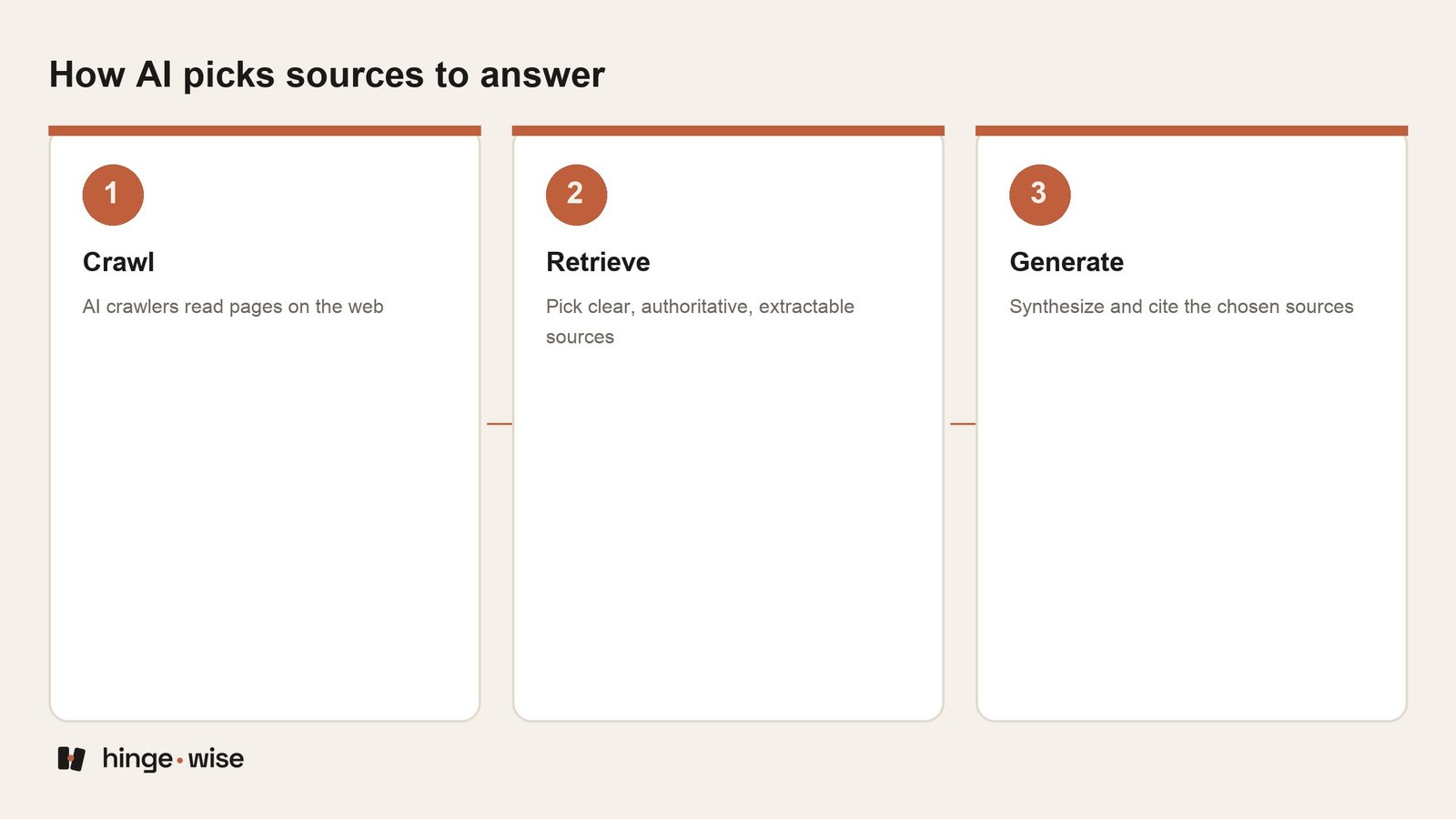
Answer engines like Google AI Mode, Perplexity, and ChatGPT search retrieve content from the web, evaluate it against the query, and synthesize a response using the most relevant and credible passages. They don’t rank pages. They select passages. A well-structured paragraph that directly answers a question is more extractable than a well-ranked page with the answer buried on paragraph seven.
Google’s AI Overviews run on a custom Gemini model built specifically for search. According to Google’s announcement in May 2024, this model uses multi-step reasoning and handles complex queries that previously required several separate searches. The implication for content: a vague page covering a topic broadly is worth less than a specific, clear passage that resolves one question completely.
Perplexity and ChatGPT search use retrieval-augmented generation (RAG). The model retrieves candidate passages from the web, scores them for relevance and credibility, and generates a response drawing from the highest-scoring ones. Your content has to clear three bars: retrievable, credible, and formatted for clean extraction.
The signals that consistently influence whether AI systems cite content (I’m drawing from observable patterns here, not a published spec from Google, since they’ve never released one for AI Overviews):
- Topical authority: sites that consistently cover a subject at depth get cited more often than generalist sites touching it once
- Self-contained passages: a paragraph that fully answers a question without depending on context from surrounding sections
- Clear standalone definitions: one-sentence explanations that work without surrounding context are highly extractable
- Cited sources within your content: linking to credible external references signals reliability to AI retrieval systems
- Structured data markup: FAQ, HowTo, and Article schema help parsers identify content type and intent before reading the full text
Google’s own data adds a useful data point. Links included in AI Overviews get more clicks than the same page would receive appearing as a standard organic listing (Google Blog, May 2024). Being cited in an AI answer isn’t just brand visibility. It drives measurable traffic.
AEO vs. SEO: What Changes and What Stays the Same
AEO and SEO share a technical foundation: quality content, site authority, credible sourcing, clean infrastructure. What changes is the output you’re optimizing for. SEO optimizes for a ranked position. AEO optimizes for a cited passage. That difference in target shapes how you write, structure, and mark up your content at a practical level.
| Factor | SEO | AEO |
|---|---|---|
| Primary goal | Rank in search engine results pages | Get cited in AI-generated answers |
| Target platforms | Google organic, Bing organic | Google AI Mode, Perplexity, ChatGPT search, Gemini |
| Content structure priority | Keyword relevance, depth, comprehensive coverage | Answer-first structure, self-contained passages, explicit definitions |
| Success metrics | Rankings, organic traffic, click-through rate | Citations and brand mentions in AI responses |
| Query focus | Keywords, short-tail and long-tail | Full-sentence questions, conversational queries |
| Structured data role | Rich results on eligible page types (FAQ and HowTo rich results are retired) | Useful hygiene for parsing; keep FAQPage, but it is not a citation lever on its own |
| Backlinks | Core ranking signal | Authority signal, plus brand mentions in credible publications |
One framing I come back to often: SEO asks “will this page rank?” AEO asks “will this passage be cited?” Same content. Different lens. Both lenses are worth using on every piece you publish.
The AEO Techniques That Actually Work
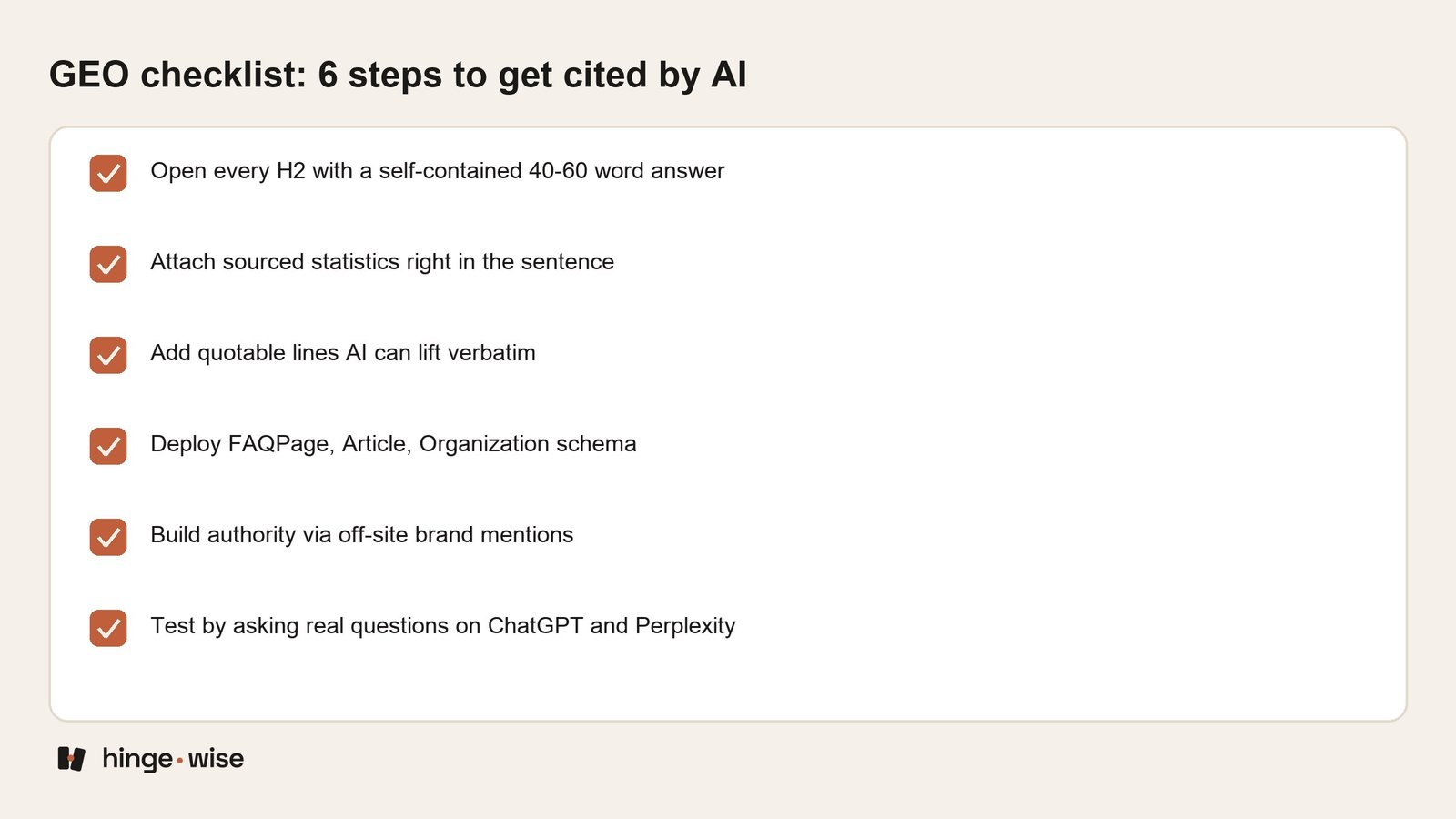
The most impactful AEO technique is also the simplest: write answer-first. Open every section with a direct response to the question that section addresses, in 40 to 60 words, before expanding. AI systems extract that opening passage as a candidate answer. Content that buries the key point after three setup sentences consistently gets passed over.
Beyond structure, here are the tactics with consistent results:
- Answer-first openers on every H2: the section heading implies a question. Answer it in the first two sentences. Then expand. This alone changes how frequently your content gets extracted.
- FAQ sections with FAQPage schema markup: write questions the way users actually phrase them in ChatGPT or Perplexity. Not compressed keyword phrases. Full sentences. “How is AEO different from SEO?” performs differently than “AEO vs SEO.” Mark up the entire FAQ block with schema so parsers identify the structure explicitly.
- Standalone definitions: every key term gets a one-sentence definition that works without surrounding context. “Answer engine optimization is the practice of structuring content so AI systems cite you in their generated responses.” That sentence can be extracted and quoted directly. A definition embedded mid-paragraph cannot.
- External citations inside your content: reference credible sources at the point you make a claim. This signals reliability to AI retrieval systems and adds E-E-A-T signals. Semrush’s AEO research, Google’s own documentation, and academic or industry publications are all fair game depending on your topic.
- Brand mentions in external sources: getting cited in news articles, industry blogs, and respected publications builds cross-source credibility. Perplexity in particular draws heavily from these secondary mentions when assembling responses.
One tactical detail most AEO guides skip entirely: Perplexity and ChatGPT receive queries phrased as full conversational sentences. Write your FAQ questions to match that phrasing, not the compressed keyword style traditional SEO trained us to target. It’s a small change. The difference in extraction rate is not small.
Three mistakes that quietly cost citations
- Optimizing for keywords instead of questions. “Best accounting software freelancers” is a keyword. “What accounting software do most freelancers actually use?” is the kind of question that triggers an AI answer. Map content to question variants, not just keyword variants.
- Expecting product pages to be cited. Product and category pages rarely show up in AI Overviews. Informational and comparison content does. If you want AEO visibility, invest in educational content first.
- Ignoring off-site mentions. AI systems weigh how your brand is described across the web, not only on your own domain. Being cited in credible industry publications makes digital PR an AEO tactic, not just an SEO one.
AEO in 2026: Where to Start
Three answer engines are worth targeting first: Google AI Overviews, Perplexity and ChatGPT search. They behave differently, but content that works for one usually transfers to the others.
| Engine | Who uses it | What tends to get cited | How it finds sources |
|---|---|---|---|
| Google AI Overviews | Broad consumer and B2B | Clear passages that answer the question directly | Google’s own index, with strong weight on authority |
| Perplexity | Research-minded users | Data-rich content with explicit sources and clean headings | Live web search; shows its sources in the answer |
| ChatGPT search | Broad and growing fast | Factual, well-structured content and lists | Live web search; often cites sources inline |
Start with Google AI Overviews: it has the widest reach, and its principles overlap most with the SEO you already do. Then check the same questions in Perplexity and ChatGPT search. Before publishing any page you want cited, run through this checklist:
- Does each major section open with a short, self-contained answer?
- Are key terms defined in plain language?
- Are data points cited with a named source and date?
- Are headings phrased as questions or direct outcomes?
- Does the page have an FAQ block written the way people actually ask, with valid FAQPage markup?
- Is the content mapped to question-format queries, not just keywords?
- Is your brand mentioned in credible external publications?
AEO results build over months rather than weeks: extractable content, accurate structured data and off-site credibility have to work together.
AEO and SEO Are Not Competing Priorities
AEO and SEO are parallel strategies, not a tradeoff. Organic search still drives a significant share of web traffic. Not every query surfaces an AI Overview. Not every user works through Perplexity or ChatGPT. Abandoning traditional search optimization because AI search is growing would show up in your traffic data fast, and not in a good way.
SEO expert Jeremy Moser, cited in Semrush’s AEO analysis, puts it clearly: “Teams who invest in both SEO and AEO are better positioned to show up wherever users ask questions.” The brands gaining ground right now are doing both. Not picking one and neglecting the other.
There’s a practical efficiency argument here too. AEO techniques make your content better for SEO. Answer-first section openers, FAQ schema, external citations, and standalone definitions all strengthen traditional rankings alongside AI citation rates. You’re building one content system that performs across both environments, not two separate workflows.
The honest version of this: if your content is currently optimized well for SEO, you’re probably closer to AEO-ready than you think. The gap is mostly in structure and markup, not a complete rebuild. Add answer-first openers to existing sections, layer in FAQPage schema, and make your definitions explicitly extractable. That’s a reasonable first step without dismantling what’s already working.
- Answer engine optimization (AEO) targets AI-generated citations, not ranked positions. Your content is either in the AI’s answer or invisible to that user, with no in-between.
- Writing answer-first, with a self-contained 40-60 word response at the start of each section, is the single highest-leverage structural change for AEO performance.
- FAQ sections with FAQPage schema markup, standalone definitions, and external citations are core AEO tactics that simultaneously strengthen traditional SEO rankings.
- Ranking in organic search does not guarantee citation in Google AI Mode or Perplexity. The two result sets overlap less than most marketers expect.
- AEO and SEO are parallel investments. Google’s own data shows that links inside AI Overviews drive more clicks than the same page appearing as a standard organic listing.
Frequently asked questions
What is answer engine optimization?
Answer engine optimization (AEO) is the practice of structuring your content so AI-powered tools like Google AI Overviews, Perplexity, and ChatGPT select and cite you in their generated responses. The goal is to be included in the AI’s answer, not just ranked in a results page beneath it.
How is AEO different from SEO?
SEO targets ranked positions in search engine results pages. AEO targets citations inside AI-generated answers. Both rely on content quality and technical authority, but they have different endpoints. A page can rank in the top three organic results and still be skipped entirely when Google AI Mode assembles its response to the same query.
What is an answer engine?
An answer engine is an AI-powered tool that generates a direct response to a user’s question instead of returning a list of links. Google AI Mode, Perplexity, and ChatGPT search are the main answer engines. They retrieve web content, evaluate it for relevance and credibility, and synthesize a cited answer without requiring users to click through results.
What are the most effective AEO techniques?
The highest-impact AEO techniques are: answer-first content structure with self-contained section openers, FAQ sections marked up with FAQPage schema, standalone one-sentence definitions for key terms, credible external citations within your content, and earning brand mentions in reputable industry publications. Each tactic makes individual passages more extractable by AI retrieval systems.
Does AEO replace SEO?
No. AEO and SEO reinforce each other. Organic search still delivers a substantial share of web traffic, and not every query triggers an AI-generated answer. AEO techniques like answer-first writing and FAQ schema also improve traditional rankings. Teams investing in both consistently outperform those optimizing for one alone.
How do I know if my content is being cited by AI tools?
Search for queries related to your content directly in Google AI Mode, Perplexity, and ChatGPT search, then check whether your brand or site appears in the cited sources. Semrush’s AI Toolkit includes emerging AI visibility tracking features. No single dashboard covers all platforms comprehensively yet, so manual spot-checking remains the most reliable method.
What should I do first for AEO in 2026?
Start with Google AI Overviews, which has the widest reach and overlaps most with SEO. Rewrite your most important pages so each section opens with a short, self-contained answer, add an FAQ block phrased the way people ask, cite sources inline, and then check the same questions in Perplexity and ChatGPT search.
Want to see how your brand shows up across AI? Get a free GEO Snapshot.
How we made this: AI helped with research and the first draft. Lam Nguyen chose the topic, edited the piece and checked the figures against their original sources before publishing. How we work: Editorial policy.