
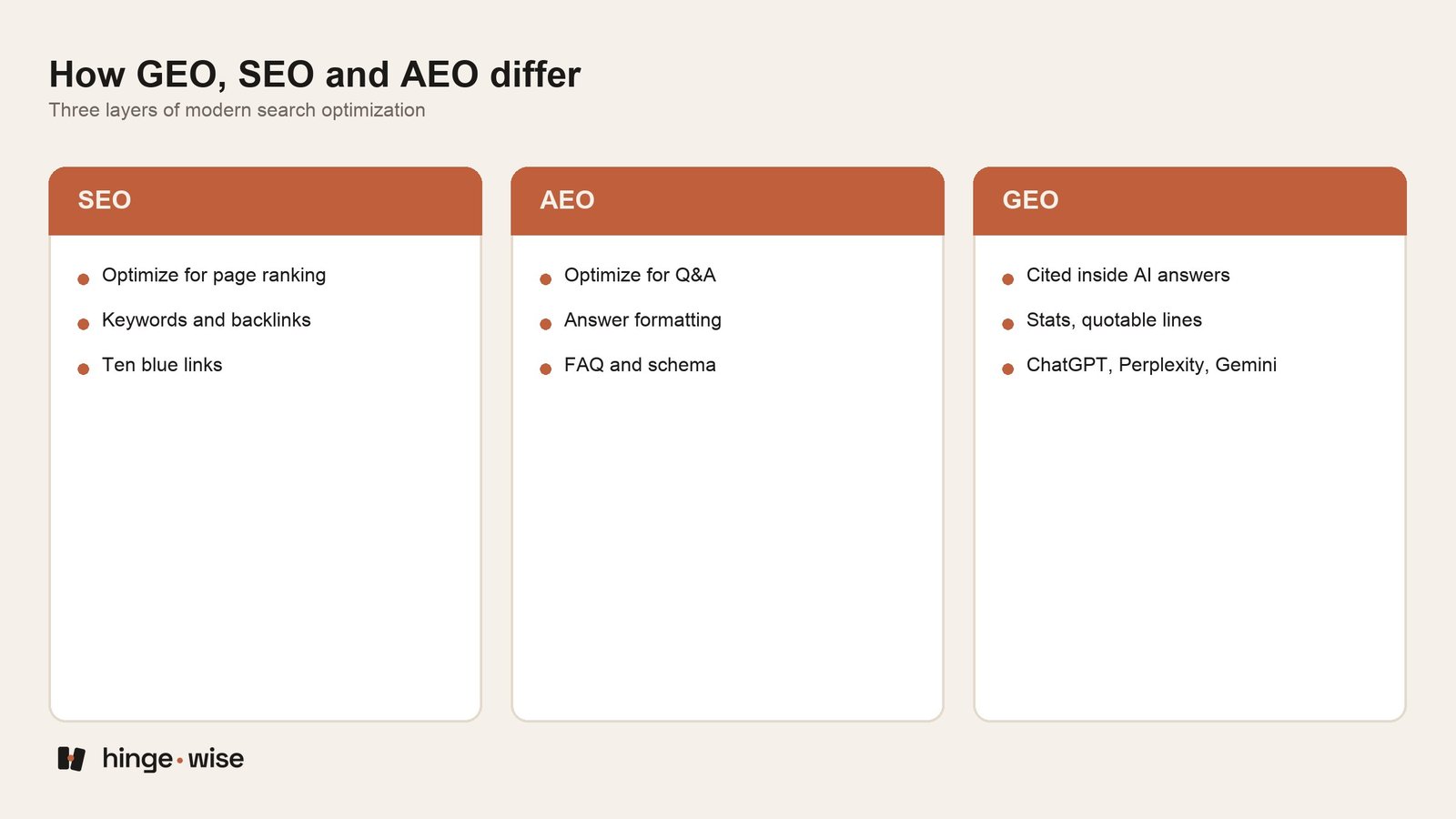
GEO (Generative Engine Optimization) is not a formal subset of SEO, but it builds on the same foundation. AEO does not replace SEO either. All three target different surfaces: SEO targets traditional rankings, GEO targets AI-generated responses, AEO targets direct question-answering engines. You need all three working together.
Three acronyms, all ending in “O.” All vaguely about getting found online. And all currently living in the same LinkedIn posts, conference decks, and agency pitches, usually without much distinction between them.
The confusion is understandable. The terminology proliferated faster than the practice did. But conflating them has real costs. Deprioritize SEO because you think GEO replaces it, and you risk the organic traffic that still drives most of your clicks. Treat AEO as just a new label for old work, and you’ll miss what’s genuinely different about appearing in ChatGPT search versus ranking in Google’s blue links. These are not the same problem.
What Is GEO, and Why Is It Different from SEO?
GEO stands for Generative Engine Optimization. The term was formalized in a 2023 research paper published on arXiv (Aggarwal et al., arXiv:2311.09735), which introduced GEO as a framework for helping content creators improve visibility inside what the authors called “generative engines”: systems like Perplexity, BingChat, and Google’s AI features that synthesize answers from multiple sources rather than returning a ranked list of links.
That distinction is the core of it. SEO gets your page to rank. GEO gets your content cited or summarized when an AI constructs an answer.
They share obvious DNA. Clear writing helps both. Structured content helps both. Topical authority carries over. But the mechanics diverge fast. Traditional search sends users to your page; generative engines may answer the question entirely without the user ever visiting your site. Different user journey. Different optimization target. The GEO paper documented that content optimized for generative engine visibility can achieve up to 40% higher inclusion in AI-generated responses compared to unoptimized content (Aggarwal et al., 2023). Meaningful gains, from changes to structure and signal quality, not backlinks.
Is GEO Part of SEO, or Its Own Layer?
Technically, GEO is not a subset of SEO. Practically, that line is blurry enough that reasonable people disagree.
Wikipedia’s current definition of SEO explicitly includes “AI-assisted search interfaces” as a target format, which means by a broad reading, GEO fits inside the SEO umbrella. The field has absorbed Technical SEO, Content Strategy, and Core Web Vitals over time. Adding AI-search optimization to that scope is consistent with how the discipline has always evolved.
But the skills diverge enough to matter. An SEO practitioner who knows PageRank architecture well may know almost nothing about how Perplexity’s citation engine selects sources. Not the same signals. Not the same tools.
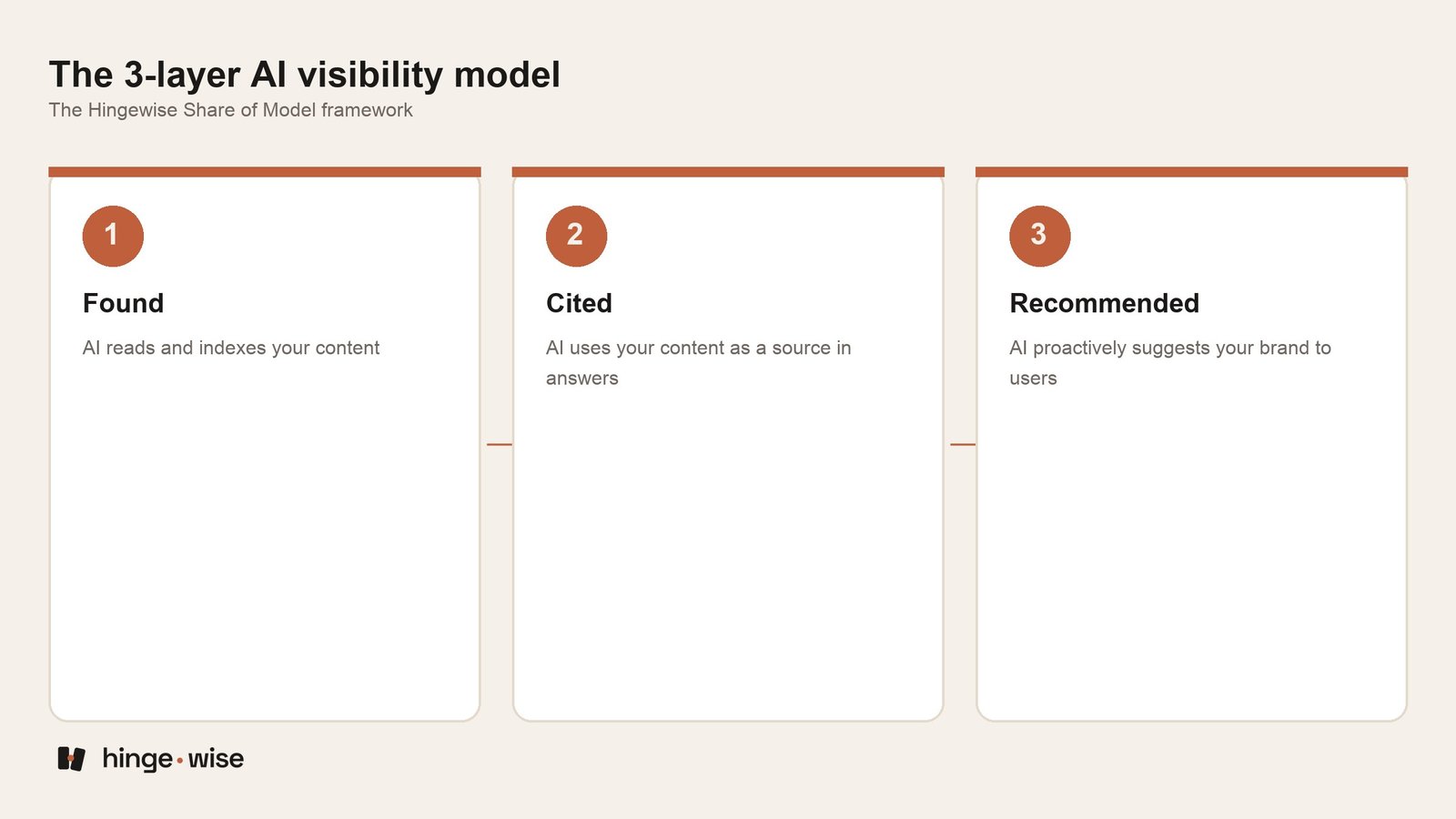
The clearest mental model: SEO is the foundation. GEO is a layer you build on top of it. Without page authority, content quality, and technical health, GEO tactics will not move the needle. AI engines like Perplexity and Google AI Overviews pull heavily from sources that already have credibility signals established through traditional search. You cannot skip the foundation and jump straight to optimizing for citations.
What Is AEO and Where Did It Come From?
AEO, or Answer Engine Optimization, emerged alongside GEO as AI-powered tools started handling questions directly rather than routing users to search results. Semrush defines it as “a set of marketing practices used to increase your brand’s visibility in AI-generated answers, like Google’s AI Mode and ChatGPT responses” (Semrush, 2024).
I’ll be honest: I find the GEO/AEO distinction somewhat blurry in practice. Both target AI-generated outputs. Both prioritize question-based queries. Both rely on structured content and entity clarity. The line the industry seems to be settling on is that GEO covers generative search visibility broadly, while AEO focuses more specifically on question-and-answer formats, including FAQ schema, voice interfaces, and structured snippet formatting.
Semrush also introduced a third term: ASO, or Agentic Search Optimization, covering brand presence in AI agent workflows like shopping or booking agents. So now we have SEO, GEO, AEO, and ASO. The acronym stack keeps growing. For most content teams right now, though, GEO and AEO can be treated as close cousins requiring similar tactics, with SEO as the shared root system.
Does AEO Replace SEO? The Direct Answer
No. The reasoning is practical, not sentimental.
Traditional search engines still handle the majority of organic traffic globally. Google AI Overviews, ChatGPT search, and Perplexity represent significant and growing share, but they have not absorbed traditional SERPs. Ranking on Google and appearing in an AI-generated answer are two different types of visibility, on two different surfaces, measured by two different signals.
Semrush states this plainly: “Ranking in organic Google search doesn’t necessarily mean you’ll also rank in AI Mode or other AI systems” (Semrush, 2024). The reverse is also true. A brand cited frequently by Perplexity may have weak organic rankings. Neither guarantees the other. They are separate problems.
AEO and SEO also optimize for different outcomes. SEO drives clicks. AEO drives citations, brand mentions, and inclusion in AI-generated answers. That is why the same Semrush source notes that teams who invest in both SEO and AEO “are better positioned to show up wherever users ask questions.” Not because AEO layers on top of finished SEO work, but because they cover genuinely different ground.
SEO, GEO, AEO: How They Actually Relate
Here is the clearest comparison I can offer:
| Dimension | SEO | GEO | AEO |
|---|---|---|---|
| Full name | Search Engine Optimization | Generative Engine Optimization | Answer Engine Optimization |
| Primary goal | Rank in traditional SERPs | Appear in AI-generated responses | Be cited in AI direct answers |
| Target surfaces | Google, Bing organic results | Perplexity, ChatGPT search, Google AI Overviews | Google AI Mode, ChatGPT, voice assistants |
| Key signals | Backlinks, content quality, technical health | Content clarity, entity coverage, citation-ready structure | FAQ schema, structured data, question-based format |
| Primary metric | Organic traffic, keyword rankings | Citation frequency in AI responses | Inclusion rate in AI-generated answers |
| Replaces the others? | No | No | No |
The shared column matters most. All three reward well-structured, authoritative, clearly written content. That’s where they converge. Where they split: SEO cares about backlink profiles and crawlability in ways that AEO or GEO don’t emphasize nearly as much. And GEO cares about how content gets synthesized by a language model, which has almost nothing to do with traditional ranking factors like domain authority or anchor text distribution.
What to Prioritize If You Are Just Getting Started
SEO first. Not a cautious answer. A practical one.
Without solid organic authority and structured content, GEO and AEO tactics will not produce results. AI engines like Perplexity and Google AI Overviews draw heavily from sources that already demonstrate credibility in traditional search. Skipping SEO to jump to AI optimization is like building on sand.
Once your SEO foundation is stable, GEO habits layer on naturally: write direct definitions for key terms, open paragraphs with clear answer statements, mark up content with structured data where applicable, and cover relevant entities with depth rather than breadth. Those habits serve both traditional search and generative citation engines at the same time.
AEO largely emerges from doing SEO and GEO well. The FAQ schema, the question-and-answer formatting, the structured markup: those are outputs of disciplined content practice, not a separate workstream you add later.
One thing worth naming: Google has not disclosed exactly what signals drive inclusion in AI Overviews. The pattern I see most consistently is that sources with genuine topical authority and useful, structured content appear more often. Whether that holds as AI search models continue to update is something none of us can predict with confidence. The honest answer is that the field is still early, and anyone claiming total certainty about AI citation signals is probably guessing.
For now, the practical path is clear. Build the SEO foundation. Add GEO structure. Let AEO follow. That order has not failed anyone I have watched try it.
- GEO (Generative Engine Optimization) is not technically a subset of SEO, but it cannot function without a solid SEO foundation underneath it.
- AEO does not replace SEO. They target different surfaces, measure different outcomes, and require different (though overlapping) tactics.
- All three disciplines share a common requirement: well-structured, authoritative, clearly written content.
- Ranking in traditional Google search does not guarantee inclusion in AI Overviews or ChatGPT responses, and vice versa.
- The right sequence is SEO first, then layer GEO, then AEO follows from doing both well.
Frequently asked questions
Is GEO part of SEO?
GEO is not technically a subset of SEO, but it builds directly on SEO foundations like content quality, site authority, and technical structure. Wikipedia‘s own definition of SEO now includes AI-assisted search interfaces as a target format, so the boundary is genuinely blurry. In practice, treat GEO as an optimization layer that sits on top of, not inside of, traditional SEO.
Does AEO replace SEO?
No. AEO and SEO target different surfaces and measure different outcomes. SEO drives rankings and organic clicks in traditional SERPs; AEO drives brand citations in AI-generated answers. Ranking on Google does not guarantee inclusion in AI Mode or ChatGPT responses, and appearing in AI answers does not mean you rank in traditional search.
What is the difference between GEO and AEO?
Both target AI-generated outputs, but GEO covers generative search visibility broadly across platforms like Perplexity, ChatGPT search, and Google AI Overviews, while AEO focuses more specifically on question-and-answer formats and structured schema. In practice, their tactics overlap significantly and they are best treated as close cousins rather than distinct disciplines.
Can you do GEO without doing SEO first?
Not effectively. AI engines like Perplexity and Google AI Overviews draw from sources that already have credibility signals established through traditional search. Research from the GEO arXiv paper (2023) shows optimization can boost AI visibility by up to 40%, but that gain is relative to an existing baseline of content quality and authority.
Where does AEO fit in the SEO and GEO stack?
AEO sits alongside GEO as a complementary layer on top of SEO. SEO provides the authority and structure; GEO extends that into AI-generated responses; AEO specifically targets question-answering engines and voice interfaces. The good news is that most AEO best practices, such as FAQ schema, structured data, and answer-ready paragraph formatting, are natural outputs of doing SEO and GEO well.
Want to see how your brand shows up across AI? Get a free GEO Snapshot.
How we made this: AI helped with research and the first draft. Lam Nguyen chose the topic, edited the piece and checked the figures against their original sources before publishing. How we work: Editorial policy.