
GEO (Generative Engine Optimization) matters because AI-powered tools like Google AI Overviews, ChatGPT search, and Perplexity now answer questions directly, bypassing traditional search results. Brands that are not visible to these systems get skipped entirely. The shift from ranked links to synthesized answers is already live, and it is accelerating fast.
Ask Google what the best CRM for small businesses is. In many US searches right now, the first thing you see is not a ranked list of websites. It is a paragraph. An AI-generated overview reads the web for you, cites a few sources inline, and the blue links beneath it become an afterthought.
That is not a fringe behavior. It is the new default for a growing share of queries.
And here is the uncomfortable truth for most brands: your SEO ranking still exists on that page. But if nobody scrolls to it, the ranking is academic.
The Search Page Has Changed. Here Is What It Looks Like Now.
Google AI Overviews now appear at the top of results for a wide range of informational, research, and planning queries. They are built on a custom Gemini model designed for “multi-step reasoning, planning and multimodality” (Google Blog, May 2024). The result: a search page that answers questions at the top and pushes traditional organic results further down the fold, sometimes well below what a user sees without scrolling.
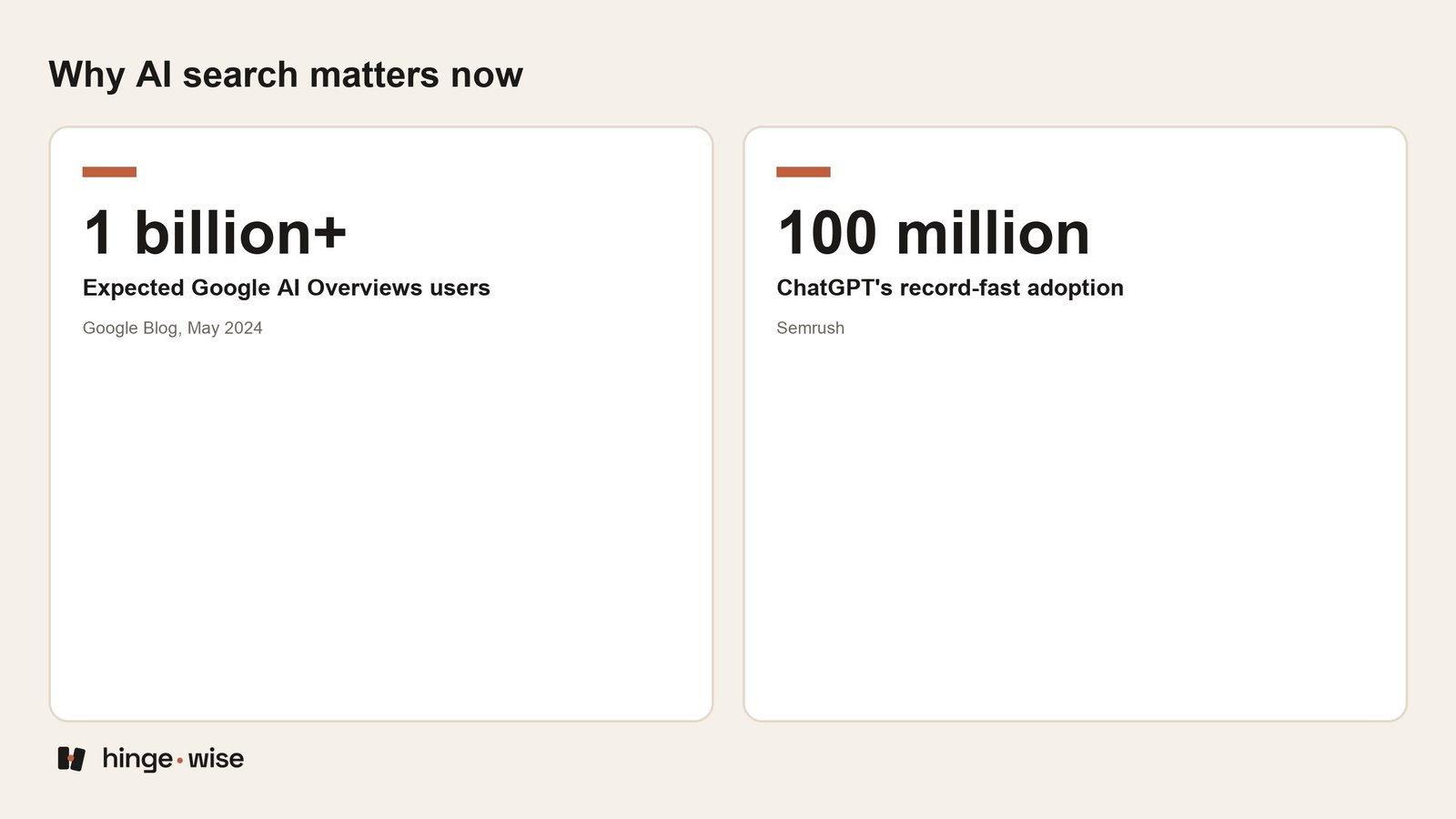
In May 2024, Google rolled out AI Overviews to hundreds of millions of US users and announced plans to reach over one billion people by the end of that year (Google Blog, May 2024). That is not a beta test. That is infrastructure.
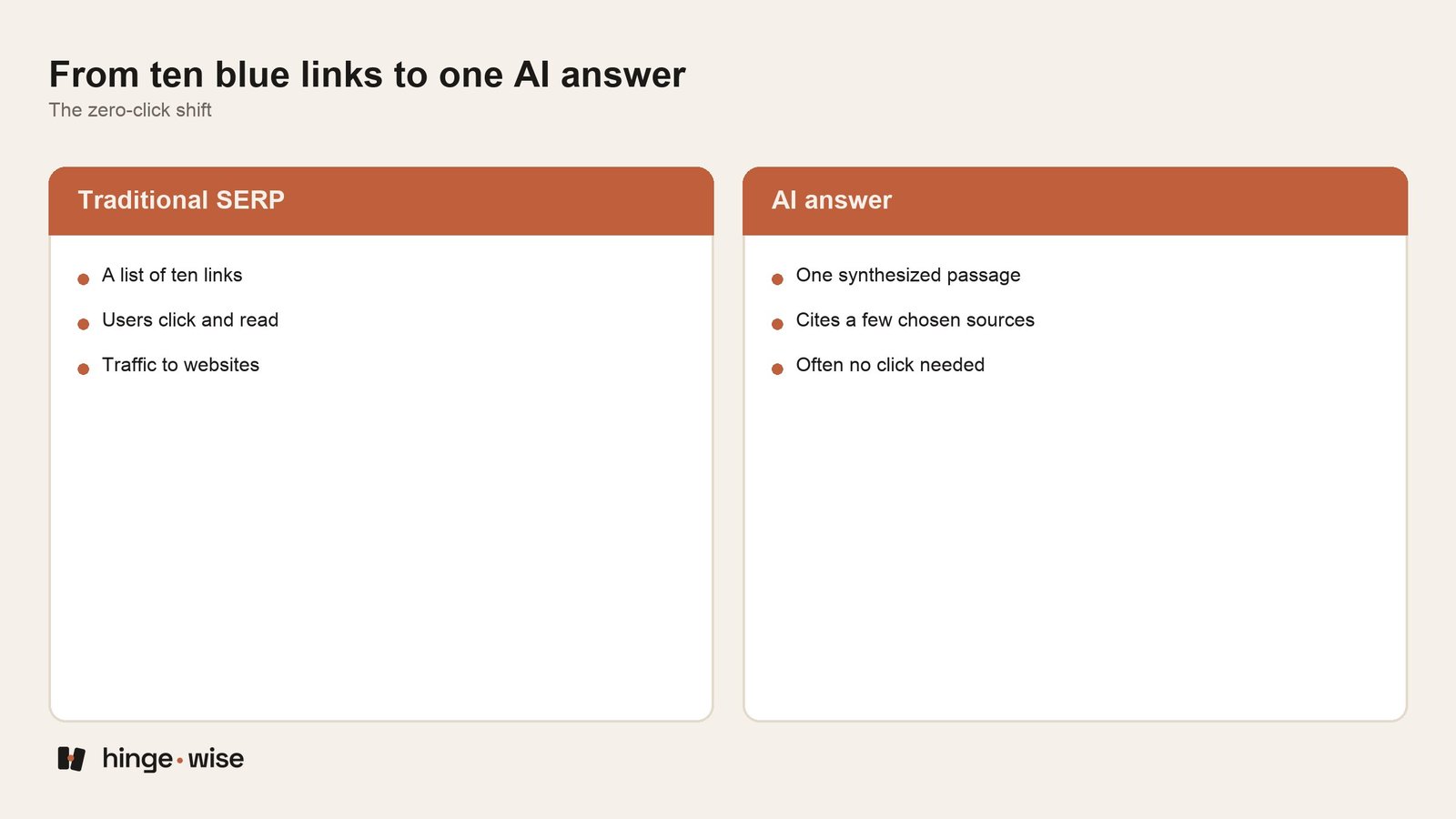
Meanwhile, ChatGPT launched search capabilities that pull live web content and cite sources directly in the response. Perplexity had already been doing this for millions of daily queries, with a model that synthesizes multiple sources into a structured answer and offers follow-up questions. Gemini, Bing Copilot, and Claude have all added similar behavior. The pattern is consistent across all of them: user asks a question, AI reads multiple sources, AI delivers the answer. The user often never leaves the interface.
For brands, this raises one direct question: are you part of the answer, or are you invisible?
What Is GEO? (A Clear Definition Worth Knowing)
Generative Engine Optimization, or GEO, is the practice of structuring your content so AI-powered search systems can find, extract, and cite it when generating answers. Semrush defines it as optimizing “your presence and content to appear in responses generated by AI-powered search systems such as ChatGPT, Google, Perplexity, Claude, and others” (Semrush, 2024).
The gap between SEO and GEO is not as wide as it sounds. A lot of what SEO has always valued, including clear writing, credible sourcing, structured content, genuine expertise, turns out to be exactly what AI systems look for when deciding what to cite. The foundation is the same. The target is different.
SEO asks: can search engines find and rank this page?
GEO asks: will an AI system extract and cite this content when someone asks a relevant question?
My take: GEO is not a replacement for SEO. It is what SEO grows into when the interface changes.
Why Zero-Click Searches Keep Growing
Zero-click behavior, where users get their answer without clicking through to any site, has been building for years. Featured snippets started it. Knowledge Panels accelerated it. AI Overviews have pushed it further, and faster, than any prior feature.
I will be honest here: I do not have a precise, citable percentage for zero-click rates specific to AI Overview queries. Google does not publish that. But the pattern is visible in Google Search Console data across informational query sets: impressions hold steady or climb while CTR for the same queries drops. Users are seeing the answer at the top. Many stop there.
What makes this different from the old featured-snippet problem is scale. Featured snippets covered a narrow slice of queries. AI Overviews expand across the full range of informational, research, and planning intent. That is a much larger surface, affecting categories that many brands built their entire content strategy around.
There is a counterpoint worth making. Google’s own data suggests that “the links included in AI Overviews get more clicks than if the page had appeared as a traditional web listing for that query” (Google Blog, May 2024). The interpretation: being cited inside an AI Overview is a high-value position. Not just a consolation for lost organic clicks, but an active traffic opportunity.
So the goal shifts. Not “rank for the keyword.” Get cited in the answer.
GEO vs. SEO: Same Foundation, Different Game
| Factor | SEO | GEO |
|---|---|---|
| Primary target | Search engine rankings (SERPs) | AI-generated answers and citations |
| Success metric | Position, organic clicks, CTR | AI mentions, citations, brand visibility in AI outputs |
| Content priority | Keyword relevance, backlinks, technical health | Clarity, credibility, extractable self-contained passages |
| Key platforms | Google, Bing | Google AI Overviews, ChatGPT search, Perplexity, Gemini |
| Overlap | E-E-A-T signals, content quality, structured data, authoritative sourcing | |
The honest summary: most GEO work is content quality work. The same article that earns a featured snippet in traditional search is a strong candidate for AI citation. But a few things matter specifically more for GEO.
Clarity of structure. AI systems extract passages, not pages. If individual paragraphs in your content can stand alone and answer a question without context from the rest of the article, those paragraphs get cited more often. Dense, jargon-heavy writing that only makes sense in sequence gets skipped.
Credibility signals. AI systems are more likely to pull from sources that have been cited by other credible sources, have clear authorship, and demonstrate subject-matter expertise. E-E-A-T, which SEO teams already care about, overlaps heavily here.
Freshness. AI Overviews update frequently. Content that is clearly dated, or reflects a world before a major platform change, is at a disadvantage. Timestamps and updated-on dates matter more than they used to.
Which Brands Actually Show Up in AI Answers?
The honest answer is: it is not fully random, but the exact weighting is opaque. Google and OpenAI do not publish “how to get cited” documentation the way they once published (parts of) how to rank in traditional search.
Academic research on GEO citation factors, including work out of Princeton on what content characteristics increase AI citation rates, points to a few consistent patterns: having concrete statistics with clear sourcing, using direct quotable claims, and demonstrating citations within your own content all correlate with higher AI citation frequency. These are not tricks. They are writing practices that good publishers have always used.
Practically speaking, the brands that show up in AI answers tend to share a few traits:
- They publish on topics they genuinely specialize in, not just topics with search volume.
- Their content answers questions directly, without burying the answer in three paragraphs of preamble.
- They are mentioned and linked to by credible third-party sources: industry publications, editorial reviews, partner sites.
- Their structured data is in order, including FAQ schema, author markup, and article schema where relevant.
Brands that consistently do not appear tend to have content that is technically fine for keyword ranking but written primarily for search engine crawlers rather than real readers. AI systems, it turns out, are closer to real readers than crawlers are.
So Why Is GEO Important Right Now, Not in Two Years?
ChatGPT reached 100 million users faster than any platform in history (Semrush, 2024). Google AI Overviews are live for hundreds of millions of users in the US today. Perplexity handles hundreds of millions of queries monthly. These are not early-adopter behaviors. They are mainstream search behaviors, and they are compounding.
The brands that build GEO visibility now, by publishing clear, credible, well-structured content on their areas of expertise, are building a compounding asset. Their content gets cited. Citations build authority signals. That authority makes future content more likely to be cited. Waiting has a cost. Not a dramatic overnight cost, but a slow one that is hard to reverse later.
There is also a competitive window here. Most brands have not started thinking about GEO yet. They are still running the playbook from 2022, focused entirely on ranking positions that a growing share of users never see. That gap will not stay open forever.
If you have not checked whether your brand shows up in AI answers for your main topics, that is a ten-minute exercise worth doing today. Open ChatGPT, Perplexity, and Google with AI Overviews enabled. Type in the questions your customers actually ask. See who shows up. If it is consistently your competitors and not you, that is the gap GEO is designed to close.
- Google AI Overviews reached hundreds of millions of US users in 2024 and are on track to reach over one billion globally, making AI-generated answers a mainstream search behavior, not a niche one.
- GEO (Generative Engine Optimization) means optimizing content to be cited by AI systems like ChatGPT search, Perplexity, and Google AI Overviews, not just ranked on a results page.
- Zero-click behavior is growing: more users get answers at the top of the search page and never scroll to organic listings, making AI citation a high-value position.
- The same content quality signals that help SEO, including E-E-A-T, clear structure, and authoritative sourcing, are the foundation of GEO. The strategies overlap significantly.
- Brands that start building GEO visibility now gain a compounding advantage; content that gets cited builds the authority signals that make future content more likely to be cited.
Frequently asked questions
What is GEO and why does it matter?
GEO stands for Generative Engine Optimization. It is the practice of optimizing your content to appear in AI-generated answers from systems like Google AI Overviews, ChatGPT search, and Perplexity. It matters because these tools now answer questions directly for hundreds of millions of users, often without sending them to any website.
Why is GEO important for businesses right now?
GEO is important because AI-powered search tools have moved from early adoption to mainstream use. Google AI Overviews reached hundreds of millions of US users in 2024. ChatGPT hit 100 million users faster than any app in history. Brands not visible in these systems are being skipped by a growing segment of their potential audience.
How is GEO different from traditional SEO?
SEO focuses on ranking in search engine results pages so users click through to your site. GEO focuses on being cited inside AI-generated answers, where users may get the information they need without visiting any website. The content quality signals overlap significantly, but GEO puts additional weight on clarity, extractable passages, and credibility sourcing.
Which AI platforms does GEO apply to?
GEO applies to any AI-powered system that synthesizes content to answer user questions, including Google AI Overviews (built on Gemini), ChatGPT with search enabled, Perplexity, Bing Copilot, and Claude. Each platform has different citation behavior, but the core content quality signals that drive visibility are consistent across all of them.
Does investing in GEO mean stopping SEO work?
No. GEO and SEO share the same content quality foundation: clear writing, credible sourcing, structured data, and genuine expertise. GEO is not a replacement for SEO but an extension of it for AI-powered interfaces. Most of what makes content rank well in traditional search also makes it more likely to be cited in AI-generated answers.
How do I know if my brand is visible in AI answers?
Open ChatGPT, Perplexity, and Google with AI Overviews enabled. Search the questions your customers actually ask about your category. If your brand or content is consistently absent from the answers, that is the gap GEO work addresses. Start with the queries where your traditional SEO already has traction.
Want to see how your brand shows up across AI? Get a free GEO Snapshot.
How we made this: AI helped with research and the first draft. Lam Nguyen chose the topic, edited the piece and checked the figures against their original sources before publishing. How we work: Editorial policy.