
AI visibility tools track how often your brand, content, or URLs appear in responses generated by platforms like ChatGPT, Perplexity, Gemini, and Google AI Overviews. In 2026, these tools fall into four main types: AI citation trackers, AI Overviews monitors, brand intelligence platforms adapted for AI, and custom API-based setups. Each measures something different.
Your site held a top-3 ranking for two years. Then a colleague mentions they asked ChatGPT for product recommendations in your category. Your brand didn’t come up. Not once. You check Search Console, your rank tracker, your analytics. Everything looks fine. But in AI search, you don’t exist.
That’s the gap ai visibility tools are built to close. With Google AI Overviews now reaching billions of users each month (Semrush, 2025), and ChatGPT having grown to 100 million users faster than any app in history (Semrush, 2025), the cost of being invisible in AI-generated answers is real. And growing.
The problem is that the tool category itself is barely two years old. Some platforms are genuinely useful. Others are dashboards that wrap a few API calls in a polished UI and call it “AI visibility monitoring.” Choosing the wrong one doesn’t just waste budget. It gives you false confidence based on the wrong data.
What Does “AI Visibility” Actually Measure?
AI visibility measures how frequently and prominently your brand, content, or URLs are cited inside AI-generated responses across platforms like ChatGPT search, Perplexity, Google AI Overviews, Gemini, and Claude. It is not a ranking. There is no position 1 in an AI answer.
That distinction matters more than it sounds. Traditional SEO measurement works because search engines return ranked lists. AI responses synthesize sources into prose. Your content either gets cited or it doesn’t. And because AI responses are non-deterministic (the same query asked twice can pull different sources), consistent measurement requires running queries at volume, repeatedly, across platforms.
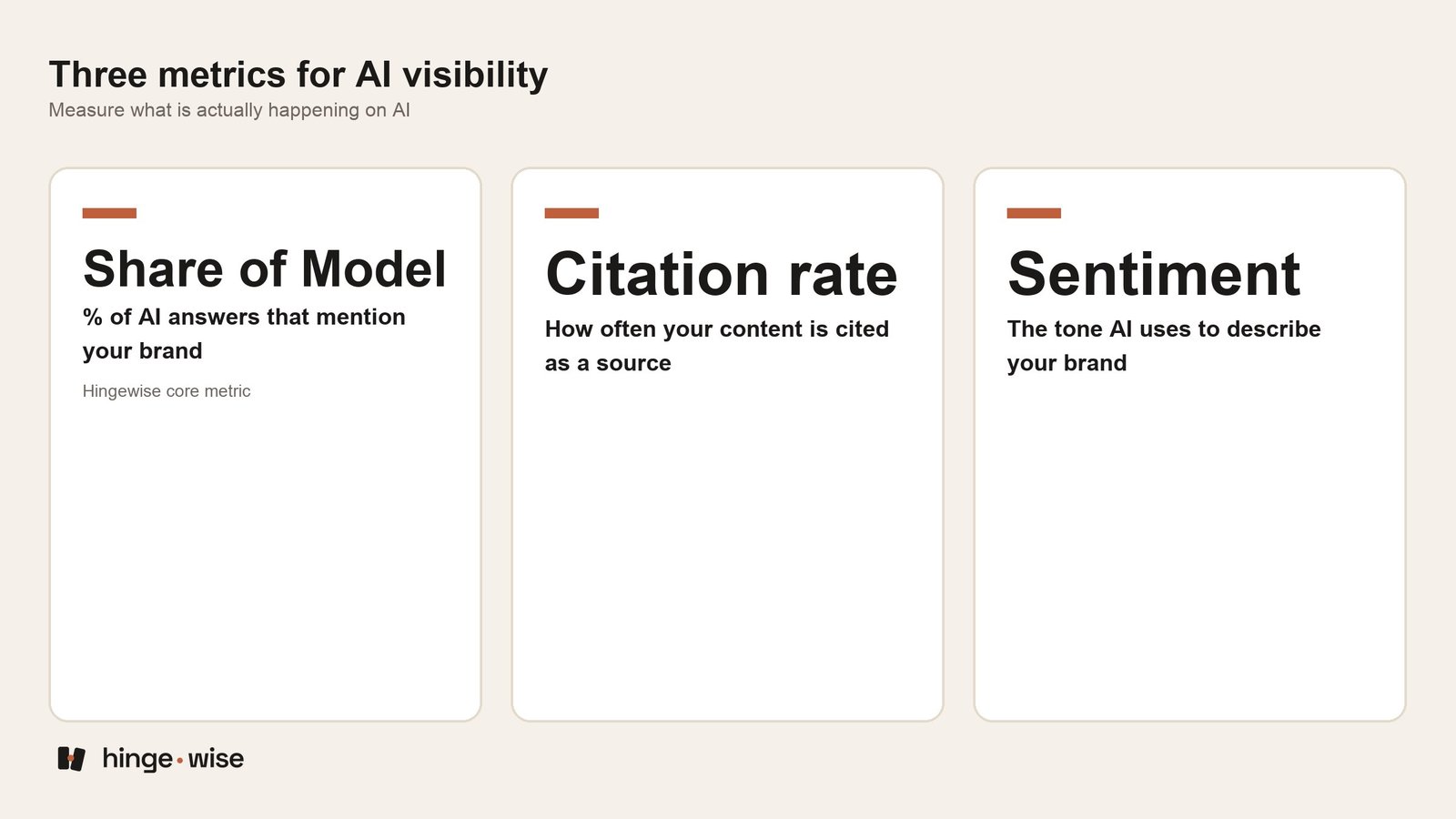
The metric the field is converging around is AI share of voice: what percentage of relevant AI responses in your category mention your brand, versus how often they mention competitors. It’s useful. It’s also only as accurate as the query library the tool is running, which is the first thing to evaluate before buying anything.
The Four Types of AI Visibility Tools in 2026
Understanding these four categories prevents a common, expensive mistake: buying a tool that tracks Google AI Overviews when your buyers research on Perplexity, or vice versa.
Type 1: AI Citation Trackers
These tools send a library of queries to AI platforms (ChatGPT, Perplexity, Gemini, Claude) and record when your brand or domain gets cited in the response. The output: citation rate, share of voice by platform, and frequency broken down by topic or query category.
Best fit: content, SEO, and GEO teams wanting to know “are we being mentioned across AI platforms, and how does that compare to competitors?” This is the most direct form of AI visibility measurement.
Core limitation: query library quality drives everything. If your query set doesn’t cover the questions your actual buyers ask, citation rates can look healthy while you’re invisible where it counts.
Type 2: SERP and AI Overviews Trackers
Usually built as add-ons to existing rank-tracking platforms. They detect when a Google AI Overview appears for a tracked keyword, whether your content is cited inside it, and how that changes over time. Both Semrush and BrightEdge have functionality in this area. Most established SEO platforms are adding some version of it.
Best fit: SEO teams who want AI Overviews monitoring alongside traditional rank tracking, without switching tools or managing a new vendor relationship.
Core limitation: these are Google-centric by design. If your buyers also use Perplexity or ChatGPT search for research (and in B2B, they increasingly do), this misses a significant share of the picture.
Type 3: Brand Intelligence Platforms Adapted for AI
Social listening and brand monitoring tools, expanded to include AI-generated content as a monitored channel. They track where your brand is mentioned across the web, including in content that AI platforms frequently cite.
Best fit: PR, brand, and communications teams already operating inside a brand monitoring platform who want AI coverage added to an existing workflow.
Core limitation: tracking brand mentions across the web is not the same as tracking AI citations directly. These platforms often conflate the two, and their AI-specific coverage typically lags behind purpose-built tools. Worth checking what they actually query and how.
Type 4: Custom API-Based Monitoring
Some technical SEO practitioners and agencies build their own monitoring by querying AI APIs directly (OpenAI’s API, Gemini API, Perplexity’s API) and logging responses at scale. Full control over query design, response logging, and data ownership. Labor-intensive to build. Harder to maintain.
Best fit: agencies delivering AI visibility as a client service, or in-house teams with engineering support and a specific need for custom query methodology.
Core limitation: AI platforms update models frequently, and each update can shift citation behavior. Perplexity adds features monthly. ChatGPT’s capabilities keep expanding. What your setup captures in Q1 may need rebuilding by Q3.
How to Compare AI Visibility Tools: The Criteria That Actually Matter
| Criteria | AI Citation Trackers | AI Overviews Trackers | Brand Intelligence Tools | Custom Monitoring |
|---|---|---|---|---|
| Platforms tracked | Multi-LLM (ChatGPT, Perplexity, Gemini, Claude) | Google-focused | Multi-channel (web, social, AI) | Fully configurable |
| Setup complexity | Low to medium | Low (add-on to existing tool) | Low | High |
| Query customization | Medium to high | Limited (keyword-based) | Low | Full |
| Data ownership | Vendor | Vendor | Vendor | Yours |
| Primary metric | Citation rate, AI share of voice | AI Overview inclusion rate | Brand mention volume | Custom-defined |
| Best for | SEO, GEO, content teams | SEO teams | PR and brand teams | Agencies, technical SEOs |
Three Evaluation Criteria Most Tool Comparisons Skip
Platform coverage is the obvious starting point. But three criteria consistently get ignored in comparison guides.
Query library depth. A tool is only as useful as the question set it tests. Does it cover your full taxonomy of buyer questions, or just a handful of generic head terms? The best tools let you import your own query list. That flexibility is worth more than a prettier dashboard.
Testing frequency. AI citation patterns shift faster than organic rankings do. A model update, a newly indexed source, a change in how Perplexity weights its background searches (as described in Moz’s 2025 breakdown of how generative engines work) can move citation rates meaningfully in days. A tool testing queries weekly gives you a different picture than one testing daily. Match frequency to what you actually need to track.
Attribution depth. This is where the gap between good tools and great tools is widest. A citation in an AI response does not automatically mean a click or a conversion. A few platforms are beginning to connect AI mention volume to downstream signals like branded search lift and direct traffic changes. Most are not there yet. Be clear about whether you need that layer before paying for it.
The Measurement Problem No AI Visibility Tool Has Fully Solved
The biggest gap in this space rarely shows up in product demos. AI responses are sampled, not crawled.
Traditional search visibility works because search engines index the web systematically. You can track coverage with reasonable completeness. AI visibility works differently. You select a query set, run it, and collect samples. Whether those samples represent what actual users are seeing at scale is genuinely hard to validate. And as Moz noted in their 2025 GEO guide, ChatGPT’s o3 model now “thinks” through queries before generating answers, while Perplexity runs multiple web searches in the background and cites sources directly in output. Same query, different model version or timing, potentially different citations.
Honestly, I don’t think any tool in 2026 has fully cracked this. The honest ones say so in their methodology documentation. Look for that transparency when evaluating platforms.
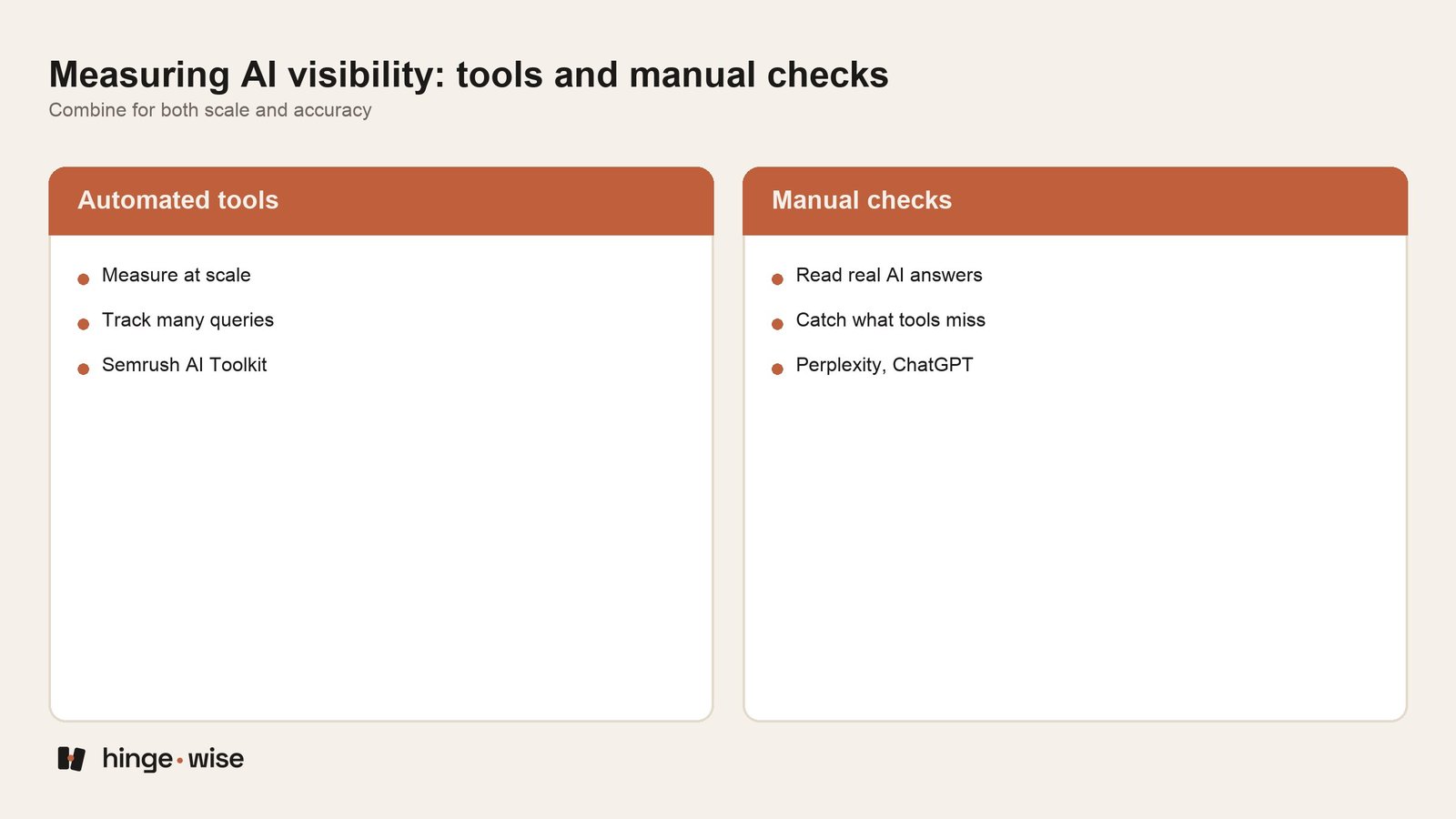
The practical response for most teams: run two tool types simultaneously. A dedicated AI citation tracker covering multi-LLM platforms, combined with your existing SEO platform’s AI Overviews module. That combination covers more ground than either alone and catches the blind spots each type misses.
For context, 41% of marketers say the top trend they’re actively exploring right now is updating their SEO strategy for AI search changes (HubSpot State of Marketing Report, 2026). The smarter ones are pairing that intent with actual measurement infrastructure. Otherwise you’re optimizing without knowing what’s working.
If you’re mapping out which combination of ai visibility tools fits your team and budget, the practical first step is a baseline: where do you currently stand across the AI platforms your buyers actually use? That’s harder to answer without data, and harder to improve without a starting point.
Hingewise’s AI Visibility Snapshot does exactly that. No commitment. Just a clear read on your current citation rate, share of voice, and where the gaps are. Request a free snapshot here.
- AI visibility tools measure citation rate and share of voice in AI-generated answers, not traditional search rankings
- The four main tool types (AI citation trackers, AI Overviews monitors, brand intelligence platforms, and custom API setups) measure different things, and picking the wrong type means measuring the wrong signal
- Query library depth and testing frequency matter more than dashboard design when comparing tools
- No tool in 2026 has fully solved the sampling problem: AI responses are not crawled at scale, they are tested in samples
- Most serious GEO teams use at least two tool types in combination to reduce blind spots
Frequently asked questions
What are AI visibility tools?
AI visibility tools track how often your brand, content, or URLs are cited inside AI-generated responses from platforms like ChatGPT, Perplexity, Gemini, and Google AI Overviews. Unlike rank trackers, they measure citation rate and share of voice rather than search position, because AI responses synthesize information into prose rather than returning ranked lists.
How do AI visibility tools differ from standard SEO tools?
Traditional SEO tools track your position in search engine results pages. AI visibility tools track whether and how often you get cited inside AI-generated answers, which have no concept of a ranking position. Many established SEO platforms are adding AI visibility modules, but purpose-built tools typically offer more depth in multi-platform citation tracking across ChatGPT, Perplexity, and Gemini simultaneously.
Which AI platforms should you track for visibility in 2026?
At minimum: Google AI Overviews, ChatGPT with search enabled, and Perplexity. These three account for the largest share of AI-assisted search queries in 2026. Gemini and Claude add meaningful coverage, particularly for technical and enterprise audiences. A tool that only tracks one or two of these platforms leaves real gaps in your measurement.
How often should you check AI visibility metrics?
Weekly testing is the practical minimum for trend tracking. Daily monitoring makes sense for high-priority brand queries or during a product launch. AI citation patterns can shift within days after a model update or when significant new content gets indexed, so monthly reporting alone will miss meaningful changes in your AI share of voice.
Can AI visibility tools explain why a brand is not being cited?
Most tools identify that you are not being cited but cannot diagnose why. The diagnostic layer requires a GEO content audit: reviewing content structure, whether pages are accessible to AI crawlers, authority signals, and how directly your content answers the questions being queried. Measurement and optimization are separate workstreams, and most teams need both.
What is AI share of voice?
AI share of voice is the percentage of relevant AI-generated responses in your category that mention your brand, compared to how often they mention competitors. It is the primary metric most AI visibility tools report. Its accuracy depends entirely on the quality and breadth of the query set the tool is testing, which is why query library customization is a key evaluation criterion.
Want to see how your brand shows up across AI? Get a free GEO Snapshot.
How we made this: AI helped with research and the first draft. Lam Nguyen chose the topic, edited the piece and checked the figures against their original sources before publishing. How we work: Editorial policy.