
A GEO agency optimizes your content so it gets cited by AI tools like ChatGPT, Perplexity, Google AI Overviews, and Gemini. Picking the right partner means checking three things: do they measure actual AI citations, do they understand how LLMs select sources, and can they show you real before-and-after evidence?
Most agencies calling themselves GEO specialists today took their SEO service deck, added “AI visibility” to the homepage, and repriced the package. No new measurement framework. No understanding of how Perplexity or ChatGPT actually select sources. Same content strategy. Different slide.
That’s the core problem when you’re evaluating a geo agency right now: the market is full of SEO shops that rebranded, not specialists who actually understand how AI systems surface content.
Research published on arxiv.org in 2023 showed that well-executed GEO strategies can boost content visibility in AI-generated responses by up to 40%. The signals that drive those gains are not title tags or link anchor text. They’re statistical specificity, citation-ready sentence structure, and brand authority across the web. Very different game.
Why SEO Experience Alone Won’t Cut It for GEO
In traditional SEO, you’re competing for a slot in a list of results. In GEO, you’re competing to become part of a synthesized answer the AI delivers directly. The AI doesn’t show options and let the user choose – it reads your content, judges whether it’s citable, and either includes your brand or leaves you out entirely. That’s the fundamental difference a real geo agency needs to understand.
The ranking signals are genuinely different. LLMs weight structural clarity, self-contained passages, statistical depth, and brand presence across credible third-party sources. A 3,000-word pillar post optimized for a head keyword can rank well on Google and get zero mentions in ChatGPT. I’ve seen this with brands that had strong organic traffic but no presence in AI answers at all – their content was built for crawlers, not for extraction.
Agencies that understand this distinction are worth a serious conversation. The ones that don’t will happily bill you for SEO work and call it GEO.
What a Legitimate GEO Agency Actually Delivers
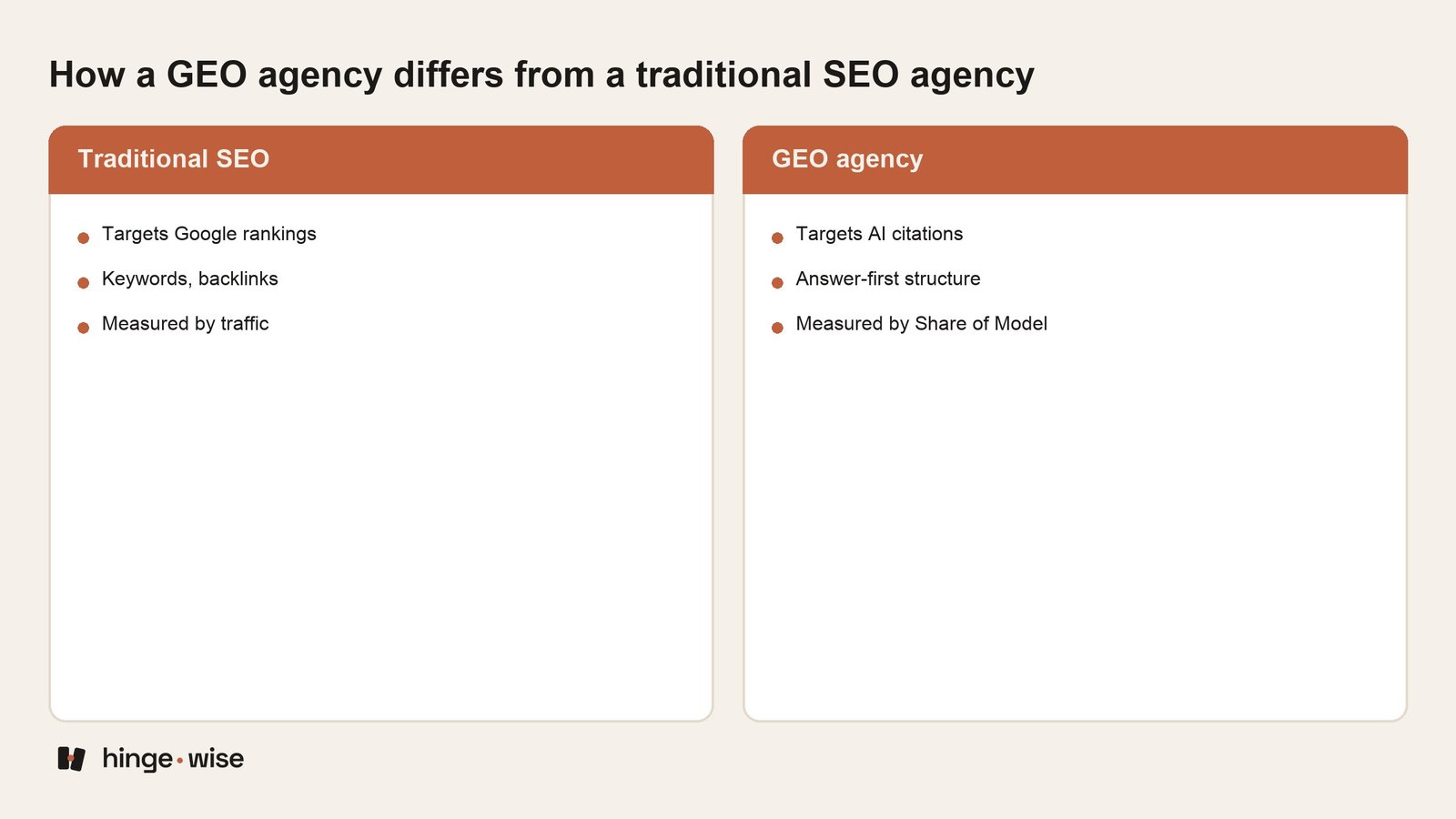
A real GEO agency builds your AI visibility across three layers: how your content is structured so AI tools can extract it, how your brand is referenced across third-party sources that AI systems already trust, and whether you can measure those citations over time. Miss any one of the three and you’re only doing part of the job.
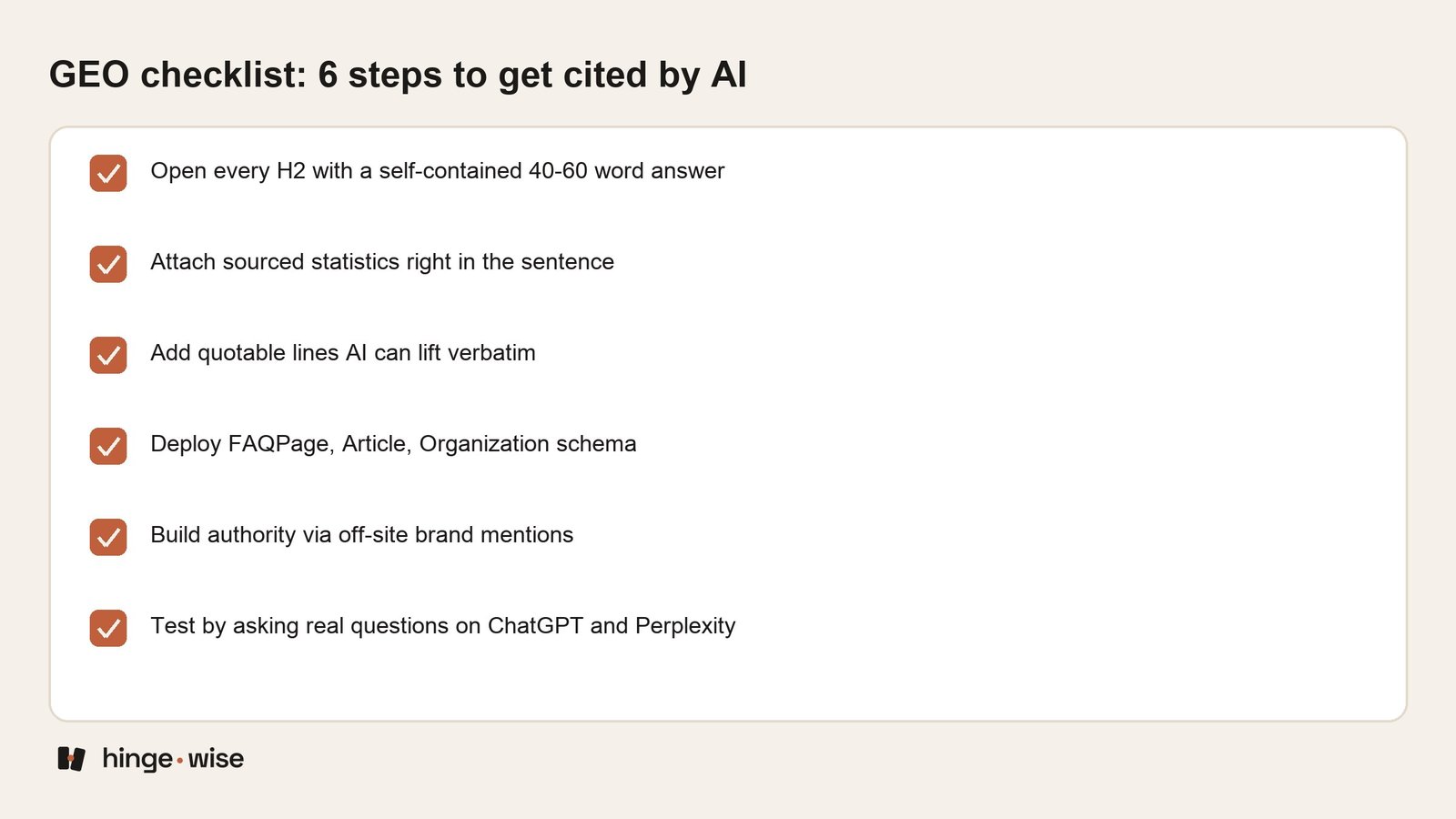
Content architecture: Writing built for extraction. Direct answers at the top of each section. Self-contained paragraphs. Tables in actual HTML text rather than images – LLMs cannot read text embedded inside image files, a detail that trips up a lot of “GEO” agencies. FAQ blocks structured around the real questions users type into ChatGPT and Perplexity.
Off-site authority: Your brand appearing across sources AI systems already cite: industry publications, credible directories, press coverage. Both Perplexity and ChatGPT search show clear preference for brands with footprint across multiple reputable third-party sources, not just a well-optimized website.
Citation tracking: Running structured prompt sets across ChatGPT, Perplexity, Gemini, and Google AI Overviews on a regular cadence, documenting where your brand surfaces and where it doesn’t.
If an agency pitches GEO but their monthly deliverables are blog posts plus a keyword ranking report, that’s SEO. Fine product. Wrong label.
The 5 Criteria That Separate Real GEO Agencies From Pretenders
These five questions cut through pitch decks quickly. Score any agency you’re evaluating on each one. Four or five out of five means you have a real conversation ahead. Two or below, keep looking.
| Criteria | What Good Looks Like | Red Flag |
|---|---|---|
| AI citation measurement | They track brand mentions in ChatGPT, Perplexity, Gemini, and Google AI Overviews using structured prompt testing – not estimated | They report “AI visibility” as a vague improvement with no raw prompt-response data to back it up |
| Content methodology | They can explain specifically what signals LLMs favor: source authority, statistical specificity, self-contained extractable passages | Their strategy is “more content, better content” with no citation-specific logic behind it |
| Reporting transparency | Reports include actual prompt-response exports: what the AI said about your brand before versus after their work | Reporting is summarized metrics only – no raw evidence of what changed in AI outputs |
| Platform coverage | Strategy covers ChatGPT search, Perplexity, Gemini, and Google AI Overviews as distinct platforms with different citation behaviors | All examples and tooling are Google-only – Perplexity and ChatGPT never come up |
| Practitioner experience | Team members have done GEO work on real accounts and can walk through specific decisions that changed citation rates | Case studies are pre-2024 SEO projects reframed as GEO wins, with no AI citation data attached |
Questions to Ask Before You Sign Anything
Skip the standard RFP checklist. These questions require specific answers, not polished slides – which is exactly why they work as filters.
“What tools do you use to track AI citations?” The right answer includes structured prompt testing across ChatGPT, Perplexity, and Gemini, possibly alongside the Semrush AI Toolkit for broader monitoring. The wrong answer is “we track rankings and organic traffic.”
“Walk me through a piece of content that got cited by an AI tool, and explain why it worked.” This separates people who understand GEO from people who read about it. A real practitioner can point to specific structural decisions: where the direct answer was placed, how sources were cited inside the content, why a table was used instead of a paragraph. Vague answers here are disqualifying.
“Can I see a sample report?” Good reports show raw prompt outputs: what each AI tool said about the client’s brand before the engagement started, what it says now, and the delta between them. Not a “23% AI visibility improvement” metric. Actual screenshots or exports from Perplexity, ChatGPT, and Gemini.
“How do you respond when AI platforms change their citation behavior?” Google AI Overviews shifted how it cited sources multiple times between 2024 and 2026. Perplexity updated its source-weighting approach as it scaled to tens of millions of users. Any agency that wasn’t tracking those changes in real time was giving clients stale strategy without knowing it.
Collaboration Models: Which Structure Fits Your Situation
Most legitimate GEO agencies offer three models. The right choice depends less on budget and more on whether you have in-house capacity to execute on strategy without external production support.
Project-based: A one-time audit and strategic overhaul. Best for companies with strong in-house content teams that need a direction reset, not ongoing production. The core deliverable is a clear document: current AI visibility baseline, content gaps across platforms, and a prioritized action list your team can execute.
Monthly retainer: Ongoing content production, citation tracking, and strategy iteration. This is what most companies actually need. GEO is not a one-time fix – AI models update, citation patterns shift, and platform behavior changes. What worked in early 2025 may underperform by late 2026. The field moves fast enough that ongoing adjustment matters.
Audit plus quarterly reviews: A middle path. Good for brands not ready for a full retainer budget but wanting expert oversight on a defined cycle.
My honest recommendation: start with a project engagement. Get the audit, get the roadmap, run a 90-day pilot on one topic cluster, and measure the results. Then decide about a longer engagement. Signing a 12-month retainer with an agency you’ve never tested is the fastest way to burn budget on trust alone.
How Hingewise Approaches GEO Partnership
At Hingewise, we run a baseline AI audit before we write a single word of content for a client. We prompt ChatGPT search, Perplexity, Gemini, and Google AI Overviews with the questions your actual buyers type, document every citation and gap, and use that data as the benchmark every future report is measured against.
Content strategy follows the data. As of mid-2026, Perplexity leans heavily on source recency and credibility, while ChatGPT search favors content that front-loads the direct answer in the first paragraph. We don’t write the same content for both platforms. We differentiate based on platform behavior we track continuously.
Reporting is transparent by default. Every monthly report includes raw prompt exports: what each AI tool said about your brand and your top two competitors last month, and what changed this month. No summary charts without the underlying evidence behind them.
For new clients, we offer a free GEO Snapshot – a baseline audit of your current AI visibility across ChatGPT, Perplexity, and Gemini, compared against two or three competitors. No pitch attached. Just data so you can see exactly where you stand before deciding on anything. Request your free GEO Snapshot here.
- A geo agency that only tracks SEO metrics is selling you the wrong product – always ask specifically how they measure AI citations across ChatGPT, Perplexity, and Gemini
- The 5 criteria that matter: AI citation measurement, content methodology, reporting transparency, platform coverage, and real practitioner experience
- Research published at arxiv.org (2023) found that GEO strategies can boost content visibility in AI-generated responses by up to 40%
- Start with a project or audit engagement before committing to a retainer – 90-day pilots are the lowest-risk way to test a new GEO partner
- Good GEO reporting shows raw prompt-response exports (before and after), not summarized “AI visibility” percentage metrics
Frequently asked questions
What does a GEO agency do?
A GEO agency optimizes your content and brand presence so AI tools like ChatGPT, Perplexity, Google AI Overviews, and Gemini cite you in their answers. Work typically covers content architecture for extractability, off-site authority building across credible third-party sources, and ongoing tracking of AI citation rates across platforms.
How is a GEO agency different from an SEO agency?
A GEO agency focuses on appearing inside AI-generated answers, not on search result rankings. The signals that matter for AI citation – self-contained passage structure, statistical specificity, source authority across the web – differ from traditional SEO ranking signals. Some overlap exists, but the measurement frameworks and content strategies are distinct.
How do I know if a GEO agency is actually getting results?
Ask for raw prompt-response reports: actual exports or screenshots showing what AI tools said about your brand before their work started versus now. Any competent GEO agency should be able to show you this directly. Avoid agencies that only show traffic or ranking improvements as proof of GEO success.
What platforms should a GEO agency be optimizing for?
At minimum: ChatGPT search, Perplexity, Gemini, and Google AI Overviews. These four have the largest AI search user bases as of 2026 – Google AI Overviews alone reaches billions of users monthly, according to Semrush. An agency focused exclusively on Google is missing a significant share of where AI search decisions happen.
How long does it take to see GEO results?
Citation improvements in AI tools typically appear within 60 to 90 days of publishing well-structured content, depending on how quickly each platform incorporates new sources. Authority-building work takes longer. A credible GEO agency sets clear timelines and measures incrementally against a documented baseline – not “wait six months and trust us.”
What should a GEO agency report include?
A proper GEO report includes raw prompt-response exports from ChatGPT, Perplexity, Gemini, and Google AI Overviews: what each tool said about your brand before the engagement and what it says now. It should also compare your citation frequency against two or three direct competitors, not just report your own numbers in isolation.
How we made this: AI helped with research and the first draft. Lam Nguyen chose the topic, edited the piece and checked the figures against their original sources before publishing. How we work: Editorial policy.