
Google AI Overviews are AI-generated summaries powered by a custom Gemini model that appear at the top of Google Search results and cite multiple web sources. To get featured, your content needs clear definitions, self-contained passage structure, schema markup, and credible authority signals. Cited links in AI Overviews often outperform traditional organic listings on click-through rate.
Most content teams are still optimizing for a position that Google AI Overviews have already displaced. The #1 blue link used to be the goal. Now there’s an AI-generated box above it that answers the user’s question before a single click happens. That box is Google AI Overviews. And if your content isn’t in it, you’ve already lost a large share of the impression.
Since Google rolled out AI Overviews broadly in 2024, a consistent pattern has emerged across competitive informational niches: pages sitting at positions 3 through 7 are losing clicks not because their rankings fell, but because AI Overviews are absorbing the query above them. Rankings held. Traffic didn’t. That gap is what this guide is about.
What Are Google AI Overviews?
Google AI Overviews are AI-generated summaries that appear at the top of search results for many informational queries, powered by Google’s Gemini models. They pull from multiple web sources, synthesize the information into a structured answer, and display inline citations linking back to the pages they referenced. As of mid-2026, they appear on a substantial share of how-to, definition, and comparison queries across major markets.
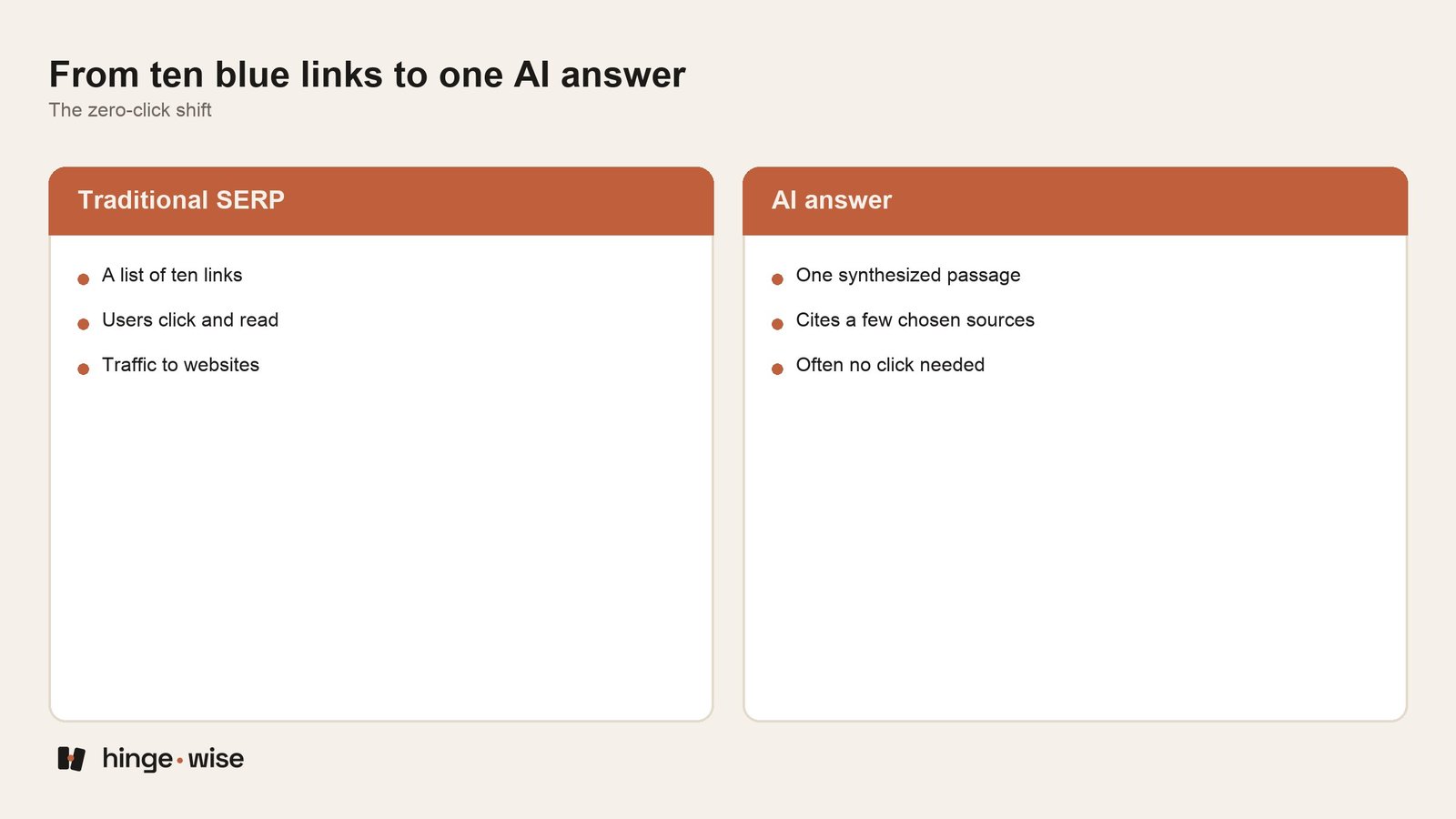
The difference from a featured snippet matters. A featured snippet quotes one source verbatim. An AI Overview pulls from several pages, rewrites the content in its own words, and cites multiple sources inline. You don’t need to outrank everyone to get cited. You need to be the clearest answer to something specific.
| Featured Snippet | Google AI Overview | |
|---|---|---|
| Sources used | One page | Multiple pages (typically 3-5) |
| Content treatment | Quoted directly from page | Synthesized and rewritten by AI |
| Ranking requirement | Usually top 10 | No clear ranking threshold |
| Click attribution | Single source link | Inline citations per claim |
| Query types | Factual, definition, how-to | Informational, complex, multi-part |
AI Overviews are not experimental anymore. They are the default experience for a large share of Google users searching informational topics.
How Does Google Decide What to Cite?
Google selects content for AI Overviews based on how directly and clearly a passage answers the query, supported by credible sourcing. Ranking position matters less than content extractability: a page at position 6 that answers a question cleanly can get cited over a page at position 1 that buries its answer in three paragraphs of scene-setting.
Google has never published a spec for exactly how this works. Anyone who tells you otherwise is guessing, including me. But the research literature points to measurable patterns.
A 2023 paper from researchers at Princeton and Georgia Tech introduced Generative Engine Optimization (GEO) as a formal framework for improving content visibility in AI search systems. They tested specific content strategies against real AI-generated responses. Adding sourced statistics and quotations from credible sources lifted a page’s visibility by roughly 30-40% over the unoptimized version, measured on pages the engine had already pulled in as sources. Their conclusion: “GEO can boost visibility by up to 40% in GE responses.” (Source: Aggarwal et al., 2023, arxiv.org/abs/2311.09735)
The mechanism is intuitive. AI systems synthesizing responses from multiple sources favor passages that are self-contained, verifiable, and specific. Vague paragraphs don’t extract cleanly. Direct, sourced statements do.
The same research also showed something worth highlighting: keyword stuffing has a negative correlation with AI citation rates. Content that repeats the query phrase frequently without actually answering it cleanly gets passed over. The AI is looking for the answer, not the keyword.
Other patterns that surface consistently:
- Content that answers the query in the first 50-100 words of a section, before expanding
- Definitions written as single, self-contained sentences (“X is Y that does Z”)
- Pages with clear E-E-A-T signals: author credentials, visible publication dates, citations to real sources
- Structured formatting that makes individual passages easy to extract without losing meaning
How to Write Content That Actually Gets Cited
The single highest-leverage change you can make: front-load your answers. Every section of your article should open with a direct, 40-60 word response to the question it addresses. Not context. Not a transition sentence. The actual answer, in plain language, before anything else.
Think of it this way: AI models extracting passages behave like a reader who only reads the first two sentences of each section. Write for that reader.
Here’s the difference in practice:
Version A: “There are several factors that influence how content appears in AI search results. Understanding these factors requires examining how Google processes information from multiple sources…”
Version B: “Content gets cited in Google AI Overviews when it provides a direct answer to a specific question, uses clear sourcing, and is structured for easy extraction.”
Version B is what gets pulled. Version A gets skipped.
A few other tactics that hold up in practice:
- Cite your sources inline with context. Not just a hyperlink, but the attribution pattern: “According to [source], [specific claim].” That signals verifiability to the AI pulling the passage.
- Write one idea per paragraph. Short, focused paragraphs extract cleanly. A 200-word block mixing multiple ideas is hard to cite without distorting the meaning.
- Define your core terms explicitly. “X is Y” statements are consistently pulled into AI Overviews. Write one clear, self-contained definition for every key concept in the article.
- Use specific data with source attribution. Vague claims (“studies show…”) don’t get cited. Specific claims with linked sources do. The GEO research confirms sourced statistics as a measurable citation factor.
Does Structured Data Actually Help?
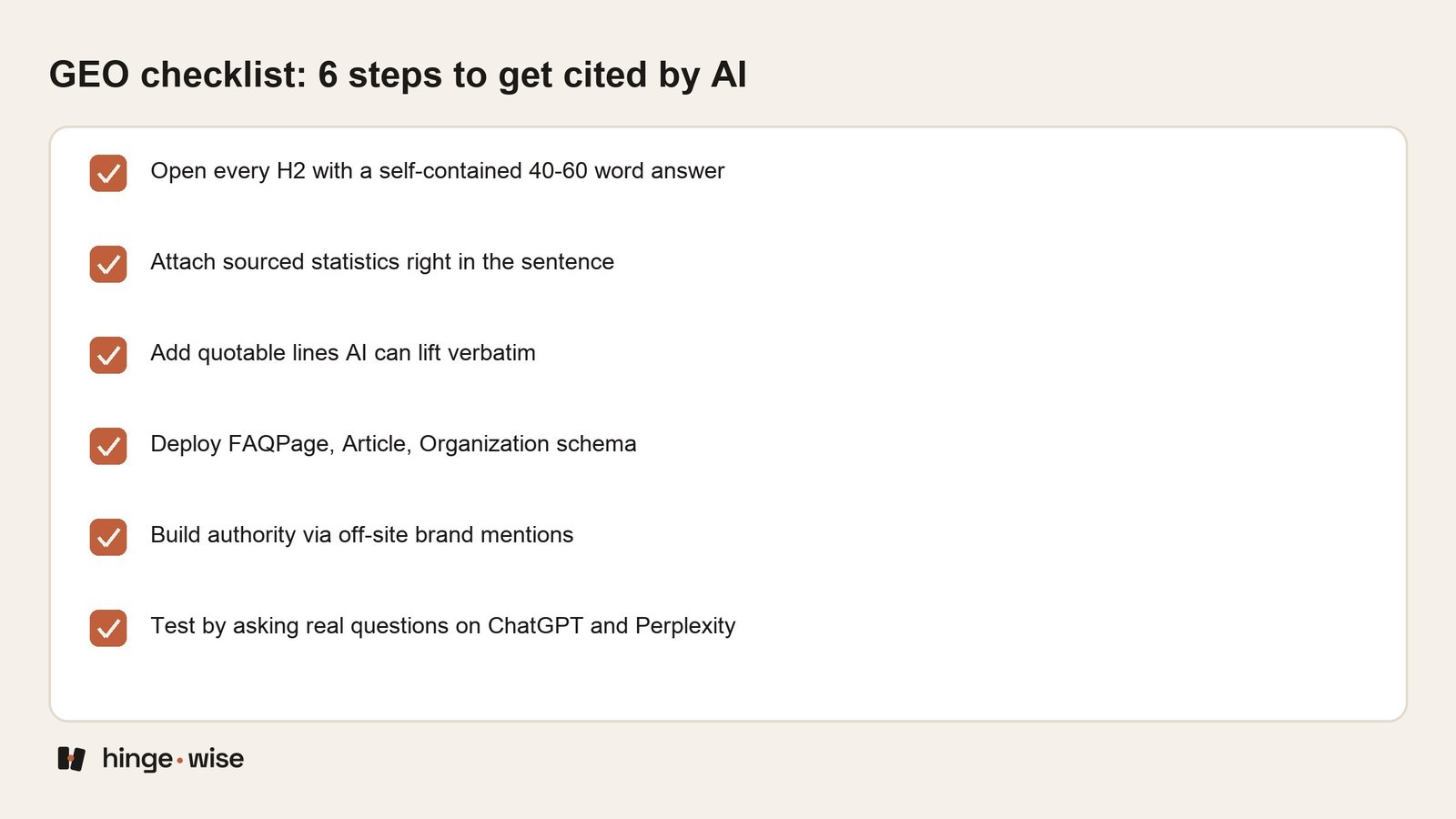
Structured data is not a confirmed direct signal for Google AI Overviews selection, at least not in any way Google has explicitly acknowledged. That said, FAQPage and HowTo schema align with exactly the structural formats AI Overviews prefer, so implementing them as supporting signals still makes sense.
Honestly, it’s not the lever most people want it to be. Schema is useful for signaling content type to crawlers and for rich results on eligible page types, though Google retired FAQ rich results in May 2026 and HowTo rich results in 2023. But if your underlying content doesn’t answer the question clearly, no markup fixes that.
What schema does help with is legibility. If your how-to content is structured like a how-to, with numbered steps and clear action verbs, you don’t need schema to make that legible to an AI. But adding FAQPage schema via Rank Math takes about 20 minutes and it reinforces the structure that already exists. That’s a reasonable trade.
How AI Overviews Are Reshaping Traffic
The traffic impact depends heavily on query type. For purely informational searches, “what is,” “how does,” and definition queries, a meaningful share of users get their answer from Google AI Overviews and don’t click through. Zero-click outcomes are real, and they’re most common for exactly the content types that many content-heavy sites rely on.
The counterintuitive part: clicks that come through AI Overview citations tend to be higher-quality than standard organic clicks. Users clicking a citation have already read the AI’s summary. They’re clicking to go deeper, not to find an answer. That’s a warmer visitor.
According to Semrush‘s research on AI search behavior, “Google’s AI Overviews now reach billions of users each month.” (Source: Semrush, semrush.com/blog/generative-engine-optimization/). At that scale, even occasional citation on high-volume informational queries creates meaningful brand exposure, regardless of whether users click through.
If your organic traffic strategy depends heavily on informational TOFU content, the disruption isn’t coming. It’s here.
How to Track Your AI Overview Visibility
Google Search Console doesn’t have a native AI Overviews filter as of mid-2026. The best available proxy: segment impressions by query type, filter for informational-intent keywords where AI Overviews commonly appear, and watch CTR trends over time. A sustained CTR drop without a corresponding ranking drop is a strong signal that AI Overviews are intercepting clicks above your result.
For more direct tracking, Semrush’s AI Toolkit (available in paid plans) identifies which of your pages appear as citations in Google AI Overviews for tracked keywords. The feature is still maturing and coverage isn’t complete, but it’s the most systematic approach currently available at scale for this specific task.
A practical manual approach: open an incognito browser, search your target queries, and document which AI Overviews appear and which sources they cite. Time-consuming, but it tells you exactly what Google is surfacing for your competitive keywords right now.
One thing I’d add that most guides skip: track your Perplexity citations alongside Google’s. Perplexity’s index doesn’t fully overlap with Google’s, but if your content is showing up in Perplexity AI responses, it’s a reliable signal that the structural qualities AI systems value are present. Perplexity gives you faster feedback than waiting for Google AI Overview placement to shift, and the optimization principles transfer directly.
If you want a baseline picture of how your site currently performs across Google AI Overviews, Perplexity, and ChatGPT search, the free GEO Snapshot at Hingewise maps your current AI visibility against competitors. A good starting point before investing in content restructuring.
- Google AI Overviews use a custom Gemini model to synthesize answers from multiple web sources; links cited inside often get more clicks than the same page appearing as a traditional organic listing, per Google’s own data
- Content that opens each section with a self-contained 40-60 word answer is significantly easier for the Gemini model to extract and cite, this is the single highest-leverage structural change to make
- A Princeton GEO study found that adding statistics with cited sources and quotations from credible sources raised visibility in AI answers by roughly 30-40%, on pages already retrieved as sources
- Structured data (FAQ schema, Article schema, How-To schema) helps Google’s crawler understand content hierarchy and makes specific answers easier to locate within a page
- Google Search Console doesn’t yet isolate AI Overview traffic; Semrush AI Toolkit and manual incognito spot-checking are the most reliable tracking methods available as of 2025
Frequently asked questions
What are Google AI Overviews?
Google AI Overviews are AI-generated summaries that appear at the top of Google Search results, powered by a custom Gemini model built specifically for Search. They synthesize information from multiple web sources and display a direct answer with links to cited sources. Google began rolling them out to all U.S. users in May 2024 and expects to reach over one billion users globally.
Do Google AI Overviews reduce organic traffic?
The impact depends on query type. For simple informational queries, AI Overviews can absorb the click entirely. But Google’s own data shows that links cited inside AI Overviews get more clicks than the same page appearing as a standard organic listing. Research-heavy and commercial queries still drive strong click-through rates even when an AI Overview is present.
How do I get my content cited in Google AI Overviews?
Focus on three things: write self-contained section openers that answer the implied question in 40-60 words, implement FAQ and Article schema markup, and build authority through credible external mentions. Content that includes cited statistics and clear definitions is more likely to be extracted by the Gemini model used in Search.
Does schema markup help with AI Overview visibility?
Schema markup helps Google’s crawler understand your content’s structure and locate specific answers within a page. FAQ schema and How-To schema in particular make it easier for the AI model to identify where question-answer pairs live. Google hasn’t officially confirmed schema as a direct citation signal, but consistent patterns across sites make it a default recommendation.
How can I track whether my site appears in Google AI Overviews?
Google Search Console doesn’t currently provide an AI Overview filter. Use Semrush’s AI Toolkit to see which tracked keywords trigger AI Overviews and whether your domain is cited. For direct verification, search target queries in an incognito window from a U.S. IP address and check whether your URL appears in the cited sources panel within the AI Overview.
Is GEO different from SEO, or the same thing?
GEO builds on top of SEO rather than replacing it. Both reward authoritative, clearly structured, well-cited content. The key difference: SEO optimizes for ranking position in search results, while GEO optimizes for being selected as a cited source within AI-generated answers. Sites already performing well in organic search have a meaningful head start in AI Overviews.
Want to see how your brand shows up across AI? Get a free GEO Snapshot.
How we made this: AI helped with research and the first draft. Lam Nguyen chose the topic, edited the piece and checked the figures against their original sources before publishing. How we work: Editorial policy.